Share your opinion analysis, research, best practice & knowledge in policing & criminal justice with our global audience!
Policing Insight welcomes article pitches from practitioners, academics & experts - see our contributor guidance page for more details https://t.co/PLt6lOsqSe
Curious what it’s like to study terrorism, counterterrorism and law enforcement in practice?
Sample preview from Liverpool John Moores University’s online programme: https://t.co/t1LwSeIl18
This sample preview shows how the course brings together theoretical frameworks, practical application and reflective learning across key security themes. Explore module previews including Key Issues in Terrorism and Political Violence, Radicalisation and Psychology of Terrorism, Critical Infrastructure Protection, Terrorism and Human Rights, International Policing Policy and Intelligence, and Aviation Terrorism and Security.
Designed for professionals working across policing, intelligence, security and defence, the programme offers a flexible way to experience the online learning environment, engage with real-world case studies and sample the depth of study before taking the next step in your professional development.
#PolicingInsight #Counterterrorism #LawEnforcement #SecurityProfessionals #PolicingEducation
@InformaConnect@InformaAcademy@LJMU
[ADVERTISEMENT]
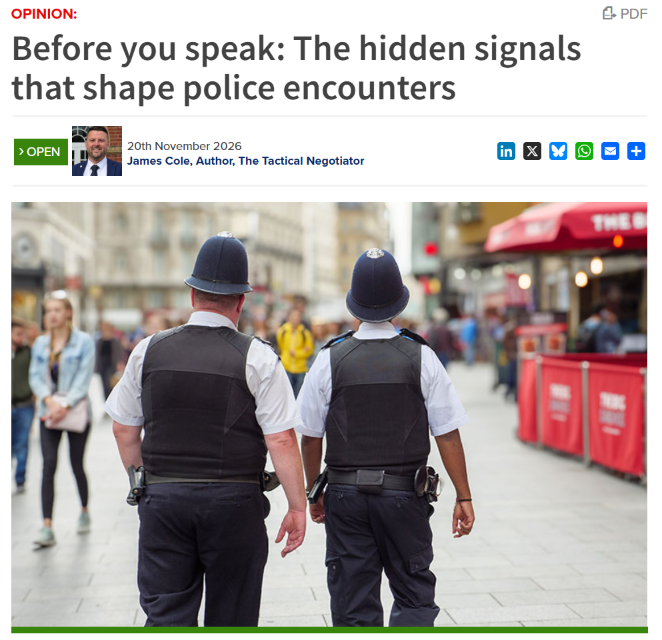
Communication in encounters between police officers and the public begin before the first question is asked, says former UK police sergeant and trained crisis and hostage negotiator James Cole, who explains how an officer’s appearance, posture, facial expression, positioning and behaviour all contribute to the way they are perceived by other people, how lessons from crisis negotiation can help officers understand the unintended messages they send, and why those messages matter for trust, co-operation and safety.
https://t.co/kvwgsiTQUD
With police reform firmly on the agenda in England and Wales, the opportunity to embrace an improved digital policing landscape should also be seized, says Dave Horton, of UK technology consultancy Triad; but the focus must be on separating enduring data and operational capabilities from the applications and infrastructure that deliver them, and funding permanent product teams to improve the capabilities, with progress possible now at force level rather than waiting for major national restructuring.
https://t.co/MgkYWe5wZi
On the UN’s World Day for the Prevention of and Healing from Child Sexual Exploitation, Abuse and Violence, deepfake detection specialist Julia Jakimenko and former law enforcement officer and online child safety professional Andrew Briercliffe argue that policing is asking the wrong first question about AI-generated abuse imagery.
https://t.co/YlKrz357xr
@UN
While 15 years separate Peter Neyroud’s review of police leadership and training from the Police Leadership Commission, the diagnosis of the leadership challenges in these reports (and others in the interim) remain largely unchanged, says former long-serving officer and now independent researcher Paul Ford, who warns that unless internal legitimacy and organisational voice become measurable, funded and enforceable elements of police leadership, reform risks repeating the conditions it is intended to change.
https://t.co/YzuFAk1bOa
The recent Europol innovation awards, overseen by the agency’s Innovation Lab, highlighted some of the most forward-thinking and effective developments across the continent, reports Policing Insight’s Andrew Staniforth; the Lab’s Industry and Research Days taking place next year will provide another platform for showcasing innovative EU solutions that policing can trust and continuously operate, given the ongoing concerns around supply chain resilience, geopolitical impacts and the strengths of sovereignty.
[SUBSCRIBER ARTICLE]
https://t.co/Akf6h09n0D
@Europol
A joint report from Refuge and the End Violence Against Women Coalition into online offences of violence against women and girls (VAWG) in the UK reveals that more than one in three women have experienced some form of online VAWG – a figure that rises to nearly half of young women – with “devastating” effects including fear, anxiety and suicidal thoughts, alongside an “often ineffective” police response, reports Policing Insight’s Sarah Gibbons.
[SUBSCRIBER ARTICLE]
https://t.co/sQC4BhSHqv
@RefugeCharity
In the latest in a series of articles focusing on the criminal service economy, Policing Insight’s Chris Dalby looks at the growing use of drones by criminal gangs, with freelance drone pilots carrying out prison drops of drugs, weapons and other items in the UK, Canada and Australia, while Cartels in Mexico and gangs in Haiti take advantage of a law enforcement vacuum to weaponise commercial drones.
[SUBSCRIBER ARTICLE]
https://t.co/WjZN0Duc3f
💡 Read more articles from 'The criminal service economy' series: https://t.co/sDs0dkGEQC
Curious what it’s like to study terrorism, counterterrorism and law enforcement in practice?
Sample preview from Liverpool John Moores University’s online programme: https://t.co/t1LwSeIl18
This sample preview shows how the course brings together theoretical frameworks, practical application and reflective learning across key security themes. Explore module previews including Key Issues in Terrorism and Political Violence, Radicalisation and Psychology of Terrorism, Critical Infrastructure Protection, Terrorism and Human Rights, International Policing Policy and Intelligence, and Aviation Terrorism and Security.
Designed for professionals working across policing, intelligence, security and defence, the programme offers a flexible way to experience the online learning environment, engage with real-world case studies and sample the depth of study before taking the next step in your professional development.
#PolicingInsight #Counterterrorism #LawEnforcement #SecurityProfessionals #PolicingEducation
@InformaConnect@InformaAcademy@LJMU
[ADVERTISEMENT]
On the UN’s World Day for the Prevention of and Healing from Child Sexual Exploitation, Abuse and Violence, deepfake detection specialist Julia Jakimenko and former law enforcement officer and online child safety professional Andrew Briercliffe argue that policing is asking the wrong first question about AI-generated abuse imagery.
https://t.co/YlKrz357xr
@UN
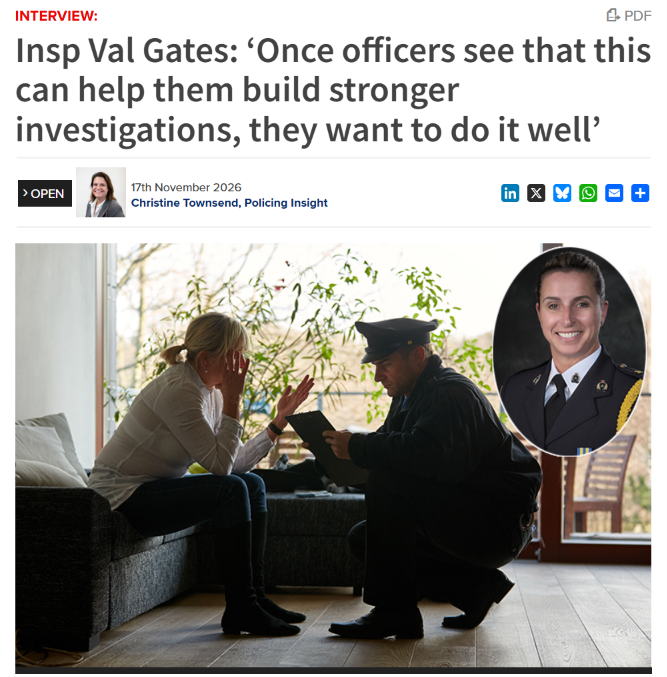
The Canadian Framework for Trauma-Informed Response in Policing builds on what many forces and officers already do well to develop often collaborative approaches that enable victims to speak in their own words and provide information that may otherwise be missed; Insp Val Gates, who led the working group alongside Barrie Police Service colleagues to draw up the framework, explained to Policing Insight’s Christine Townsend the background to the Framework, the ‘Six Rs’ that underpin it, and how it is improving investigations.
[SUBSCRIBER ARTICLE]
https://t.co/I5RPW8tOvf
@BarriePolice
While 15 years separate Peter Neyroud’s review of police leadership and training from the Police Leadership Commission, the diagnosis of the leadership challenges in these reports (and others in the interim) remain largely unchanged, says former long-serving officer and now independent researcher Paul Ford, who warns that unless internal legitimacy and organisational voice become measurable, funded and enforceable elements of police leadership, reform risks repeating the conditions it is intended to change.
https://t.co/YzuFAk1bOa
In the latest in a series of articles focusing on the criminal service economy, Policing Insight’s Chris Dalby looks at the growing use of drones by criminal gangs, with freelance drone pilots carrying out prison drops of drugs, weapons and other items in the UK, Canada and Australia, while Cartels in Mexico and gangs in Haiti take advantage of a law enforcement vacuum to weaponise commercial drones.
[SUBSCRIBER ARTICLE]
https://t.co/WjZN0Duc3f
💡 Read more articles from 'The criminal service economy' series: https://t.co/sDs0dkGEQC
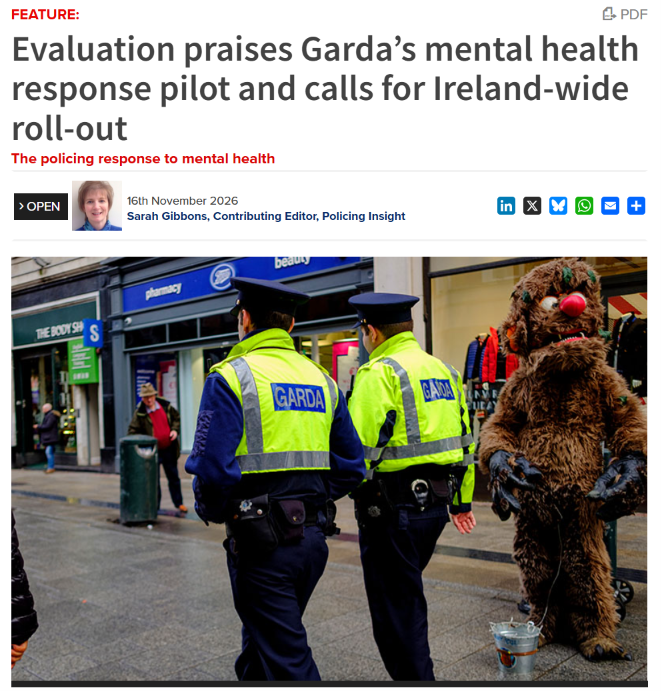
An evaluation of the Community Access Support Team (CAST) initiative in Ireland – pioneered jointly by An Garda Síochána and the Health Service Executive to better manage mental health crises – has praised the success of the pilot in the Limerick Division for redistributing workload, reducing repeat demand, and improving outcomes for vulnerable individuals, and calls for the approach to be rolled out across the country, as Policing Insight’s Sarah Gibbons reports.
[SUBSCRIBER ARTICLE]
https://t.co/fRB7hW4vLv
💡 Read more articles in 'The policing response to mental health' series: https://t.co/LUoPAuJDym
@GardaTraffic@Gardainfo
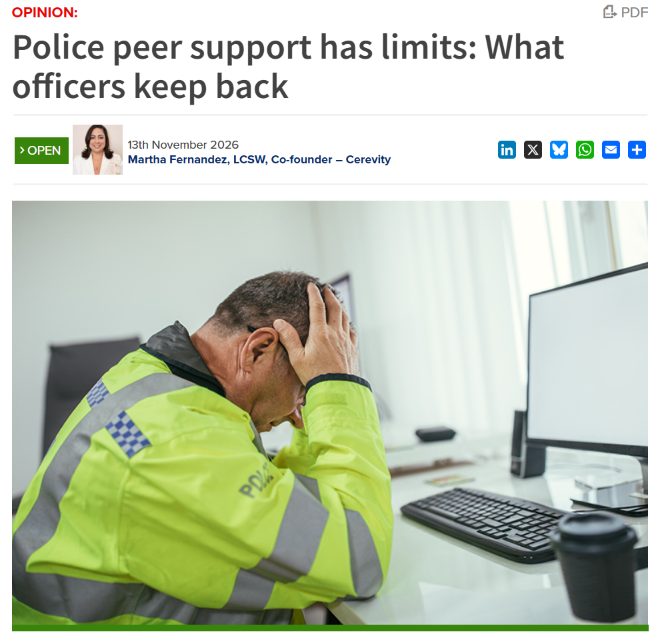
Peer support has become a cornerstone of officer wellbeing, but it works best when forces are honest about what officers will not say to a colleague, explains Licensed Clinical Social Worker Martha Fernandez, who advocates forces building a “second door” to offer a professional route for those unable or unwilling to discuss every issue with peers.
https://t.co/LevfxPbLpL
The Canadian Framework for Trauma-Informed Response in Policing builds on what many forces and officers already do well to develop often collaborative approaches that enable victims to speak in their own words and provide information that may otherwise be missed; Insp Val Gates, who led the working group alongside Barrie Police Service colleagues to draw up the framework, explained to Policing Insight’s Christine Townsend the background to the Framework, the ‘Six Rs’ that underpin it, and how it is improving investigations.
[SUBSCRIBER ARTICLE]
https://t.co/I5RPW8tOvf
@BarriePolice
The wealth of commentary on the plans for police reform in England and Wales has focused almost entirely on officers, while largely overlooking the role of staff, says Ben Pratt, former Assistant Chief Officer at Hampshire & Isle of Wight Constabulary and now an Associate Director with Leapwise consultancy, who argues that police staff should be front and centre in future reform planning, and sets out 10 steps to help ensure this happens.
https://t.co/ORKvRvk3eb
💡 Read more articles in 'The reform of UK policing' series: https://t.co/JKVQHWTRrq
An evaluation of the Community Access Support Team (CAST) initiative in Ireland – pioneered jointly by An Garda Síochána and the Health Service Executive to better manage mental health crises – has praised the success of the pilot in the Limerick Division for redistributing workload, reducing repeat demand, and improving outcomes for vulnerable individuals, and calls for the approach to be rolled out across the country, as Policing Insight’s Sarah Gibbons reports.
[SUBSCRIBER ARTICLE]
https://t.co/fRB7hW4vLv
💡 Read more articles in 'The policing response to mental health' series: https://t.co/LUoPAuJDym
@GardaTraffic@Gardainfo
When officers in New York responded to reports of a woman in Times Square armed with two knives who had already stabbed two people, initial de-escalation efforts were followed by officers drawing their Tasers, and when these failed to stop 49-year-old Pamela Cisneros, she was shot dead; Penn State University Assistant Professor Ben Jones argues the incident highlights the need for a non-lethal back-up for Taser – the public order shields that have been used for de-escalation successfully in the UK for many years.
https://t.co/6RztoyDNoC
A recent report from the Australian Institute of Criminology evaluating Australia’s National Action Plan to combat modern slavery highlights the need for more engagement with state and territory governments to support victim-survivors, greater involvement of those with lived experience in shaping strategic priorities, and more effective training and awareness initiatives across law enforcement, as Policing Insight’s Sarah Gibbons reports.
[SUBSCRIBER ARTICLE]
https://t.co/IMgfJphY8k