I wonder if this structure layers in additional conflicts of interest. Imagine you are the CEO of one of the portfolio companies of say Warburg. If you hire The OpenAI Deployment Company vs say a boutique, should you worry about
a. Ability of OpenAI Deployment Company to advice you on cost optimization without locking in their models
b. Optics of money flowing from LPs of the fund that owns your company to the GP entity itself directly ?
Redpoint has a presentation out that says 67% of enterprises are running open-source models in production (vs 23% in 2025).
Expect more enterprises to adopt the Dara approach. Use expensive models to explore. Bring in cheaper models/open source to optimise spends.
While it is a minority view, there is a chance that OpenAI/Anthropic may find revenue plateauing sooner than expected coz per token costs on a blended basis across models drops fast.
Dara (CEO of Uber) on their AI spend:
"We blew through our AI budget in a quarter, for the whole year. It is forcing us to adjust.
We are going to meter headcount increases because to the extent that my engineers are getting much more efficient, their throughput is increasing. There's a cost to that, and it's a significant cost.
AI adoption has been occurring in all parts of the business –– whether it's engineers and how they scope projects, how they build, debugging, platform migrations.
I'm pushing the teams to fundamentally use the power of AI to rebuild systems and processes from the bottoms up.
I do think it's a combination for us right now of encouraging adoption, but then driving efficiency.
We're using the more expensive models to explore. Once we scale some of these experiences, we'll look to bring in more efficient models that are more efficient on a token basis or are open source."
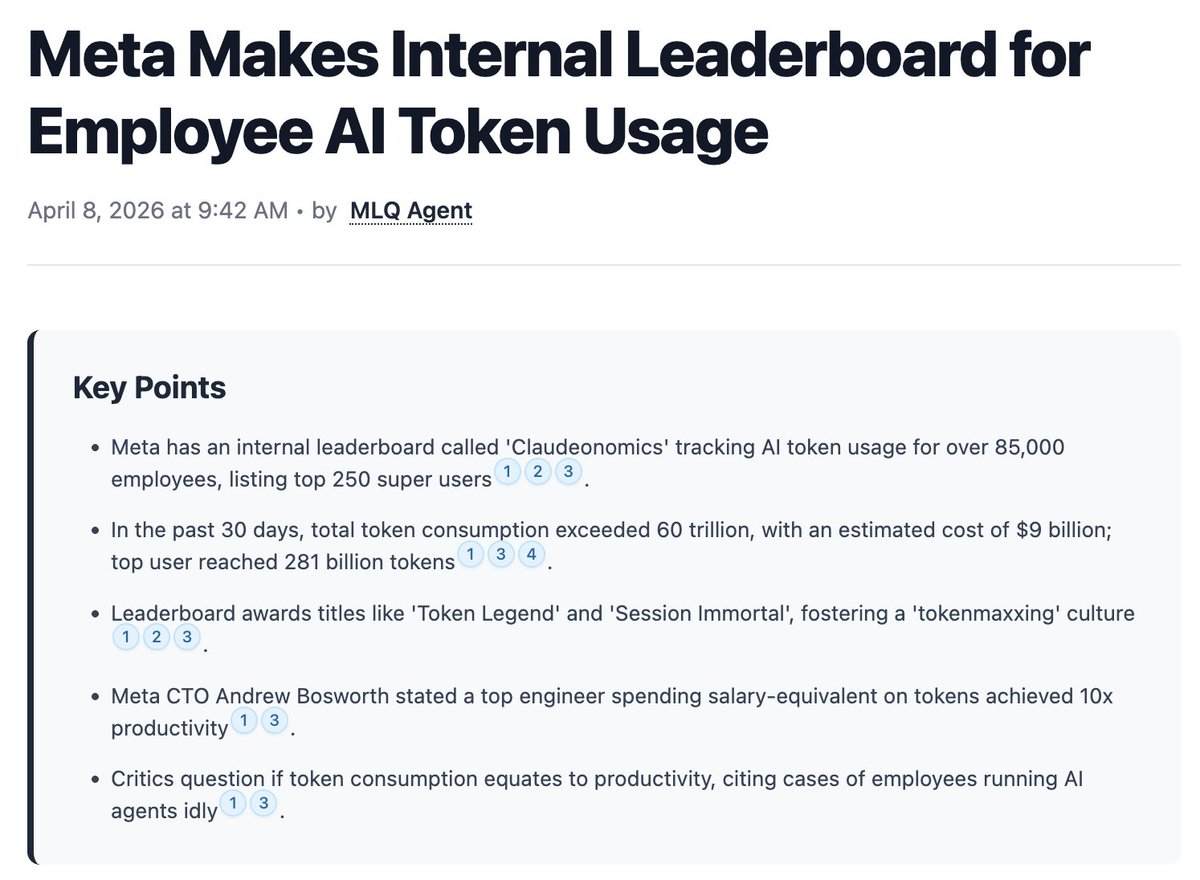
Most people now agree that Tokenmaxxing is a stupid metric.
In coming months, I expect we will view similarly the time when folks highlighted 'x million lines of code were written by AI' or 'y% of code was AI generated'.
All that matters is IFCFAI. Incremental Free Cash Flow from AI :-)
Generically, for $1 of incremental margin, rule of thumb is to spend up to $0.4 to generate that margin.
The incremental margin could be due to higher revenue or lower costs.
The $0.4 of spend in the case of AI was previously being monopolized by frontier labs. Over next 3 years, I think the $$ gets spread widely across a bunch of actors with lower moats. Whether it is the harness layer or a consulting firm ..
Video based Customer Identification for identity verification is widely used in India by banks. Currently, rules require a live person (trained bank officer) must be on the call from the bank & this person will visually verify the customer and ask randomized questions. Wonder if AI video models have evolved sufficiently to pass the test with a live human.
Today Instagram had this massive exploit where hackers were just stealing rare handles left and right. Hundreds of accounts gone.
People losing handles they’ve owned since 2010, some worth hundreds of thousands.
I own a few rare ones so I was actually stressed watching this happen in real time, which I haven’t been in years.
Obama White House account got hit.
These aren’t some random new accounts, these are verified, locked down accounts and they still got compromised.
The thing is the exploit is so simple it’s almost funny. Attacker goes to Forgot Password, says their account is hacked, turns on a VPN to match the target’s location (which now you can find on the about section of the page).
Instagram’s AI support flow asks them to verify with a selfie.
They grab a photo from the target’s profile, run it through an AI video generator to make an animation of the person’s face moving around, upload that to Meta’s AI as proof.
And Meta’s AI just accepts it because it can’t tell the difference between a real selfie and an AI-generated video of someone’s face
.
Once verified they change the email to theirs. Password reset link goes to their email. They own it now. 2FA gets bypassed somehow in the process but honestly I don’t know exactly how, just that it did.
Point is even locked down accounts went down.
Then you try to recover your account and you’re talking to a chatbot that has zero ability to help.
You can’t escalate to a human. You’re just stuck. Your asset is gone and there’s no one to call.
The whole thing just highlighted how stupid it is to automate account security without any human in the loop.
One AI fooling another AI while there’s literally no person anywhere to catch it.
Meta took hours to even acknowledge it while accounts were getting stolen every minute.
Now thankfully it’s patched but I don’t think it will be the last one. Stay safe!
@InvestmentBook1 Two of my favourite prompts after loading these transcripts
a. Identify inconsistencies between what the management has previously stated and what happened subsequently.
b. Identify situations where the management did not answer clearly the analyst question & dodged
Anyone looking at Sovereign AI for India needs to read
@bgurley summary.
For more context,
Zhipu has 12x since IPO in Jan 2026.
Minimax has 5x since IPO in Jan 2026.
Chinese open source/weight models (Esp Qwen by Alibaba) dominate at r/LocalLLaMA. Gemma is the only non-Chinese model mentioned prominently.
Quick summary of what is happening with LLM model companies in China. 1) There is more VC $ available for open-weights than you think, 2) they are generating real revenue (as did open-source sw/saas companies in the West).
https://t.co/vluRvWJsId
Expenditure on software is typically capitalized. If you use the tokens to vibe code a software tool, it should ideally be capitalized?
On the other hand, using AI to handle operational activity (a call center, a research report etc) should probably be expensed?
How do you differentiate between the two?
Question for the finance types: Is expenditure on inference tokens supposed to be capitalized or expensed?
What are best practices in tracking spend & deciding what treatment will give an accurate assessment of the underlying activity?
I think productivity per developer increases dramatically.
I don't think revenues decline as much as markets expect. Many CIOs I spoke to are very hesitant to change their IT services vendors. There is career risk in shifting vendors & screwing up. So, I don't think customers churn either.
3 months ago, the narrative was AI would degrade profitability of multiply sectors in tech - including Software & Cybersecurity. Both are up 40%+ from their bottoms.
Indian IT services companies still haven't bounced much & narrative remains of them being a huge AI loser. Wonder whether just light investor positioning, INR depreciation boosting profits & a general rethink about AI cost/benefit/applications will lead them to rebound.
This weekend read The Halo Effect:
The core idea of the book is that when a company is performing well financially, observers- journalists, investors, analysts- tend to retroactively describe its culture, leadership, strategy and people in glowing terms. When the same company later struggles financially, every previous attribute get recast as a flaw. The underlying reality may not have changed much but our perception of the cause changes to match the outcome.
I think that India is currently suffering from a negative Halo Effect. Because the market has not done well and needs to be rationalized the observers are finding all possible flaws to try and justify the reasons in hindsight.
If we can separate the current performance from the – in this case negative- Halo, we can better understand whether this poor performance is temporary or something more permanent.
Tokenmaxxing is like asking people how much internet they surf, browse, or stream.
Not a useful KPI except for token sellers. I am surprised that few have taken this as AI diffusion benchmark ‼️