Getting a little out of hand. 40% CAGR consecutively for 15 years is an unreasonable expectation to set with investors. There is no precedent for companies starting above $1b valuation, let alone $1t .
SPACEX BETS ON TRILLION-DOLLAR AI FUTURE
Morgan Stanley projects SpaceX revenue could soar to $3.4 trillion by 2040, helping justify its targeted $1.77 trillion IPO valuation. The forecast is driven largely by explosive growth in the company’s AI business, with revenue expected to rise sharply from current levels. SpaceX generated $18.7 billion in revenue in 2025 and plans to raise about $75 billion in what could become the largest IPO ever.
The rarest object type in the universe isn't black holes. It's us. Conscious matter. The flame of life.
We have a duty to expand it in scope and scale in order to preserve it.
Let me explain exactly why every new subdivision in America looks like the top photo, because the math is wild.
A mature tree increases a home's value by 7 to 19 percent. On a $400,000 house, that's $28,000 to $76,000. A single shade tree produces the cooling equivalent of ten room-size air conditioners running 20 hours a day. One tree on the west side of a house cuts energy bills by 12 percent within 15 years. The bottom photo is worth more, costs less to live in, and sells faster. This has been documented by the University of Washington, Clemson, Michigan State, and the USDA. The data is not in dispute.
Removing those trees saves the builder roughly $5,000 per lot. Concrete trucks need twice the dripline radius of every standing tree. Utility trenches need flat ground. A bulldozer flattens 200 lots in an afternoon. Preserving trees adds weeks and thousands per home.
So the developer pockets $5,000 in savings and the buyer eats $50,000 in lost value for the next two decades. The person making the decision and the person paying for it have never been in the same room.
The Woodlands, Texas is the proof of what happens when they are. George Mitchell bought 28,000 acres of Houston timberland in 1974 and preserved 28% as permanent green space. He forced McDonald's to build behind the tree canopy. That McDonald's became one of the highest-volume locations in Texas. The first office building, designed to reflect the surrounding forest so you couldn't see it from the street, leased completely.
The Woodlands median home price today: $615,000. Katy, a comparable Houston suburb that clear-cut: $375,000. Named #1 community to live in America two years running.
Fifty years of data. The trees are worth more than removing them saves. Developers clear-cut anyway because they sell the house once and leave. You live in it for 30 years.
A lot of hype around Claude disrupting industries and entire business models with daily updates.
These are excellent productivity enhancements. We’re seeing an efficiency revolution, but it won’t remove humans from business decisions or communication. AI won’t have all the context all the time.
The devil is in the details, and process is what builds competitive advantages. Data engineers remain extremely relevant.
Companies should automate, break things, rebuild them—rather than sticking to old tried-and-true approaches. Innovate, have a backup plan, and execute. Otherwise be competitively outpaced. Amazon for example. I’d rather have someone one my team who failed several times before achieving something great over someone who claims greatness without due process.
Even with ominous chatbots, I still get asked for help viewing .pdf documents. It won’t surprise me if that changes to help viewing .pptx documents.
Claude can now build interactive charts and diagrams, directly in the chat.
Available today in beta on all plans, including free.
Try it out: https://t.co/tHPAZRgQkn
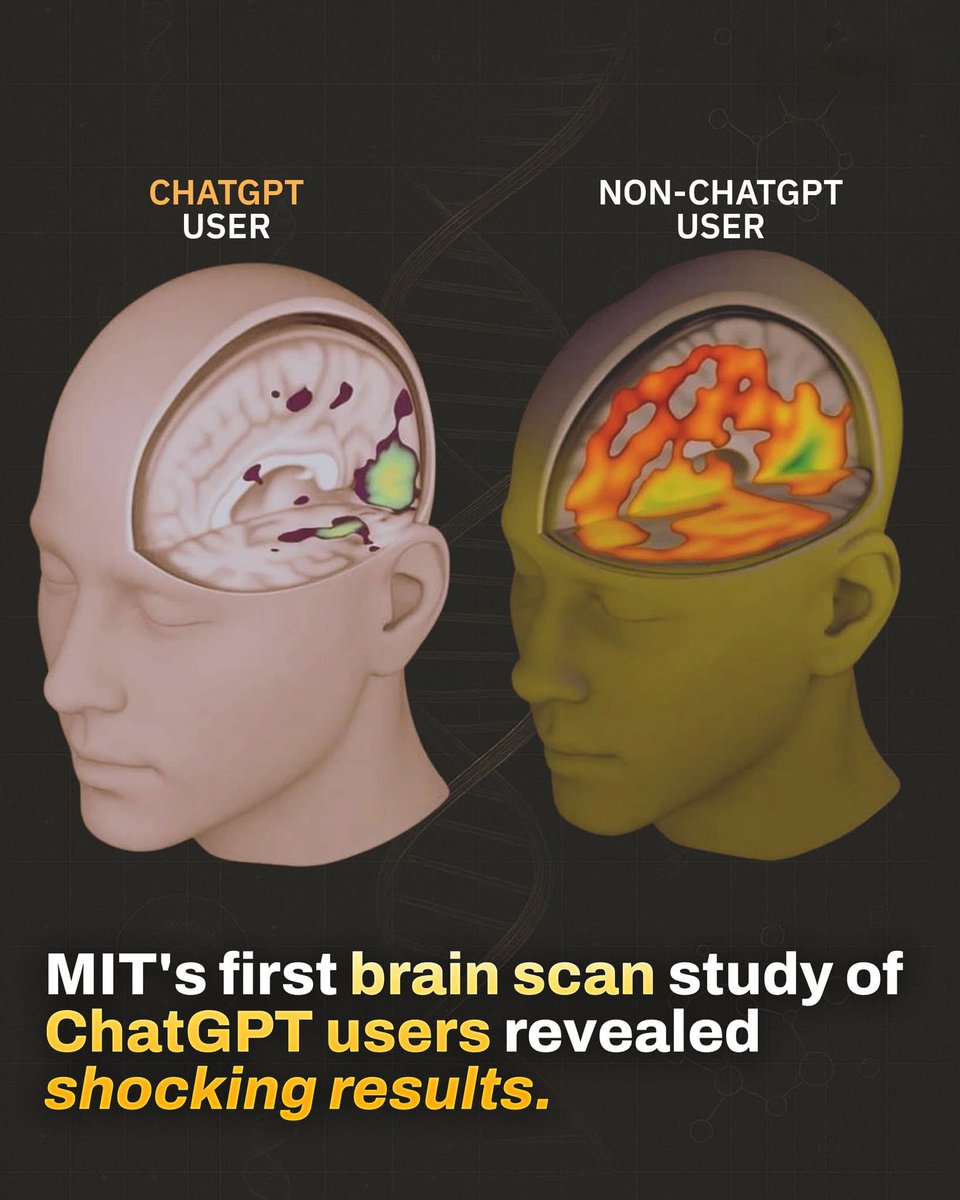
🧠 MIT recently completed the first brain-scan study on ChatGPT users—and the results are deeply revealing.
Rather than boosting brain function, prolonged AI use may be dulling it.
Over four months of cognitive data suggest we might be measuring productivity all wrong ⤵️
In MIT’s study, participants had their brains scanned while using ChatGPT.
→ 83.3% of users couldn’t recall a single sentence they’d written just minutes earlier.
→ In contrast, those writing without AI had no trouble remembering.
Brain connectivity dropped sharply—from 79 to 42 points.
→ That’s a 47% drop in neural engagement.
→ The lowest cognitive performance among all user groups.
Even after stopping ChatGPT use in later sessions, these users showed continued under-engagement.
→ Their performance remained lower than those who never used AI.
→ This suggests more than dependency—it’s cognitive weakening.
Beyond the scans, educators flagged the writing itself.
→ Essays were technically solid, but often called “robotic,” “soulless,” and “lacking depth.”
Here’s the paradox:
→ ChatGPT makes you 60% faster at completing tasks…
→ But it reduces the mental effort required for learning by 32%.
The top-performing group?
→ Those who began without AI and added it later.
→ They retained the best memory, brain activity, and overall scores.
Using ChatGPT can feel empowering—but it may quietly offload your thinking.
→ You gain speed, but lose engagement.
→ You get answers, but stop learning how to think.
The takeaway isn’t to avoid AI—but to use it intentionally.
→ Use it to assist, not replace your mind.
→ Build cognitive strength—not dependency.
MIT’s early study on AI and the brain lays out the stakes. The way we use these tools matters more than ever.
@PythonPr Non-AI answer:
Score is a namespace that points to an object.
Saved_score points to the same object when compiled. Since Python is line-by-line execution, saved_score now just references the same object as score.
The score namespace is then reassigned to a new object.
This pilot study provides evidence for the importance of pH balancing in women with LUTS, not for long-term baking soda use as a supplement. During the study, effects on blood pH were inconclusive, but high sodium diets are linked to blood pressure issues.
This study of 33 women (ages 50–60, 50% with chronic disease) in Turkey between 2015 and 2017 lacks placebo control and randomized sampling. It should not be generalized to the broader population but should merely guide decisions to conduct additional studies and experiments.
I would like to see the placebo-controlled, comparative pharmacotherapy study that was being performed after this pilot study.
Baking soda prevents getting up in the night to pee in clinical trial.
‣ Decreases night time urination
‣ Improves daytime energy
‣ Massively improves subjective sleep
in another human study.
1/2 - 2 tsp dissolved in water is a good range to experiment with.
When the urine is highly acidic, it can irritate the sensitive lining of the bladder, triggering the sense of urgency + causing the bladder muscles to spasm.
Baking soda corrects it.
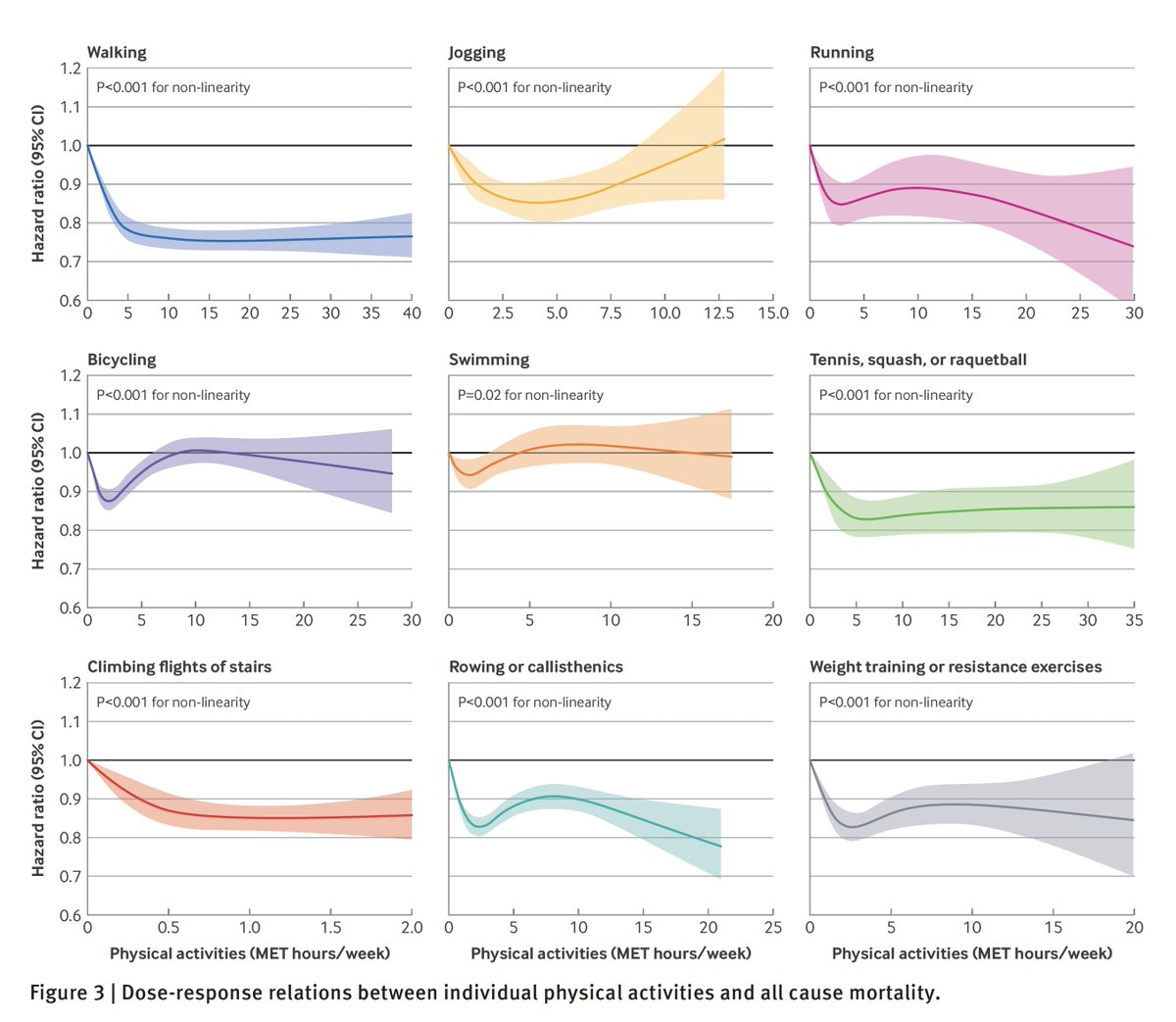
Physical activity and the reduction of all-cause mortality, from 2 very large prospective cohorts
1. The relationship is non-linear, suggesting a threshold effect for many types of exercise as seen below
How I imagine every 𝕏 influencer is spending their weekend... trying to get that $1,000,000.
If I win the prize, I will pay the taxes, then dedicate 100% of it to scaling out, formalizing operations, and building a formal OSINT team to hold institutions accountable. I already have a hiring pipeline with my other startup. No money for me. There's too many projects and not enough coders like me or @beaverd .
Top 100 podcasts on Spotify in the US:
1. The Joe Rogan Experience
2. This Past Weekend w/ Theo Von
3. The Shawn Ryan Show
4. Crime Junkie
5. The Tucker Carlson Show
6. Matt and Shane's Secret Podcast
7. Good Hang with Amy Poehler
8. The Daily
9. Candace
10. Up First from NPR
11. Armchair Expert with Dax Shepard
12. Bad Friends
13. Pardon My Take
14. Smosh Reads Reddit Stories
15. Morbid
16. The Diary Of A CEO with Steven Bartlett
17. Call Her Daddy
18. The Journal.
19. The Tim Dillon Show
20. Dateline NBC
21. The Mel Robbins Podcast
22. SmartLess
23. Crime, Conspiracy, Cults and Murder
24. The Bill Simmons Podcast
25. Distractible
26. Last Podcast On The Left
27. NPR News Now
28. Huberman Lab
29. Billions Club: The Series
30. Rotten Mango
31. Modern Wisdom
32. Rockin' Robin
33. Unseen
34. Pod Save America
35. Spotify Gaming
36. Two Hot Takes
37. MrBallen Podcast: Strange, Dark & Mysterious Stories
38. CreepCast
39. Giggly Squad
40. 2 Bears, 1 Cave with Tom Segura & Bert Kreischer
41. Today, Explained
42. PBD Podcast
43. All-In with Chamath, Jason, Sacks & Friedberg
44. Financial Audit
45. KILL TONY
46. Andrew Schulz's Flagrant with Akaash Singh
47. The Megyn Kelly Show
48. The Rewatchables
49. The Ben Shapiro Show
50. The Basement Yard
51. Breaking News from Pod Save America
52. ChainsFR On Spotify
53. Conan O’Brien Needs A Friend
54. The Big Picture
55. Funky Friday with Cam Newton
56. Stuff You Should Know
57. The Rest Is History
58. My Favorite Murder with Karen Kilgariff and Georgia Hardstark
59. anything goes with emma chamberlain
60. Your Mom's House with Christina P. and Tom Segura
61. Fantasy Footballers - Fantasy Football Podcast
62. This American Life
63. Be better everyday
64. The Matt Walsh Show
65. Science Vs
66. Part Of The Problem
67. Petty POV with Charlotte Dobre
68. Morning Brew Daily
69. The MeidasTouch Podcast
70. We Might Be Drunk
71. New Heights with Jason & Travis Kelce
72. 48 Hours
73. 20/20
74. The Ramsey Show
75. Danny Jones Podcast
76. Lex Fridman Podcast
77. The Ezra Klein Show
78. So True with Caleb Hearon
79. Murder With My Husband
80. The Deck
81. The Broski Report with Brittany Broski
82. True Crime with Kimbyr
83. Are You Garbage? Comedy Podcast
84. Behind the Bastards
85. If Books Could Kill
86. American Alchemy with Jesse Michels
87. TRIGGERnometry
88. Soul Boom
89. What Now? with Trevor Noah
90. The Watch
91. Breaking Points with Krystal and Saagar
92. Wait Wait... Don't Tell Me!
93. The Comment Section with Drew Afualo
94. Morning Wire
95. Rotten Mango Video
96. Whiskey Ginger with Andrew Santino
97. Just Creepy: Scary Stories
98. The President's Daily Brief
99. The MeatEater Podcast
100. The Bulwark Podcast
You are an American because you are allowed to exist as an individual.
Most of the world is collective by default. People are born into tribe, sect, class, religion, or party, and they never truly leave it.
Loyalty comes before truth, belonging comes before belief. To step outside the collective is seen as betrayal.
That is why people dream of America.
They are not fleeing poverty alone, they are fleeing absorption. They are fleeing systems where the group owns the person, where deviation is punished, and where the price of security is silence.
In America a society built on the idea that you exist before the group does. That your conscience is not leased to a higher collective purpose.
Collectivism promises more money, protection, belonging, warmth. But the exchange is never equal.
What it takes from you is who you are, your independence of mind, your right to stand alone, your ability to say “no” without being erased or punished.
Collective systems can't tolerate that idea. They survive by conformity, not truth. They need people who repeat, not people who think.
That is why collectivism moralizes dependency and pathologizes independence. The individual becomes selfish, antisocial, disruptive, anything except sovereign.
America was meant to be free, and freedom is cold. It requires responsibility, risk, failure, standing alone without guarantees.
That is why collectivist ideologies despise it, and why they constantly try to soften it, dilute it, or replace it with managed dependency.
Once you accept that the collective owes you comfort, it will soon decide that you owe it obedience.
This is the trade every collectivist system makes.
You must fight to remain an individual because once individualism is gone, it never returns peacefully.
They want you to abandon the very thing that made you society desirable to the rest of the world, to submit to “community” as a moral authority.
But the world does not admire collectives. It escapes them.
If America forgets that it was built for individuals, not managed populations, it will become just another place people dream of leaving.