Voice agents built with ElevenLabs can now be covered with insurance - in the same way that human agents can!
A first of its kind - adding real risk coverage and accountability, even for the toughest edge cases.
https://t.co/5IKndEXHKI
A year ago, I moved from Australia to SF to join AIUC as the first engineer to build out the confidence infrastructure for frontier models.
Today, we're announcing our $40M Series A led by @RibbitCapital, with @firstharmonic and @terraincap. Alongside our $15M seed from Nat Friedman, this brings our total funding to $55M.
The Artificial Intelligence Underwriting Company has raised $55M to audit and insure frontier AI models.
Insurance produces audits the public can trust and understand. The mechanism is simple: insurers need audits to price the risk. They pick auditors they believe will help them price the risk most accurately. Insurers then turn the audits into a price signal that cuts through political debates. Insurers are aligned with the public: if they get the audits wrong, they go out of business. That’s different from today, where labs pick their own auditors, creating public distrust.
Insurance only works if we scale up auditing, and we are building the infrastructure to do that. Millions of agents are being deployed; they leave terabytes of traces and will create thousands of incidents across dozens of risk categories. To scale auditing, we need reliable agents to surface evidence traces for human review.
History guides us. Take cars: auto insurers funded crash tests to price risks; crash tests led us to airbags, lowering the risk. Take electricity: home insurers funded lightbulb tests to price fire risks; today, every lightbulb carries a safety mark. Nuclear safety works similarly.
We’ve been learning by doing.. In the last 6 months, we’ve audited and insured frontier agent builders like Cursor, ElevenLabs, Lovable and Harvey. For ElevenLabs to get the world’s first agent insurance coverage, a Lloyd’s of London insurer required quarterly technical audits by an auditor of the insurer’s choice. We’ve built infrastructure for quarterly technical audits of any agent, working alongside firms like Gray Swan (technical evaluations) and Schellman (audit).
In the coming weeks, we’ll share our vision for how an insurance ecosystem can work for the frontier, and open source the world’s first actuarial model for frontier AI catastrophic risk.
We’re hiring across all roles in San Francisco. Come do your life’s work with us.
Rune & Rajiv
Nuts what has been happening. One on end we're fully going towards an age of accelerated research. On the other, feels like a violation of research ethics and rights.
Most of what Lovable does to earn your trust, you'll never see.
Every app has built-in authentication, access controls, encrypted data, security scans, deployment gates, and more.
It's why you won't hear us say "vibe coding" much anymore.
We're way past vibes now.
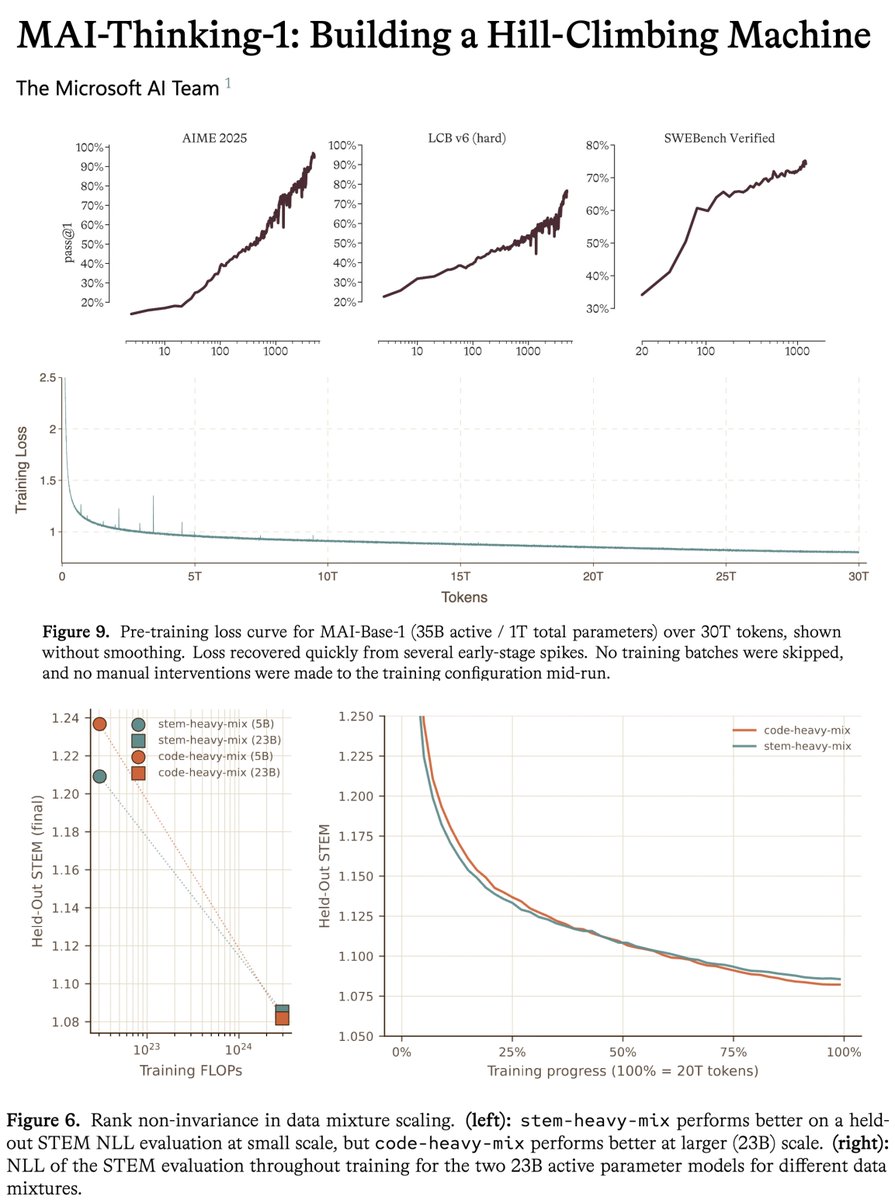
microsoft MAI tech report is a gold mine, one of the most transparent for a model at this scale.
this model uses zero synthetic data or distillation from previous models. this means reasoning, agentic behavior, tool use are all learned fully during post-training with no cold start. bold choice that makes it harder and requires more iterations to reach sota, but you get FULL control over your model series and it proves they are serious about being a frontier lab.
the tech report is insanely detailed and precise about numbers. to give an example, they give the exact MFU across all the iterations of the model, with the exact changes etc. they also share the full scaling ladder recipe, to my knowledge this is the first time i've seen this in a tech report at this scale
let's look at all of this in this likely very long thread 🧵
Inside Cognition with Grant Sanderson of @3blue1brown
We sat to discuss what it’s actually like to work as an engineer on the frontier of AI. The day-to-day, how work actually gets done, and what it feels like to build on a team that's like “a close-knit group of athletes training for the Olympics.”
Video link below:
Why what you attend to can't be static:
https://t.co/4R5A5ljyah
Transformers can't change what they attend to after training. Backprop is too global and too destructive for continual learning. The brain doesn't work this way. 1/2