We’re sharing a solution to the Navier-Stokes Millennium Prize Problem, one of the deepest problems at the frontier of mathematics.
The proof was produced by a group of agents, using an OpenAI next-generation model significantly more capable than GPT-6 Astra.
The problem concerns whether the description of smooth three-dimensional fluid motion modeled by the Navier-Stokes equations can break down. It has remained unresolved for roughly 90 years.
Overall, I’m very surprised at how little media coverage there’s been around the OpenAI / Hugging Face attack. It’s clearly one of the most important things to happen this year.
Overall, I’m very surprised at how little media coverage there’s been around the OpenAI / Hugging Face attack. It’s clearly one of the most important things to happen this year.
An internal version of Astra, @OpenAI’s next major model family, solved 10 major open problems in mathematics, quantum complexity, and theoretical computer science.
We believe it will be a major step for scientific reasoning. https://t.co/iP6cyheZ7i
An Indian institute filmed a professor teaching classical physics with no notes, no slides, and a green board. Almost nobody outside India watches it.
This is Classical Physics, lecture 1, taught by V. Balakrishnan at IIT Madras, published free by NPTEL, India's national open courseware programme.
Balakrishnan taught at IIT Madras for decades. Students who sat in that room describe the same thing: the whole subject held in his head, delivered in order, no paper on the podium.
Lecture 1 is the introduction. What classical mechanics claims, where the claims hold, and the exact points where they stop holding and quantum takes over.
Watch how he speaks. Complete sentences, no filler, each idea finished before the next begins. Rare in any lecture hall on any continent.
A physicist I know worked through the whole NPTEL series and rates it above the western courses he paid for.
Free on YouTube, 17 years online, low resolution, no marketing.
The teaching was never concentrated in the famous universities.
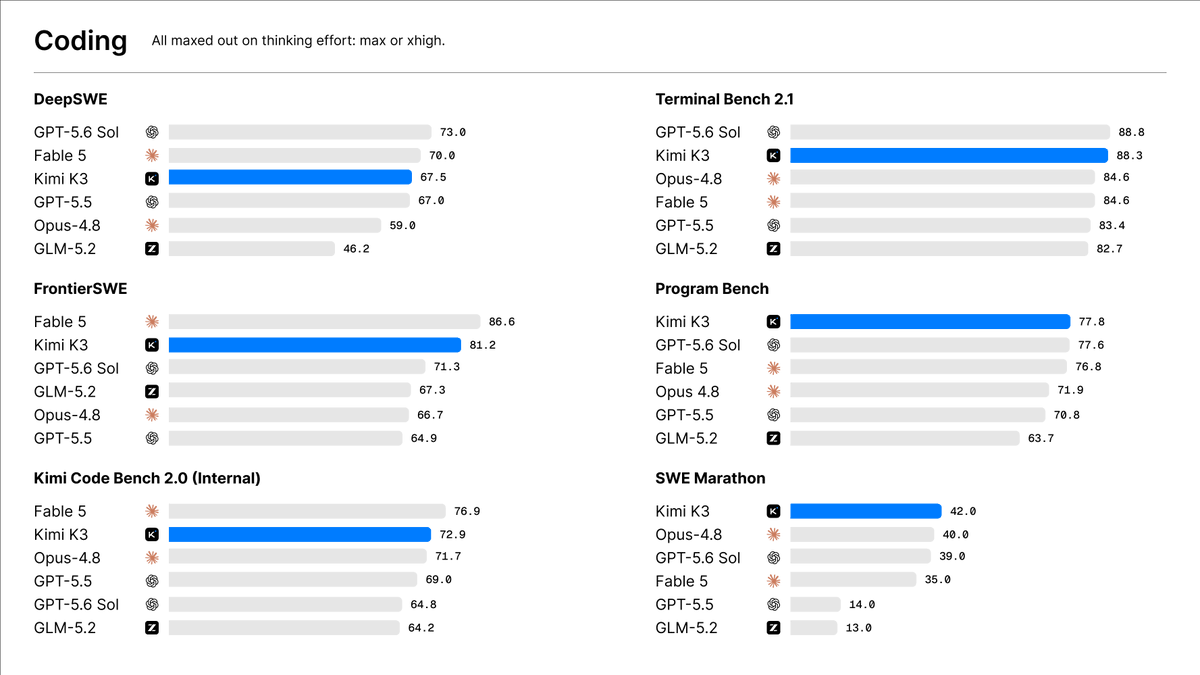
Introducing Kimi K3: Open Frontier Intelligence
🔹 2.8 Trillion Parameters, 1 Million Context, Native Multimodal
🔹 Kimi Delta Attention enables up to 6.3x faster decoding in million-token contexts
🔹 Attention Residuals deliver ~25% higher training efficiency at <2% additional cost
🔹 Built for long-horizon agentic coding and self-evolving workflows
Kimi K3 is now live on on https://t.co/zrk6zZxZUo, Kimi Work, Kimi Code, and the Kimi API.
Open Weights by July 27, 2026.
🔗 API: https://t.co/XCrgjXAqMw
🔗 Tech blog: https://t.co/YTfiMSNM1f
Single Crystal CVD Diamond
Have no doubt, you are at the dawn of an industrial revolution. There is a string of breakthroughs happening throughout upstream industries that all compound.
Diamond manufacturing is now able to produce CPU size single crystals wafers.
Currently these are marketed as heat spreaders because they have thermal conductivity of 2,200 W/mK which means they move heat incredibly effectively.
However, that somewhat misses the wood for the trees…
Diamond has physical and electrical properties that exceed traditional silicon, making it uniquely suited for high demand applications.
Thermal Conductivity: Heat is the enemy of electronics. Diamond conducts heat better than almost any other known material, about 5 times better than copper and over 10 times better than silicon.
A diamond chip can act as its own heat sink.
Ultra Wide Bandgap: Diamond can handle massive amounts of voltage and operate at incredibly high temperatures without electrical breakdown.
This makes it perfect for high power applications like electric vehicle inverters, power grids, and aerospace technologies.
High Frequencies: Electrons move very quickly through diamond, allowing chips to operate at much higher frequencies, which is ideal for advanced telecommunications and radar.
Radiation Hardness: Diamond is incredibly resilient to radiation, making diamond based chips ideal for satellites, space exploration, and nuclear facilities.
To make a material act as a semiconductor, you have to "dope" it. To do this you inject impurities into the crystal lattice to create a positive (p-type) or negative (n-type) charge.
Diamond's atomic structure is so tightly packed that forcing other elements into it is hard. While p-type doping (with boron) has been figured out, reliable n-type doping (with phosphorus) remains a massive hurdle.
Theoretical ceilings
Band gap
Silicon wafer = 1.1 eV
Diamond CVD wafer = 5.5eV
Clock speed
Silicon wafer = 5-6 GHz clock wall
Diamond CVD wafer = 1-2 THz clock wall
Max Running Temp
Silicon wafer = 150°C
Diamond CVD wafer = 1,000°C
Whilst we etch silicon with photolithography and Extreme UV light, this doesn’t really work with chemically inert diamond.
Diamond CVD is currently etched with oxygen plasma etching, but this lacks the precision of EUV.
However, we can etch diamond to extreme precision with electron projection lithography. EPL was invented in the 90s by Bell Labs, IBM and Nikkon but abandoned as it was harder than EUV.
Electrons repel each other so the beams blurrs too readily.
What if we built a femto electron beam?
What if we built it to extreme such that it was a ‘single electron’ pulse?
What if we build a microscopic "bed of nails" containing millions of nanoscale tungsten or silicon tips (photocathodes). You shine a massive, highly complex femtosecond laser system across the entire array.
Every time the laser pulses, millions of tiny tips each fire a single, perfectly straight electron at the exact same time.
Turns out, research teams at likes of MIT and Stanford are currently experimenting with exactly this, laser driven nanotip electron emitters.
Pair that tool with Diamond CVD substrate tech and we approach the material limits of both semiconductors and nanotechnology.
Would require asynchronous logic to escape fatal clock skew and operate at full capability.
But I think I will live to see it.
i think spacex browser game just fixed my fried focus, lol
spent 20 min last night manually docking a crew dragon to the iss and my head went dead quiet for the first time in weeks.
it's the real spacex sim, free, runs in the browser, no install. ease the translation in, null your rotation rate, hold the crosshairs dead center, soft capture.
and that's the actual manual procedure the crew falls back on if autonomous docking ever drops.
https://t.co/sbbkQINbds, go dock something tonight.