Focus only on 3 variables while deciding to invest in companies Promoter, Business and Valuations
Rest everything else is Noise even Macroeconomics. Why? Because things which are not in your control should not make any difference to your investment thesis
Empirically proven too as strong business have done exceptionally well despite macros, geopolitics, wars, famines, epidemics
#InvestmentFramework #mentalmodel
The more businesses you study,
The more management you meet,
The more plants you visit,
The more scuttlebutt you do,
The more investors you connect with,
The better you get at the GAME.
Microcap investing isn't about finding the next multibagger stock.
It's about increasing your surface area of luck and exposure.
The more you learn, the more you meet, the more you explore - the luckier you get.
That's microcap investing !!
Businesses and Investor make the most of money when they “BET ON CHANGE”
Internet in 2000s
DPI and cheap internet access in 2010s
Solar in 2020s
AI now
An indigenously developed UGV (Unmanned Ground Vehicle) named HULC 3.0 (High Utility Load Carrier) with a payload capacity of 300kg.
Developed by Gyrotronix Robots a deep tech co & completely bootstrapped.
A framework to get you to a 50-100 bagger stock.
What it takes:
1. Small/Mid starting market cap - so that there is enough scope for the market cap to expand.
2. Institution worthy but under-owned by institutions - Secular multi year growth catalyst + scope for persistent buying over months and years
3. Neglect (during hold period) - not a mainstream idea - often they don't believe in it till the last one-third phase - ability to hold against consensus is the edge
4. Long Holding period - huge gains are made only if you’re willing to hold the positions for years and decades and have an aversion to selling or booking profits.
5. Drawdown - methodology to ignore 50-90% drawdowns. I don’t say ability to stomach as one can’t really stomach it. It essentially comes down to not even looking at it or avoiding calculating your returns or drawdowns. Vision helps (covered below).
6. Allocation - Just the right starting allocation (typically small enough) that you never feel the pinch even if it goes wrong and you can continue to hold on for as long as it takes
7. Vision - to see the big picture and the larger trend and not be bothered by events in the interim.
This in no way means one should follow this approach - there are many ways to make it work in the markets - but just to understand that this is what it takes.
AI can be understood as a 5 layer cake. The lower you go, the better the pricing power. Good AI investing means allocation across the cake, not just a single layer. Read this excellent article in @thefynprint today
https://t.co/K8bAqxTPgw
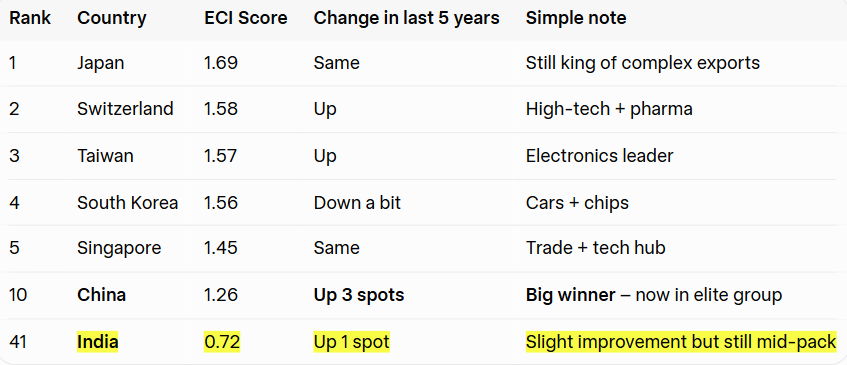
@phreakv6 This also resultantly reflects in the Economic Complexity Index for exports, China has moved up a lot in these rankings due to their R&D focus and massive scale up
https://t.co/t6cBwqcoxj
Economic Complexity Index - It looks only at exports (what a country sells to the world)
It measures two things -How many different things you export (diversity), How rare or hard those things are to make (sophistication – needs lots of knowledge, skills, factories, technology).
High ECI = your country can make complex stuff like cars, electronics, chemicals, machines.
Low ECI = you mostly sell simple things like oil, rice, clothes, or raw metals.
Countries with high ECI usually grow richer faster and create better-paying jobs. It is one of the best predictors of future growth (better than just GDP numbers)
China did this in just 30 years by focusing on factories, learning tech, and making more and more complicated products. India tried reforms and grew fast in total size, but its exports are still not as smart overall.
India is strong in services (like software, IT) and some areas like pharma and gems – but ECI mostly looks at goods exports, not services.
New 2025-2026 - Asia now dominates the top ranks (Japan, Taiwan, Korea, Singapore, China). The world’s smart economy power is shifting to Asia even more.
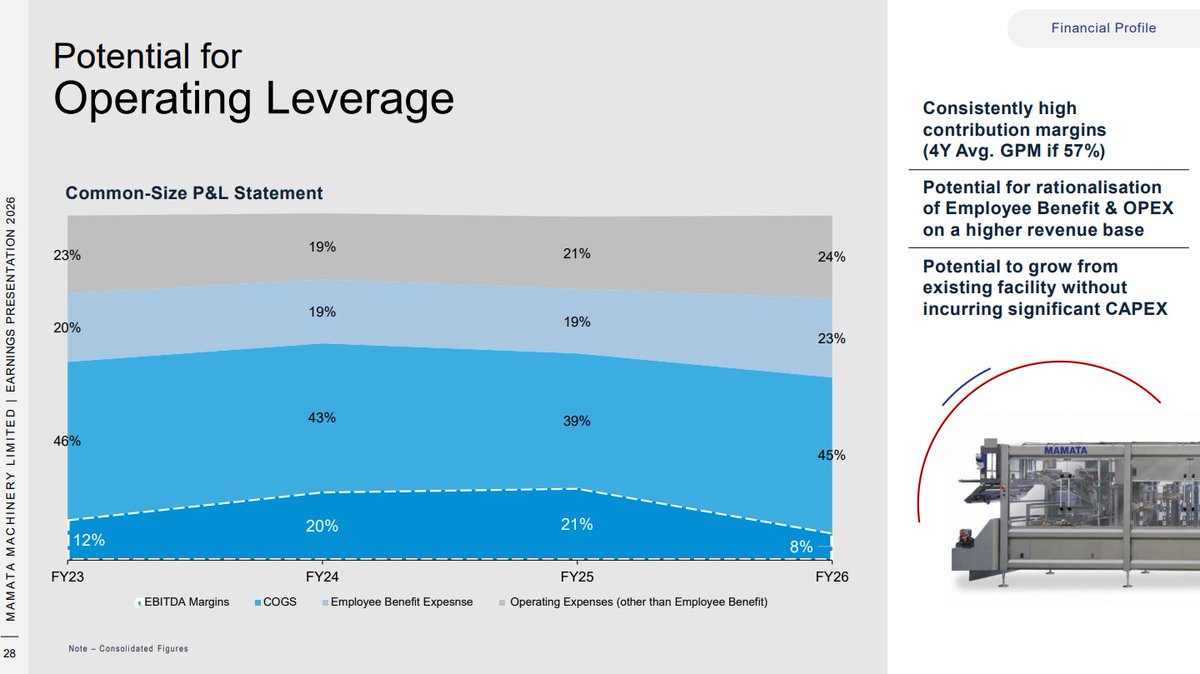
What Potential for Operating Leverage looks like.
These kinds of business models throw high incremental ROCE which in turns results in significant cash flows for incremental growth
Mamata Machinery is a packaging machinery manufacturer with marquee customer base
Yup, This is exactly why need to stay deeply aligned with sectoral tailwinds - track where government spending is directed, where institutional and fund house money is flowing, and what their priority sectors are.
Geopolitics matters too, but the real weightage should go to sectoral and index-level tailwinds & find out where capex happening
SG Mart Ltd - Q4FY26 | Concall Insights
Financial Highlights
•Q4FY26 revenue crossed ₹1,800cr, highest quarterly revenue achieved by the company
•Q4FY26 reported EBITDA stood at ₹56cr including ₹6cr inventory gains
•Q4FY26 business EBITDA stood at ₹50cr
•FY26 EBITDA increased 35% YoY to ₹137cr
•FY26 reported ROCE stood at 15%
•Annualized Q4FY26 ROCE estimated at ~25%
•Operating cash flow generation stood at ~₹300cr during FY26
•Company closed FY26 with net cash of ₹750cr
•Working capital cycle reduced to 20 days through inventory and debtor rationalization
Margins
•Q4 EBITDA margins supported by higher contribution from value-added businesses
•Inventory gains contributed ₹6cr EBITDA in Q4FY26
•Q3FY26 had inventory losses of ₹15-20cr due to steel price fluctuations
•Service center EBITDA estimated at ₹1,700-2,100/ton
•Renewable structures EBITDA estimated at ₹3,000-5,000/ton
•Steel profile business EBITDA estimated at ₹5,000-8,000/ton
•B2B trading EBITDA estimated at ₹700-1,000/ton
•Management expects Q1FY27 EBITDA spreads to remain similar to Q4FY26 levels despite geopolitical headwinds
Capex
•FY26 gross capex including CWIP and advances stood at ~₹525cr
•Q4FY26 incremental capex stood at ~₹125cr
•Majority of capex allocated towards new service centers and land acquisition
•Company approved minimum ₹600cr capex plan over next two years
•Capex allocation includes new service centers, land acquisition and profile machine additions
•Additional capex may be incurred for renewable structures and profile expansion if demand scales faster
Capacity Expansion
•Service center volumes increased to 190,000 tons in Q4FY26 versus 163,000 tons QoQ
•Renewable structures business currently operating at ~60,000 tons annualized run rate
•Management expects renewable structures volume to scale to 130,000-150,000 tons in FY27
•Steel profile business achieved ~7,000 tons volume in Q4FY26 and already operating at 5,000-6,000 tons monthly run rate in April
•Steel profile business expected to exceed 100,000 tons annual volume in FY27
•Company plans to increase service center count from 7 currently to 11-12 by FY27-end
•Management targets ~20 service centers over next three years
•Renewable structure capacity can scale rapidly with existing land infrastructure available
Business Expansion
•Company strategy shifting away from low-margin B2B trading toward higher-margin value-added businesses
•Focus areas include service centers, renewable structures and steel profile businesses
•Company launching multiple new steel profile products for warehousing, construction and industrial applications
•Coated steel products to be added through service center network to improve profitability mix
•Puff panel business expected to benefit from increasing adoption in factories and warehouses
•Management expects strong demand growth in puff panels over next 3-4 years due to insulation advantages
Guidance
•Management reiterated FY27 annualized EBITDA guidance of ₹300-350cr subject to geopolitical normalization
•Quarterly performance expected to improve sequentially as new verticals scale up
•Management expects 50% CAGR business growth over next three years primarily driven by value-added businesses
•EBITDA growth expected to outpace revenue growth due to improving business mix
•Service center annualized volume target over next three years estimated at ~2mn tons
•Renewable structure business expected to reach ~300,000 tons annual volume over next three years
•Steel profile business also expected to scale to ~300,000 tons annual volume over next three years
Ambition is a double edged sword.
Ambition without courage to do the hard things leads to a frustrated, depressed, angry person.
Who is perpetually feeling trapped and stuck and takes it out on others, especially their loved ones.
Great ambition blooms when it is coupled with great courage.
Courage to do the hard things, courage to walk a different path, courage to fail, courage to be misunderstood, courage to be mocked.
Let me explain what just happened today because it deserves so much recognition.
GalaxEye is a Bengaluru startup founded in 2021 by IIT Madras engineers. Today they launched Mission Drishti on a SpaceX Falcon 9. It is India's largest privately built satellite at 190 kg. And it carries a technology that no commercial satellite has ever carried before.
Normal satellites take photos of the Earth using optical cameras. Like your phone camera, but from 500 km up. The problem is obvious. Clouds. Night. Fog. Smoke. If any of these are in the way, the photo is useless. India has monsoon cover for 4 months a year. That is 4 months where optical satellites are partially or fully blind over large parts of the country.
The alternative is SAR. Synthetic Aperture Radar. Instead of taking photos with light, it sends radar waves down and reads what bounces back. Radar goes through clouds, through darkness, through smoke. A SAR satellite can image a flooded village at 2 AM during a cyclone when no optical satellite can see anything.
The problem with SAR is that the images look nothing like photos. They look like grainy black-and-white radar maps. A military analyst or a trained geospatial engineer can read them. A farmer, a disaster response team, or a city planner cannot.
Until today, if you wanted both optical and SAR data for the same location, you needed two different satellites, passing over at different times, at different angles. Then someone had to manually align and fuse the two datasets. Expensive, slow, and the data never perfectly matched because the satellites saw the same spot minutes or hours apart.
GalaxEye put both sensors on one satellite. Optical and SAR, fused into what they call OptoSAR. Three times more information than a single sensor. Processed onboard by an NVIDIA AI chip at 1.8 metre resolution.
Now in practice, during the next cyclone hitting Odisha, one satellite pass gives you a clear image of which villages are flooded, which roads are cut, and which buildings are standing. Day or night. Cloud or clear. In near real-time.
For defence, it means you can monitor a border area 24/7 regardless of weather. For agriculture, it means tracking crop health across an entire monsoon season without a single cloud gap. For infrastructure, it means monitoring construction progress on highways and bridges without waiting for a clear day.
GalaxEye tested their SAR tech on ISRO's POEM orbital platform. The satellite was tested at ISRO facilities. IN-SPACe provided regulatory clearance. NSIL, ISRO's commercial arm, will distribute the imagery globally. And it launched on SpaceX because ISRO's PSLV doesn't have the right orbit slot for this mission.
Yes, four IIT Madras graduates built a world-first satellite in 4 years in Bengaluru.
Take a bow!
JUST IN: Skin exams are getting automated.
SquareMind just raised $18M to build a robotic system that scans your entire body and tracks every mole over time.
• Swan robot captures full-body dermoscopic images in minutes
• Tracks new and changing spots across visits
• Replaces spot-check exams with total skin coverage
• Creates a time-series record for earlier melanoma detection
• Plugs directly into dermatology clinics
Robotics is going to reshape healthcare.
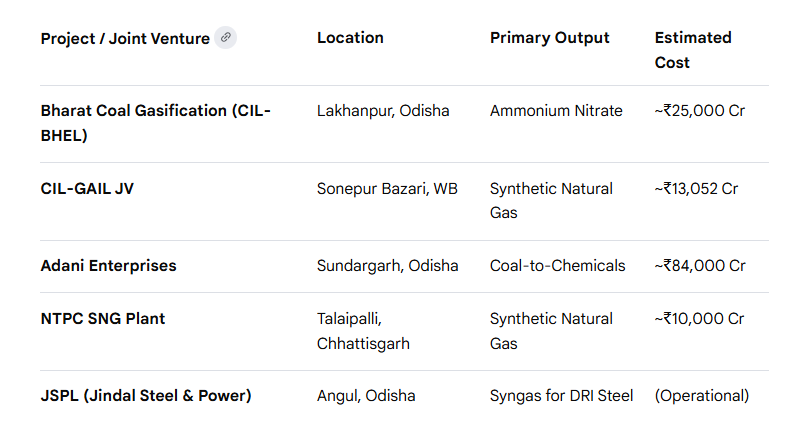
Coal Gasification is a new Industry that is being created.
It is currently at a nascent stage like Solar Industry was back in 2020
Companies in its value chain will be big benefitiaries if these projects become Techno-commercially feasible in combination with govt policies
Serious capital commitment is a strong positive signal
India's Coal Gasification Plan.
Only JSPL currently has coal gasification commercial in India which is all for captive consumption.
Govt incentive scheme with a total outlay of ₹8,500 crore.
Adani alone to deploy 84000 Cr for Coal Gasification.
Market seems to be recognizing moats of SG Mart looking beyond the surface-level analysis opinion that this is a commodity business
Business Mental Model work well in markets if one has patience
SG Mart has advantage in sourcing, distribution, pricing which are key in thriving in a commodity business
And the biggest kicker is runway for growth is huge
#fundamentalanalysis