@cremieuxrecueil Is it possible to get a link to the data and for your friend to post the data reduction pipeline to GitHub (anonymously even?). I'm not confident that a data collection in India is remotely the same as in the West, especially census data.
@astro_jaz Me: I could tell you about the number of stars in the universe, but I'm more interested in the number to your phone
Her: We can go on a date, but only if you planet
Happy to announce our public data release of the FIRE-2 cosmological zoom-in simulations of galaxy formation:
https://t.co/2JoPnKYwe6
https://t.co/CXsZypco6g
@PlayByPay Doing mine right now, theres a lot I could say but Twitter has a character limit (happy to discuss tho). The thing that gets to me sometimes is seeing so many friends living out their 20s while I keep studying. But it's a personal journey too, can't compare yourself to others
@nehathemartian If they believed in me they'll definitely believe in you. I was not a great candidate (according to my undergrad GPA), and was mostly rejected. But not completely rejected. Research/good rec letters helped a bunch too
@johnnie62722 @beamsontoast@bgreene Pretty sure you can find this level of eloquence at a physics grad student party. That said, this misses the mark anyways. The issue has to do with coupling people to their creations; you can appreciate someone's creation without appreciating them as a person.
@beamsontoast@bgreene I like some songs by Chris Brown, but I don't like Chris Brown (since he beat Rihanna). I can appreciate someone's creation without appreciating *them*, whether it be a quote, an idea, a work of art, etc.
Excited to share @PreeetPatel's first paper! He uses FIRE-2 simulations to predict complex elemental abundance patterns in the stellar populations of low-mass (dwarf) galaxies, including mock observations to test their observability. @UcdAstro
Finally, a big thanks to my advisors and mentors, @sloebman, @AndrewWetzel, without whom I could not have written this paper or conducted this exciting research. A big thanks to my co-authors Claude-André Faucher-Giguère, Kareem El-Badry, and Jeremy Bailin
#astrophysics#galaxies
My first paper is now on the arXiv! https://t.co/IzvCdpNMWr
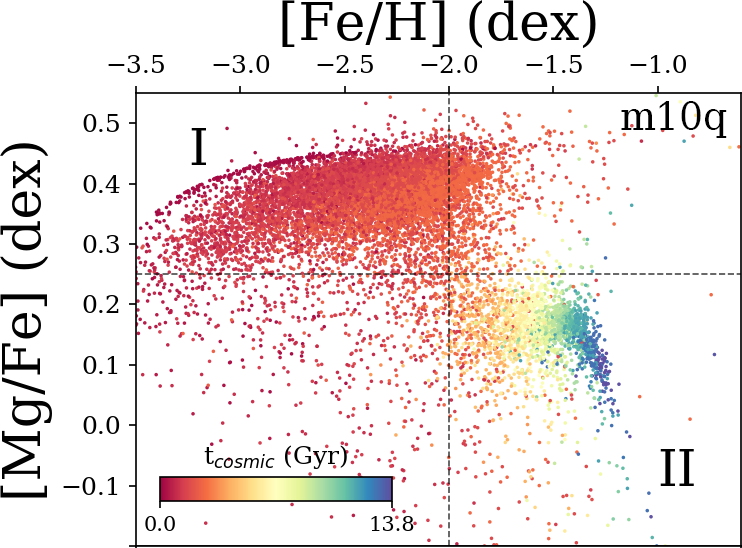
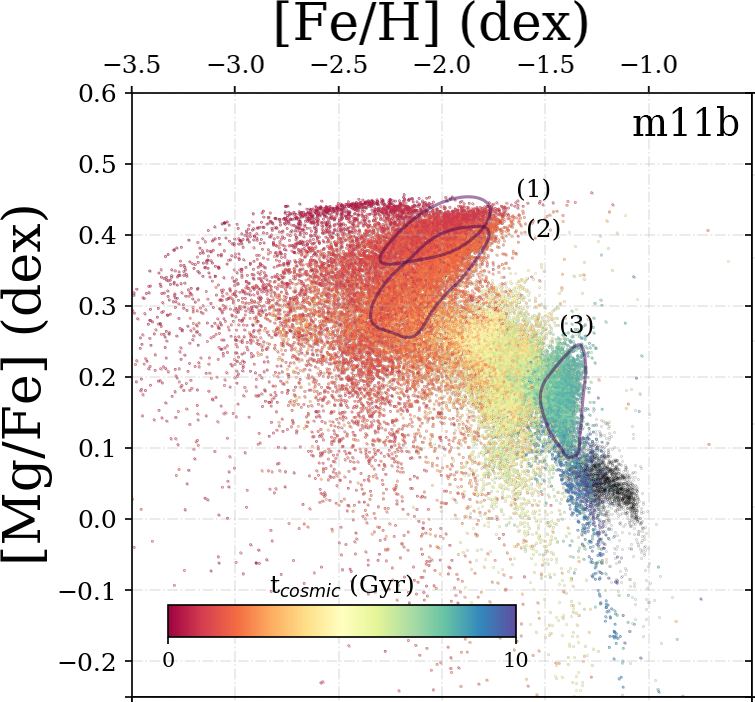
We find evidence of bursty star formation and satellite accretion embedded in the present day elemental abundance distributions ([Mg/Fe] versus [Fe/H]) of simulated dwarf galaxies.
We looked at the present day, global stellar abundances of 8 galaxies (shown here). Of these, m11h, m11b, and m10q served as case studies for different abundances features.
Additional details can be found in the paper, where we visualize the bursty star formation and go into greater detail about the feedback effects responsible for these features. We also find that JWST/ELTs should be able to resolve the break in m10q!
In the other two, we find two drastically different effects of bursty star formation. m11b experiences recurrent, bursty star formation which leaves 'stripes' in the abundances. m10q experienced a single large burst, which left a gap in the general abundance trend.
In the case of m11h, we find that a secondary enrichment feature (encircled region 'II') is the result of a satellite accretion ~1 Gyr prior to present day. You can see the satellite galaxy that merged in the right panel!