Don't start a startup in high school. What if it works? You'll lose the opportunity you'd otherwise have to explore random, interesting ideas, driven only by curiosity. Because while you will indeed learn a lot from a startup, you won't have any choice about what you learn.
The founder of Postman says you have to kill your existing org chart, especially if you're still operating with a pre ai hierarchy arrangement.
The modern org chart, according to @a85:
- wide span of control (even within exec team)
- work directly with ICs, not through layers
- either you're building, or you're selling
Projects are led by staff/principal engineers with high agency. They see across the board as well as deep in the stack.
Product managers are building APIs and prototyping in Claude instead of writing PRDs.
Designers are shipping PRs through Cursor directly instead of relying solely on Figma.
Everyone is building. And the management's job is to develop better judgment.
I put a lot of heart into my technical writing, I hope it's useful to you all.
📌 Here's a pinned thread of everything I've written.
(much of this will be posted on the Claude blog soon as well)
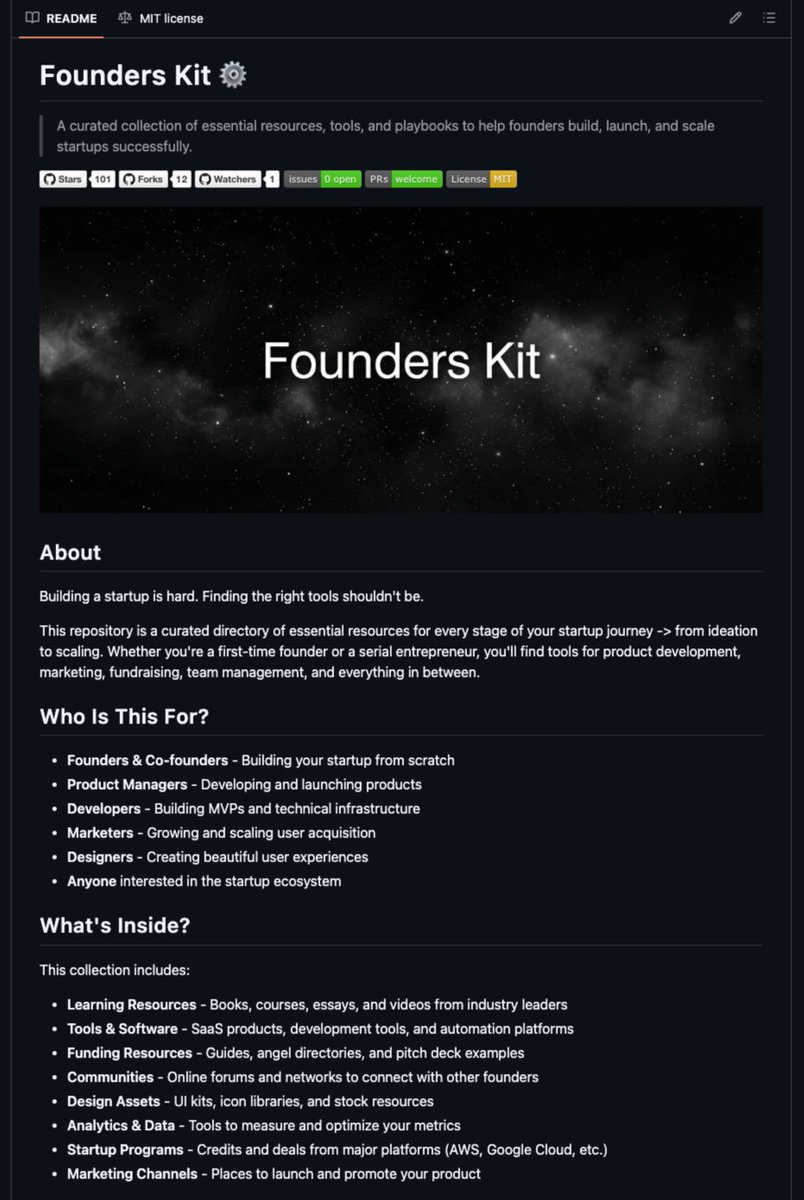
🚨BREAKING: Someone just dropped the ultimate startup toolkit for free.
It's called Founders Kit and it has every resource a founder needs to go from idea to IPO.
Paul Graham essays. YC courses. Pitch deck examples. Fundraising guides. 200+ tools across design, analytics, automation, and marketing.
No paywall. No newsletter gate. No BS.
100% Open Source.
If you want details please do
Like+
Comment "Send"+
Repost+
Follow me for auto DM
Just received my AI Sashakt badge from IndiaAI Mission, MeitY, and Intel India for taking the AI Responsibility Pledge, under India AI Impact Summit 2026. #AIPLEDGEINDIAoo! Visit https://t.co/p9FK58HA9W and become a Responsible AI citizen! #AIPLEDGEINDIA
A few random notes from claude coding quite a bit last few weeks.
Coding workflow. Given the latest lift in LLM coding capability, like many others I rapidly went from about 80% manual+autocomplete coding and 20% agents in November to 80% agent coding and 20% edits+touchups in December. i.e. I really am mostly programming in English now, a bit sheepishly telling the LLM what code to write... in words. It hurts the ego a bit but the power to operate over software in large "code actions" is just too net useful, especially once you adapt to it, configure it, learn to use it, and wrap your head around what it can and cannot do. This is easily the biggest change to my basic coding workflow in ~2 decades of programming and it happened over the course of a few weeks. I'd expect something similar to be happening to well into double digit percent of engineers out there, while the awareness of it in the general population feels well into low single digit percent.
IDEs/agent swarms/fallability. Both the "no need for IDE anymore" hype and the "agent swarm" hype is imo too much for right now. The models definitely still make mistakes and if you have any code you actually care about I would watch them like a hawk, in a nice large IDE on the side. The mistakes have changed a lot - they are not simple syntax errors anymore, they are subtle conceptual errors that a slightly sloppy, hasty junior dev might do. The most common category is that the models make wrong assumptions on your behalf and just run along with them without checking. They also don't manage their confusion, they don't seek clarifications, they don't surface inconsistencies, they don't present tradeoffs, they don't push back when they should, and they are still a little too sycophantic. Things get better in plan mode, but there is some need for a lightweight inline plan mode. They also really like to overcomplicate code and APIs, they bloat abstractions, they don't clean up dead code after themselves, etc. They will implement an inefficient, bloated, brittle construction over 1000 lines of code and it's up to you to be like "umm couldn't you just do this instead?" and they will be like "of course!" and immediately cut it down to 100 lines. They still sometimes change/remove comments and code they don't like or don't sufficiently understand as side effects, even if it is orthogonal to the task at hand. All of this happens despite a few simple attempts to fix it via instructions in CLAUDE . md. Despite all these issues, it is still a net huge improvement and it's very difficult to imagine going back to manual coding. TLDR everyone has their developing flow, my current is a small few CC sessions on the left in ghostty windows/tabs and an IDE on the right for viewing the code + manual edits.
Tenacity. It's so interesting to watch an agent relentlessly work at something. They never get tired, they never get demoralized, they just keep going and trying things where a person would have given up long ago to fight another day. It's a "feel the AGI" moment to watch it struggle with something for a long time just to come out victorious 30 minutes later. You realize that stamina is a core bottleneck to work and that with LLMs in hand it has been dramatically increased.
Speedups. It's not clear how to measure the "speedup" of LLM assistance. Certainly I feel net way faster at what I was going to do, but the main effect is that I do a lot more than I was going to do because 1) I can code up all kinds of things that just wouldn't have been worth coding before and 2) I can approach code that I couldn't work on before because of knowledge/skill issue. So certainly it's speedup, but it's possibly a lot more an expansion.
Leverage. LLMs are exceptionally good at looping until they meet specific goals and this is where most of the "feel the AGI" magic is to be found. Don't tell it what to do, give it success criteria and watch it go. Get it to write tests first and then pass them. Put it in the loop with a browser MCP. Write the naive algorithm that is very likely correct first, then ask it to optimize it while preserving correctness. Change your approach from imperative to declarative to get the agents looping longer and gain leverage.
Fun. I didn't anticipate that with agents programming feels *more* fun because a lot of the fill in the blanks drudgery is removed and what remains is the creative part. I also feel less blocked/stuck (which is not fun) and I experience a lot more courage because there's almost always a way to work hand in hand with it to make some positive progress. I have seen the opposite sentiment from other people too; LLM coding will split up engineers based on those who primarily liked coding and those who primarily liked building.
Atrophy. I've already noticed that I am slowly starting to atrophy my ability to write code manually. Generation (writing code) and discrimination (reading code) are different capabilities in the brain. Largely due to all the little mostly syntactic details involved in programming, you can review code just fine even if you struggle to write it.
Slopacolypse. I am bracing for 2026 as the year of the slopacolypse across all of github, substack, arxiv, X/instagram, and generally all digital media. We're also going to see a lot more AI hype productivity theater (is that even possible?), on the side of actual, real improvements.
Questions. A few of the questions on my mind:
- What happens to the "10X engineer" - the ratio of productivity between the mean and the max engineer? It's quite possible that this grows *a lot*.
- Armed with LLMs, do generalists increasingly outperform specialists? LLMs are a lot better at fill in the blanks (the micro) than grand strategy (the macro).
- What does LLM coding feel like in the future? Is it like playing StarCraft? Playing Factorio? Playing music?
- How much of society is bottlenecked by digital knowledge work?
TLDR Where does this leave us? LLM agent capabilities (Claude & Codex especially) have crossed some kind of threshold of coherence around December 2025 and caused a phase shift in software engineering and closely related. The intelligence part suddenly feels quite a bit ahead of all the rest of it - integrations (tools, knowledge), the necessity for new organizational workflows, processes, diffusion more generally. 2026 is going to be a high energy year as the industry metabolizes the new capability.
I spent $1.4 million on Microsoft Copilot.
$30 per seat per month.
4,000 employees.
Why?
2 words.
Digital transformation.
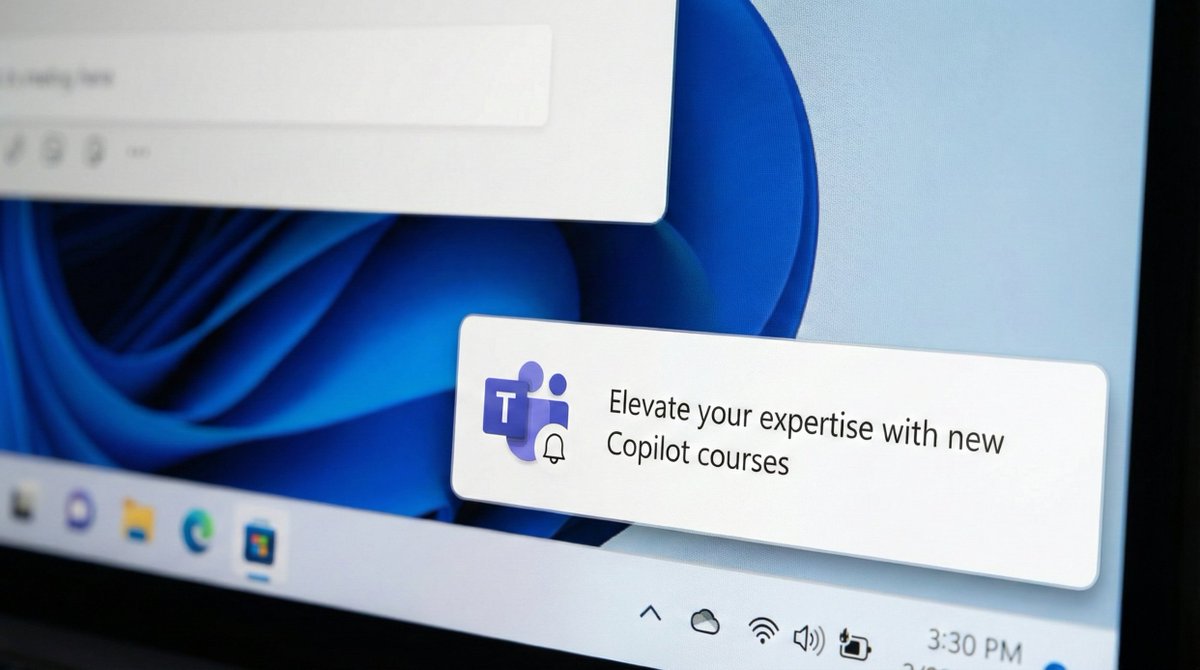
This morning I opened Microsoft Teams.
My top notification wasn't from my boss.
It wasn't from my team.
It wasn't a customer escalation.
It wasn't my wife.
It was Microsoft.
Telling me to learn how to use the thing I already bought.
It said ... "Elevate your expertise with new Copilot courses."
I've had these licenses for 6 months.
Apparently ... I should have waited.
The courses are 47 minutes each.
There are 9 of them.
That's 7 hours of learning.
Times 4,000 employees.
28,000 hours.
To learn the tool ... that was supposed to save us 40,000 hours.
We're already down 12,000 hours.
And no one's opened it yet.
Here's the math I don't put in the deck.
4,000 employees.
Average salary ... $105,000.
That's $50 an hour.
Times 7 hours of training.
Times 4,000 people.
$1.4 million.
In labor.
Just to learn the tool.
The training ... costs as much as the software.
$2.8 million.
Year 1.
To save 12,000 hours.
That's $233 ... per hour saved.
The CFO will never see this slide.
But I'll mandate the training.
Completion rates will be tracked.
Tracked means dashboarded.
Dashboarded means presented.
Presented means ... "adoption metrics are strong."
The graph will go up ... and to the right.
Strong adoption ... of the training ... for the tool no one uses.
Microsoft will send another case study team.
The case study will be called
"Enterprise drives 98% Copilot Academy completion."
The CEO will post it on LinkedIn.
He still won't know what Copilot does.
But he'll know we're ... "committed to continuous learning."
Learning is a journey.
The journey costs $1.4 million per year.
Plus $1.4 million in training labor.
To summarize emails ... we could read in 30 seconds.
But here's the thing.
I'll renew next year.
Because canceling requires a business case.
The business case requires ROI data.
The ROI data comes from the dashboard.
The dashboard shows 98% training completion.
98% is a success.
Success means renewal.
Renewal means ... I keep my job.
My job is ... making decisions.
I made a decision.
The decision was $2.8 million.
The decision cannot be wrong.
Because wrong decisions ... don't get promoted.
I got promoted.
So the decision was right.
This is called ... "strategic alignment."
Next quarter ... we're adding Microsoft 365 Copilot Studio.
It costs extra.
It lets us build ... custom Copilots.
Custom Copilots ... to automate the workflows ... no one has ... because everyone's still ... in training.
Microsoft says it's ... "transformational."
I believe them.
I have to.
I already signed the contract.
I feel this way most weeks tbh. Sometimes I start approaching a problem manually, and have to remind myself “claude can probably do this”. Recently we were debugging a memory leak in Claude Code, and I started approaching it the old fashioned way: connecting a profiler, using the app, pausing the profiler, manually looking through heap allocations. My coworker was looking at the same issue, and just asked Claude to make a heap dump, then read the dump to look for retained objects that probably shouldn’t be there; Claude 1-shotted it and put up a PR. The same thing happens most weeks.
In a way, newer coworkers and even new grads that don’t make all sorts of assumptions about what the model can and can’t do — legacy memories formed when using old models — are able to use the model most effectively. It takes significant mental work to re-adjust to what the model can do every month or two, as models continue to become better and better at coding and engineering.
The last month was my first month as an engineer that I didn’t open an IDE at all. Opus 4.5 wrote around 200 PRs, every single line. Software engineering is radically changing, and the hardest part even for early adopters and practitioners like us is to continue to re-adjust our expectations. And this is *still* just the beginning.
Google's Cursor competitor: FREE!
My course for you to learn: FREE!
My holiday gift to you 🎁
[⚠️ Comment "Antigravity" & I'll send you the link]
Antigravity is Google's answer to Cursor.
It's an AI tool that works directly on your device.
Not just for developers!
For ANYONE who works with text.
It's 100% free right now.
Access to Gemini 3 Pro.
Even Claude Opus 4.5 (!)
Use Nano Banana Pro right in the chat.
No subscription. No trial. No credit card.
This won't last forever.
I've been teaching Cursor to PMs for months.
But Cursor costs $20/month.
Antigravity removes that barrier completely.
So I rebuilt the entire course for AG.
It's an Antigravity course taught IN Antigravity.
So everything you do is directly applicable!
The AI IN the tool is your teacher.
What you'll learn:
→ Write PRDs with AI assistance
→ Analyze CSV data and survey results
→ Create strategy documents
→ Build reusable templates and workflows
But here's what most people don't realize:
This isn't just for PM work.
The real reason I wanted to get this out today...
On-device AI assistants are useful for LIFE:
🔹 Want to reorganize your files?
🔹 Rename hundreds of photos?
🔹 Clean up your Downloads folder?
🔹 Convert documents between formats?
🔹 Troubleshoot why something isn't working?
Just open the files and ask.
Talk to it like a person.
I spend all day in these tools now.
I've never been so productive.
Or had so much fun.
AI in a browser is like wearing a straightjacket.
This is a terrible day for a launch.
But I genuinely want to free you!
You've been meaning to learn this stuff.
You've got the time.
The course is free.
The tool is free.
No excuses!
This is my gift to you.
Happy Holidays 🌲
👉 Repost + comment "Antigravity" & I'll send you the link
My CISO called me at 3 AM last Tuesday.
"We caught someone."
I asked, "Caught them doing what?"
He said, "Typing."
Let me explain.
We have an employee in IT. Great worker. Always online. Never complained. Perfect Slack etiquette.
One problem.
His keystrokes were arriving 110 milliseconds late.
One hundred and ten milliseconds.
That's 0.11 seconds.
The average American remote worker has 20-40ms of latency.
This guy? 110ms. Every. Single. Keystroke.
My security team ran the numbers.
That latency doesn't come from a bad router in Ohio.
That latency comes from Pyongyang.
Our "Senior DevOps Engineer" was a North Korean operative.
Running his work laptop through a laptop farm.
In America.
While he worked from a government building.
In North Korea.
He passed the interview. He passed the background check. He passed the vibe check.
He did not pass the speed of light.
Here's what people don't understand about physics:
Light travels 186,000 miles per second.
But it still has to go through China.
And China adds latency.
Since April, Amazon has caught 1,800 of these attempts.
Eighteen hundred.
I called an emergency meeting with my board.
I said, "We need to implement Keystroke Velocity Auditing across all remote employees."
They said, "That sounds invasive."
I said, "You know what else is invasive? The Democratic People's Republic of Korea in your Jira tickets."
They approved the budget.
We now monitor keystroke timing to the microsecond.
If your latency exceeds 60ms, you get a call from HR.
If it exceeds 100ms, you get a call from the FBI.
We've already flagged 47 employees.
Turns out 44 of them just have bad Wi-Fi.
3 of them are "still under investigation."
The lesson?
You can fake a resume.
You can fake a background check.
You can fake an American accent on Zoom.
But you cannot fake the speed of light.
Physics is the ultimate background check.
Hire accordingly.








![carlvellotti's tweet photo. Google's Cursor competitor: FREE!
My course for you to learn: FREE!
My holiday gift to you 🎁
[⚠️ Comment "Antigravity" & I'll send you the link]
Antigravity is Google's answer to Cursor.
It's an AI tool that works directly on your device.
Not just for developers!
For ANYONE who works with text.
It's 100% free right now.
Access to Gemini 3 Pro.
Even Claude Opus 4.5 (!)
Use Nano Banana Pro right in the chat.
No subscription. No trial. No credit card.
This won't last forever.
I've been teaching Cursor to PMs for months.
But Cursor costs $20/month.
Antigravity removes that barrier completely.
So I rebuilt the entire course for AG.
It's an Antigravity course taught IN Antigravity.
So everything you do is directly applicable!
The AI IN the tool is your teacher.
What you'll learn:
→ Write PRDs with AI assistance
→ Analyze CSV data and survey results
→ Create strategy documents
→ Build reusable templates and workflows
But here's what most people don't realize:
This isn't just for PM work.
The real reason I wanted to get this out today...
On-device AI assistants are useful for LIFE:
🔹 Want to reorganize your files?
🔹 Rename hundreds of photos?
🔹 Clean up your Downloads folder?
🔹 Convert documents between formats?
🔹 Troubleshoot why something isn't working?
Just open the files and ask.
Talk to it like a person.
I spend all day in these tools now.
I've never been so productive.
Or had so much fun.
AI in a browser is like wearing a straightjacket.
This is a terrible day for a launch.
But I genuinely want to free you!
You've been meaning to learn this stuff.
You've got the time.
The course is free.
The tool is free.
No excuses!
This is my gift to you.
Happy Holidays 🌲
👉 Repost + comment "Antigravity" & I'll send you the link](https://pbs.twimg.com/media/G8yK_cDXAAA5BvS.jpg)