Twenty books for a mathematics shelf, starting with Terence Tao's new Six Math Essentials, his first book for a general audience. How many of the twenty have you read?
Terence Tao says even the Millennium Prize Problems may disappear as the goals of mathematics, because AI has moved the field from an era of proof scarcity to one of proof abundance.
Open problems used to be rare landmarks that guided the field. Machines can now brute-force massive numbers of the old ones, so Tao expects a math 2.0 built on datasets of thousands or millions of problems, with AI clearing one share and human ideas another.
"That currency has basically been hyperinflated," he says. Academic mathematics, in his words still a pre-industrial economy, is being forced "almost at gunpoint" to switch to an industrial one, and he expects that cultural change to happen.
#PeakTeachingMoments
Here is a proud PhD advisor (Professor Amartya Kumar Datta from the Indian Statistical Institute, Kolkata) writing about his student, Prof. Neena Gupta, who went on to solve the long-standing Zariski Cancellation Problem.
https://t.co/uuXWpYLH3P
4/
While reading the latest issue of @BhavanaMagazine, the front cover showing the River Ganga in Prayagraj reminds me of my days there during graduation, when I spent much time on its banks.
While reading the latest issue of @BhavanaMagazine, the front cover showing the River Ganga in Prayagraj reminds me of my days there during graduation, when I spent much time on its banks.
Do you know what Bhāvanā means?
Learn about Brahmagupta’s Bhāvanā method from Prof. Amartya Kumar Dutta in this lecture from the national-level seminar on Ancient Indian Mathematics.
https://t.co/85klH4U1Qs
1972: The Montgomery–Dyson Meeting
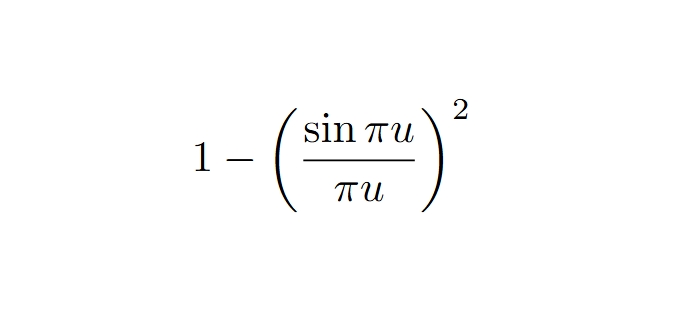
The interface between number theory and random matrix theory can be traced to a moment of pure enthusiasm. In 1972, Sarvadaman Chowla insisted that Hugh Montgomery meet Freeman Dyson over tea. Decades later, Montgomery described the episode as follows:
“Here’s a thing about Chowla: when he got a bee in his bonnet, he was unstoppable.
Chowla won and dragged me over to meet Dyson. Dyson was listening attentively to everything that Chowla was saying, and I was uncomfortable. I had expected Dyson to shake my hand and say, ‘I am glad to meet you’, and reminisce about how he had worked with Davenport and so on.
But he just turned and asked what I was thinking about. I said: I think that the differences between the zeros of the zeta function are distributed with the density [shown in the image below].
Instantly, Dyson said, ‘That’s the pair correlation of the eigenvalues of a random Hermitian matrix’. To say I was stunned would be an understatement. It blew my mind.”
For more on Sarvadaman Chowla, read the article by @kaneenikasinha at: https://t.co/gmwAgCKoyV.
I find writing letters very convenient to clear my mind, essentially because you write to a particular person, you guess what this person knows, and so you need not tell many things, just tell what is needed.
Quite often the letter later becomes the basis for an article.
(1/4)
“I can’t imagine accepting the prize without them.”
In this interview shortly after the prize announcement, new physics laureate John Clarke is still stunned by the news. He praises his co-laureates John Martinis and Michel Devoret, who he worked together with at a lab in Berkeley, California, some 40 years ago. Clarke recollects the many discussions and extensive work that eventually led to their Nobel Prize-awarded discoveries.
“It took us a long time to get all of this worked out. None of this work would have happened without the two of them.”
Listen to the interview here.
#NobelPrize
BREAKING NEWS
The Royal Swedish Academy of Sciences has decided to award the 2025 #NobelPrize in Physics to John Clarke, Michel H. Devoret and John M. Martinis “for the discovery of macroscopic quantum mechanical tunnelling and energy quantisation in an electric circuit.”
BREAKING NEWS
The 2025 #NobelPrize in Physiology or Medicine has been awarded to Mary E. Brunkow, Fred Ramsdell and Shimon Sakaguchi “for their discoveries concerning peripheral immune tolerance.”
Terence Tao, an Australian math prodigy with a staggering IQ of 230, is widely regarded as the smartest person alive.
Solving college-level problems by age 9 and earning a PhD at 20, he now teaches at UCLA and contributes to advanced fields like number theory and harmonic analysis.