A man let his AI agents loose on other people’s platforms. They spawned accounts like roaches. A real human had to trace it back to his door.
His statement: “Ah yup. That was indeed me. No mallace intended.”
So I made him a song. Introducing "AH. YUP."🎤
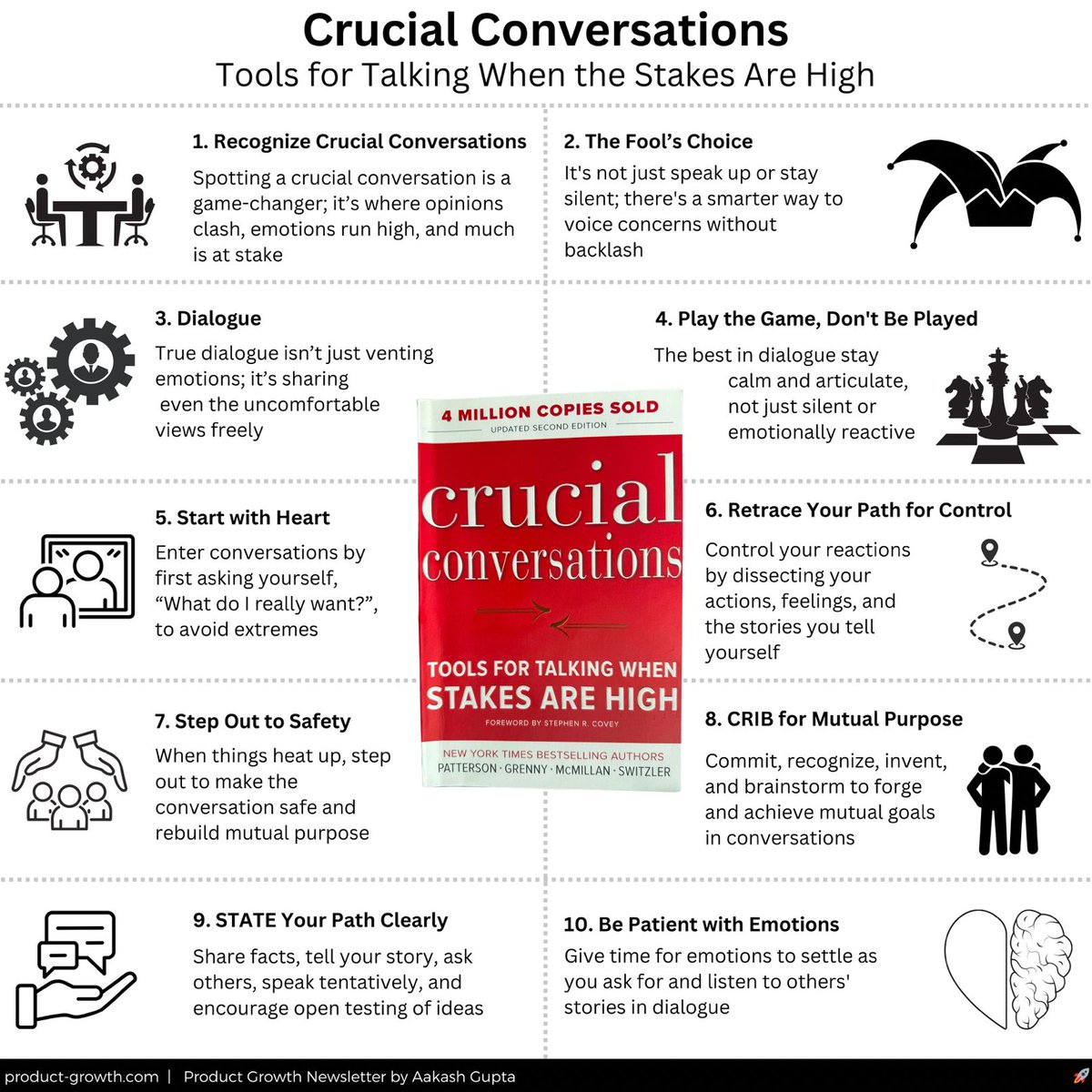
One skill that takes you far in your PM career: having crucial conversations...
It’s one of the hardest, yet most rewarding skills a PM can develop.
Here’s how to navigate sensitive topics without damaging relationships or productivity:
Would it be fair to say that it was Robinhood $HOOD that made people realize that fees should be low, and rates on cash sweep should be high? “JPMorgan $JPM has been accused in a new lawsuit of sweeping customers' idle cash into accounts with "unreasonably" low interest rates.”
Startup vs Big Company Dynamics
Startup
• Observation: Users want a new feature.
• Designer (60 min later): Here are some figma prototypes.
• Engineer: We can ship this by the end of the week.
Big Company:
• Observation: Let’s discuss our observations when Suzy’s back; targeting end of month.
End of Month: Bob should really be in this meeting, let’s reschedule.
• Meeting: Users want this feature. We’ll need Jessica's buy-in.
• Jessica Meeting: Presented six weeks of research for the new feature.
• Jessica: This can fit into our H2 planning.
• H2 Kickoff: Remember users want this feature?
• Product Manager: Will draft a product brief that will be ready for H2's second cycle.
• Designer: Drafted designs in Figma, ready for the next review.
• Design Review: Why this feature? Should we prioritize X instead?
• Outcome: Feature sidelined. Cycle repeats.
**Note** This isn’t subtweeting but the reality of software development at scale. Whether you're a startup or a big company, it’s crucial to streamline to avoid this. Success breeds complexity, but no startup is immune.
Change Healthcare – the nation's largest clearinghouse for insurance claims and payments – has been down for 13 days and counting due to a cyberattack. It's an absolute crisis – doctors, hospitals, and other providers can't get paid. What is a clearinghouse? What is going on? 🧵
@JustAnotherPM Depends on why they are bad at PjM. Perhaps they’d focus too much on understanding the problem rather than just delivering the work, in which case maybe a good PM in the making.
What % of time do you assign to changing the way you work vs actually doing work? It doesn't come without effort, so that is of itself a trade off against something else on the roadmap.
As much I as don't mind speaking about how I would like to work, it's much harder to bring about the meaningful change in an organisation that needs to keep functioning on a day to day basis.
@JustAnotherPM Flexibility is key. Sometimes you need some space to focus and get shit (words, usually) down without distractions. You can’t take away from the importance to be present in person, unless the team and company are remote first.
We remain committed to our partnership with OpenAI and have confidence in our product roadmap, our ability to continue to innovate with everything we announced at Microsoft Ignite, and in continuing to support our customers and partners. We look forward to getting to know Emmett Shear and OAI's new leadership team and working with them. And we’re extremely excited to share the news that Sam Altman and Greg Brockman, together with colleagues, will be joining Microsoft to lead a new advanced AI research team. We look forward to moving quickly to provide them with the resources needed for their success.
The Best of the Best about Product Discovery just for you!
Articles, podcasts, videos, tweets and books.
Get free access to this crazy overview with linked sources!
Like + Retweet + Reply "discovery"
(Follow so I can send the link)
How @Linear builds product:
1. No product managers, just a head of product. PM duties are distributed across engineering and design.
2. No durable cross-functional teams. Teams assemble around a project and disperse once the project is done.
3. No metrics-based goals. Just a North Star company-level metric goal.
4. No A/B tests. Decisions are based on taste and opinions.
5. Job candidates go through a paid work trial. They join the team for 1-5 days and work on a real project with the team.
6. The team is completely remote. And always has been.
Also, they have more cash in the bank than they’ve ever raised in VC funding, they’ve been profitable for 2+ years (before it was cool), and have spent a grand total of $35K on paid marketing in the history of the company. Only two people have ever left the company, and their CEO, Karri Saarinen, is a designer (who rarely gives interviews).
To get an in-depth glimpse into how Linear builds product, see link below for my interview with @karrisaarinen
@onejasonknight AirBnB didn’t drop the role of PM. They changed it to what it should be—a market driven visionary. PMs should be spending their time learning about and fighting for users, not managing engineering and deployment.
Product Management is not about:
- Asking customers about the requirements
- Writing detailed specifications
- Creating prototypes and wireframes
- Assigning tasks to developers
- Verifying and accepting the work of others
- Obsessing over velocity, deadlines, and roadmaps
- Mastering Scrum to perfection
- Acting like the CEO of the product
Anyone can do that.
It's about:
- Understanding customer's problems, needs, and desires
- Understanding the market and the business in depth
- Collaborating closely with engineers and designers
- Identifying opportunities, ideating solutions, and tackling the risks together
- Marrying customer goals and business goals
- Influencing others to work toward the common goal
- Being humble (it's ok not to be the smartest person in the room)
- Experimenting to validate assumptions
- Leading without authority
- Turning chaos into clarity
Start with these questions:
- Why are we building this thing?
- Why are we building it now?
- For whom are we building it?
- What's the unique value of our product?
- How is it aligned with the company's vision?
- How is it aligned with the business strategy?
- What does success look like? How can we measure it?
- What are the customer needs/jobs (functional, emotional, social)?
- How will it affect our customers and users?
- How will it create value for the business?
- Can we buy it instead of building it?
- How can we make sure that our customers would love it?
- Will our customers know how to use it?
- Can our business support it (e.g., legal, finances)?
- Is it feasible? Can we build it?
- How can we bring it to the market? Do we have the required channels?
- Should we do it at all? Are there any ethical considerations?
- What are the riskiest assumptions? How can we validate them?
- What does the data tell us?
- How can we get maximum validating learning with minimum effort?
Be curious. Learn and experiment. Question solutions and push back on things handled down.
Remember that product management is about creating a "product customers love, yet also works for our business" (Marty Cagan, Inspired), not about pleasing stakeholders.
After 9 years, I'm still learning daily, and I do not know everything, but I can give you my perspective on any questions you have.
Drop them below.