Prof Darrel Francis ☺ Mk CardioFellows Great Again
@ProfDFrancis
Cardiologist, Scientist.
I separate taking my work seriously (I do) vs myself seriously (I don't)
Ideas my own (best ones stolen from my amazing PhD students)
Can YOU interpret clinical research statistics?
Courses of silent, 15-minute seminars, to do on your phone during boring Zoom calls.
Do each seminar twice, a few days apart:
First time to learn.
Second time, GO FOR GOLD!
Click here > https://t.co/8rSnO8FDFa
@Math_files I would argue the marking scheme has in it, either A, B, C, or D. If you choose at random you have a 25% chance of hitting what the marking scheme says.
Therefore I would choose A or D, and hope for the best.
@mugander@rajkumar_chris@drjohnm@rallamee@bnallamo It is _not_ what we would get from simply biological subtraction anxiety itself, because there is no reason for that to occur on a date UNIFORMLY DISTRIBUTED over the range 0 to 6 months. Rather, the anxiety (excess slope) would be greatest at the start, and then tail off.
@mugander@rajkumar_chris@drjohnm@rallamee@bnallamo ... but then no more, from 6 months on.
It is _not_ what we would get from a protocolised phone call _at_ exactly 6 months: that would be a huge blip _at_ exactly 6 months.
Just starting training in Cardiology?
Or just curious about echocardiography?
Free online echo course for absolute beginners - all welcome!
https://t.co/pHA4qwewXF
@mugander@rallamee@mshunshin In principle I am skeptical that making it _harder_ for blood to circulate, can make symptoms in (any kind of) HF better. Would you want your CO restricted like that?
However, I was skeptical of Coronary Sinus Reducer because it sounded mad too...
Placebo trials key here...
I'm delighted that the British Heart Foundation has awarded £5 million for a BHF Centre for Research Excellence at the National Heart & Lung Institute.
Congrats to Profs Manuel Mayr and Costanza Emanueli and team, for all their brilliant work!
https://t.co/lap5hGKbKf
@mandeep_mayo At first I thought "nothing", but then I read the responses, including "Severe AR", which I am swung by. Is the giveway that:
(a) On the first beat, contrast goes into the aorta, but then slops back into LV?
(b) LV takes ages to clear, despite good EF?
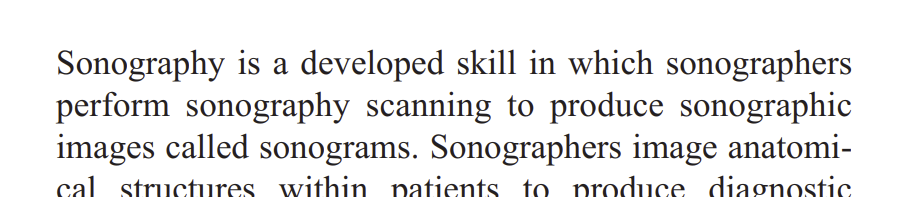
Hat tip to our excellent PhD student Catherine Stowell for finding this and telling me this concept is called "polyptoton".
I pretended that I knew that already, since I am a professor and obviously I know everything.
But anyway you be the judge:
https://t.co/TO88msEBEn
Do you guys ever do inside-jokes in your papers?
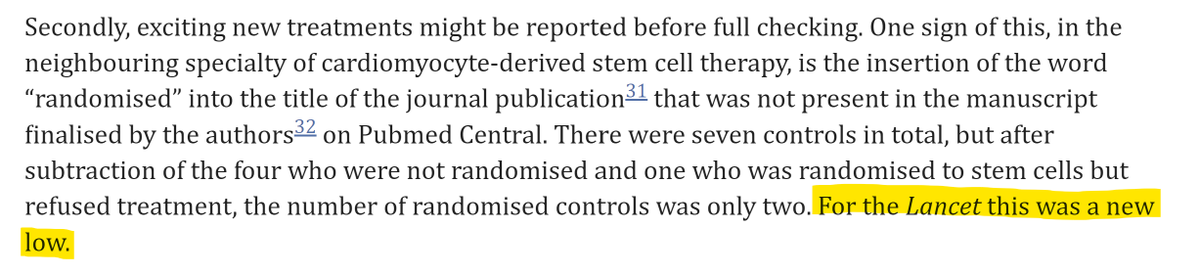
This was one that I had to pull rank on, against the wishes of the entire rest of the authors, to get in. "What if one day we want to publish in the Lancet?"
"Nah, never gonna happen. And anyway they don't read the BMJ."
@AngryCardio @MohammedAlo@MaryanneDemasi@JAMAInternalMed@pbyrne82 Just to clarify, I am not laughing at them for being a bit thick.
It was just a huge coincidence that I laughed out loud at that time, your honour.