We cordially invite researchers and scholars to submit their original manuscripts for consideration in the forthcoming November issue of ANABIDA.
Anadolu Business Intelligence and Data Analytics Journal https://t.co/lsMXlbXOit
I recommend Columbia mathematician Michael Harris’s wide-ranging, informative and thought-provoking essay in Boston Review on AI and mathematics:
https://t.co/igA4fbmhgc
Harris rightly worries about the possible negative effects of AI-generated proofs and mathematics on collective knowledge in the field, as I have also argued here: https://t.co/oKhvHdjpP3
Of course, used in the right way, AI is a tool that can be beneficial in many fields. The question is whether we can develop institutions, norms and practices to support its beneficial use and whether the current direction of the technology in Silicon Valley will enable us to do so.
Daniel Kahneman - the psychologist who won a Nobel in economics - spent his life proving one thing: your confidence is lying to you
A bat and a ball cost $1.10. The bat costs $1 more than the ball. The answer "10 cents" jumps to mind instantly. It's wrong (it's 5 cents) - and ~50% of students at Harvard, MIT and Princeton say it without checking.
That gap is his whole point: the fast, intuitive mind builds a clean story from almost nothing, and the feeling of certainty has nothing to do with being right.
"Confidence is a feeling, not a judgment."
"Stock pickers can't develop intuition - there isn't enough regularity for it to form."
"You can build a very coherent story out of very little information."
~45 min, free. how your mind fools you - from a man who studied it for 50 years ↓
🦔UC Berkeley's computer science department just posted its worst failure rates in years. 35.3% of CS 10 students got F's in spring 2026, up from under 10% in prior semesters. Professor Dan Garcia says the primary driver is a "vast increase in academic dishonesty" through LLMs. Students use AI to complete assignments, never learn the material, then fail exams. His office hours, once full, are now empty.
My Take
Companies are firing experienced engineers while the pipeline that produces new ones is being gutted by the same technology. Students use AI to bypass the hard part of learning, show up to exams without the understanding, and fail. One professor discovered a student's linear algebra class had an "open AI" policy for homework and exams. That student then couldn't do basic linear algebra in the next course.
Both ends of the workforce are eroding at the same time. Senior engineers are getting cut to fund AI spending. Junior engineers are graduating without the skills because AI did their coursework. And the companies spending trillions on these tools haven't connected those two facts yet.
Hedgie🤗
We’ve automated every single thing we can @every with AI agents.
And yet there’s way more human work to do than ever. We’ve gone from 4 -> 30 human employees since GPT-3.
I wrote a report on the structural reasons: how AI makes expert competence cheap, why that drives up demand for experts, and why the dynamic only intensifies as we approach AGI.
After Automation: https://t.co/Lb7SUCduAg
Introducing Gemini for Science — a collection of AI tools to help accelerate the scientific process. Gemini can already assist in solving complex problems, but our new @GoogleLabs prototypes can help streamline more daily scientific tasks, including:
📃 Staying on top of new papers
🧑💻 Transforming research goals into usable code
💡Generating new hypotheses
#GoogleIO
🚨Just IN: If you've used ChatGPT for writing or brainstorming in the last 6 months, your creative ability may already be permanently damaged.
A controlled experiment just proved the effect doesn't reverse when you stop using it.
3,302 creative ideas. 61 people. 30 days of tracking.
Researchers split students into two groups. Half used ChatGPT for creative tasks. Half worked alone. For five days, the ChatGPT group outperformed on every metric. Higher scores. More ideas. Better output. AI was making them better.
Then day 7. ChatGPT removed. Every creativity gain vanished overnight. Crashed to baseline. Zero lasting improvement.
But that's not the bad part.
ChatGPT users' ideas became increasingly identical to each other over time. Same content. Same structure. Same phrasing. The researchers called it homogenization. Everyone using ChatGPT started producing the same ideas wearing different clothes.
When ChatGPT was removed, the creativity boost disappeared -- but the homogenization stayed. 30 days later, same result. Their creative range had been permanently compressed.
Five days of use. Permanent damage 30 days later.
A separate trial confirmed it. 120 students. 45-day surprise test. ChatGPT users scored 57.5%. Traditional learners scored 68.5%. AI reduces cognitive effort. Less effort means weaker encoding. Weaker encoding means less creative raw material.
You're not renting a productivity boost. You're financing it with your originality.
The interest rate is permanent.
@fbetulkurnaz@fbetulkurnaz Hocama katılıyorum. Ek olarak tartılı ortalama kullanılarak yapılan sıralamada 2 ondalık basamak kullanımı ile yapılan bir özetleme gördüm. 3 ondalık basamak kullanıldığında Üniversite sıralama puanındaki farklar daha da azalıyor. Bant sistemi daha verimli
MIT proved every major AI model is secretly converging on the same "brain."
It’s called the “platonic representation hypothesis,” and it’s one of the most mind-blowing papers you’ll ever read.
You train a vision model purely on images. You train a language model purely on text.
They use completely different architectures. They process completely different data. They should have completely different "brains."
But as these models scale up, something impossible is happening.
When researchers measure how they organize information, the mathematical geometry is identical.
A model that only "sees" images and a model that only "reads" text are measuring the distance between concepts in the exact same way.
The models are converging.
The researchers named this after Plato’s Allegory of the Cave.
Plato believed that everything we experience is just a shadow of a deeper, hidden, perfect reality.
The paper argues that AI models are doing the exact same thing.
They are looking at the different "shadows" of human data, text, images, audio. And they are independently discovering the exact same underlying structure of the universe to make sense of it.
It doesn't matter what company built the AI.
It doesn't matter what data it was trained on.
As models get larger, they stop memorizing their specific tasks. They are forced to build a statistical model of reality itself.
And there is only one reality to map.
2024, Arxiv
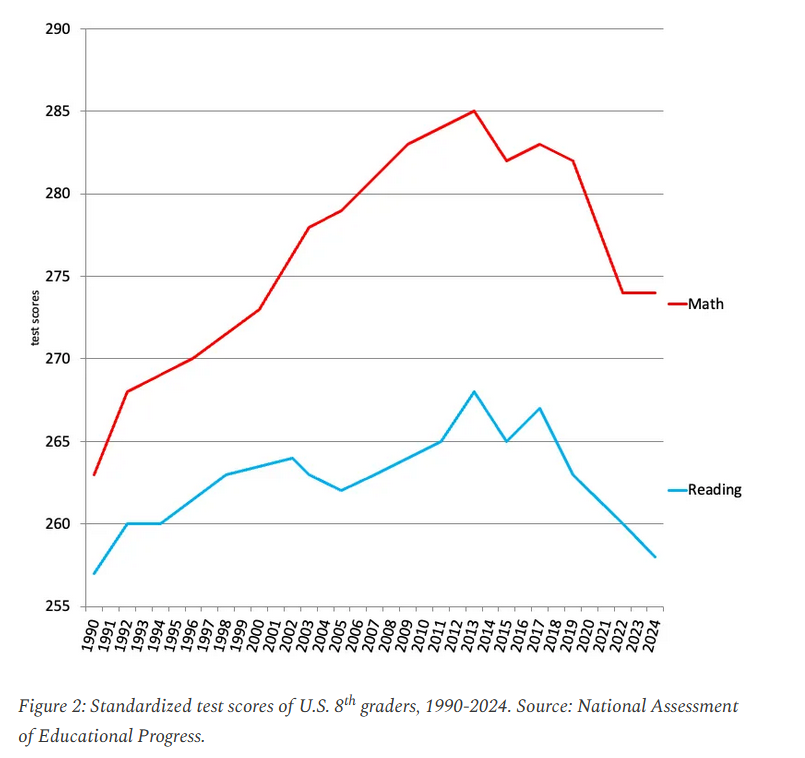
🦔Schools across the US are reversing years of technology-first classroom policies after studies show laptop and screen use has either decreased test scores or produced no improvement. Maine adopted one-to-one laptop policies in 2002 and showed no improvement after 15 years.
Neuroscientist Jared Cooney Horvath told the Senate that frequent in-class computer use correlates with significantly lower math and science scores across both high and middle income countries, and that Gen Z is the first generation in modern history to score lower than their parents on standardized tests. Schools in Kansas, North Carolina, Michigan and elsewhere are restricting laptop use and returning to pen and paper, with some reporting improvements in reading comprehension within months.
My Take
The data here is hard to argue with. Fifteen years of laptops in Maine classrooms produced no improvement in test scores. Schools that switched back to pen and paper saw reading comprehension improve within months. The technology industry spent billions convincing schools that screens were the future of learning, and the evidence is pointing in the opposite direction.
We're pulling laptops out of elementary classrooms in 2026 at the same moment we're deploying AI into hospitals, courtrooms, and financial systems that depend on humans being able to think critically, catch errors, and exercise judgment. The children who spent their formative years navigating text boxes instead of working through problems on paper are the same people who will be asked to oversee those AI systems in ten years. If the screen-first approach genuinely stunted the development of analytical thinking it was supposed to enhance, we have a compounding problem that goes well beyond test scores.
Hedgie🤗