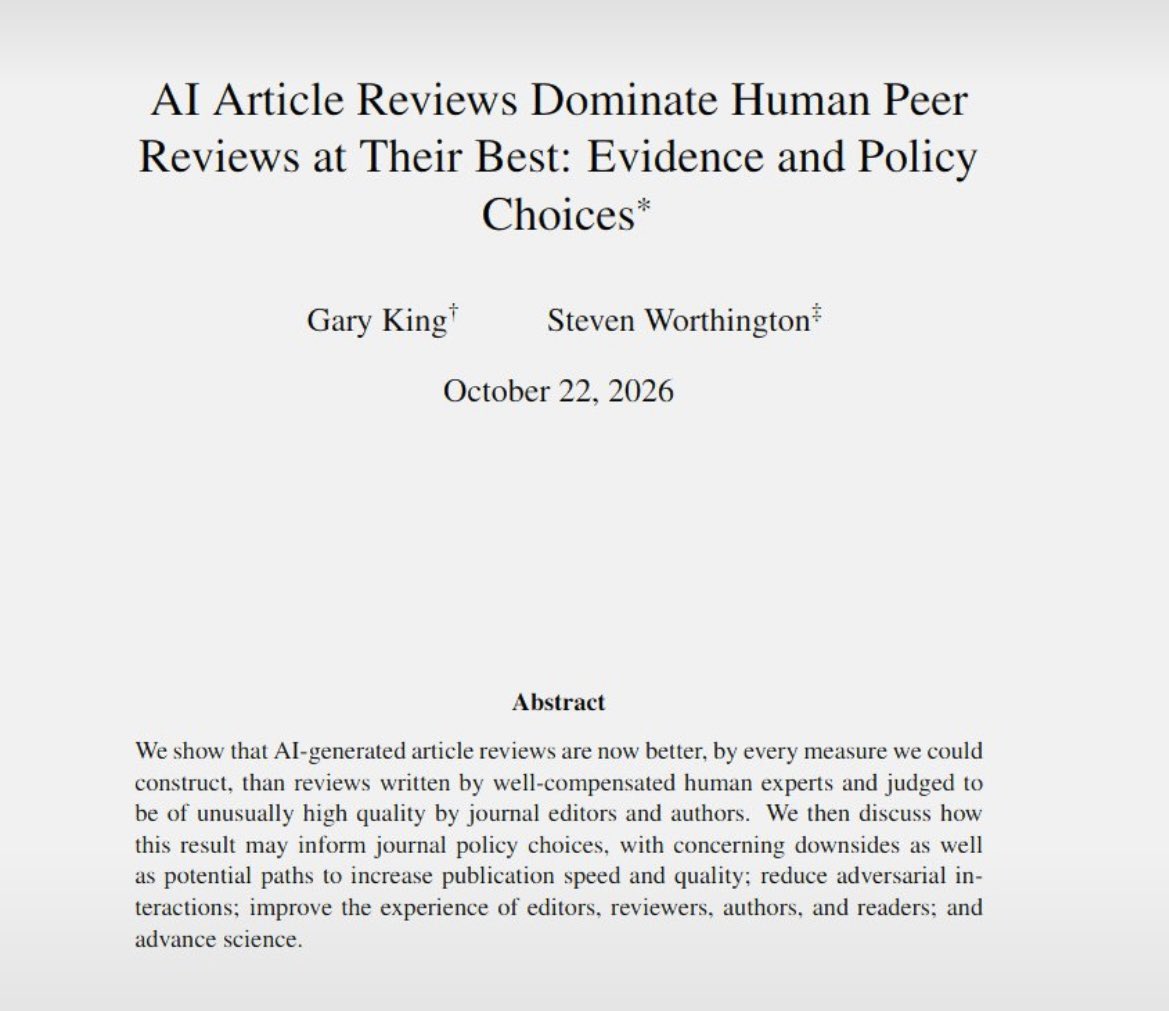
The importance of this paper cannot be overstated.
The authors compared AI reviews with 134 reports written by carefully selected, paid human experts.
The results are impressive.
Not only AI received higher ratings across all seven dimensions assessed by an AI judge.
But even three former journal editors preferred AI reviews in 90% of the cases.
The potential benefits of AI reviews for scientific advance are getting enormous: faster and higher quality feedback, less reviewing work, more time for research.
We could even imagine journals run entirely by AI editors and reviewers. This could radically disrupt a publishing system that costs researchers considerable time and money. Let me say: some disruption would be welcome.
But there are also major concerns.
What happens when a few AI systems become gatekeepers across sciences?
They might increase average review while narrowing the range of ideas that survive.
This is particularly critical at the scientific frontier, where an important contribution may challenge the assumptions that existing research takes for granted.
And even worse: let’s not forget that, near the frontier, AI systems become more likely to hallucinate.
So they might embed errors at the very core of human knowledge.
A tsunami is coming.
And we’re not ready.
*
Paper in the first reply
"I learned on Reddit today that Libb Thims has passed away—most likely, and tragically, in the same manner as one of his most cherished idols, Ludwig Boltzmann. To put it mildly, Libb was a highly unusual character, and his views were deeply controversial. 🧵⬇️
Today, it would be a disservice to Libb to ignore the invisible weight he was carrying. The truth is, he was fighting a battle that so many face in silence—one that eventually became too heavy for him to bear.
First in the UK, second in the world!
We’ve retained our @WorldUniRanking for the third year in a row! 🎉
This success is thanks to every single member of Imperial’s community, as we work together to make a meaningful difference in the world.
Firm Says Microbes Strike Hydrogen Gold in California Oil Field https://t.co/zY9ydn7OCA
IF (big if) this is true, it is a huge thing, as it can convert depleted oil fields into H2-producing wells at very lost cost. 🫧
We’ve been named as 1st in the UK and 2nd in the world by QS @worlduniranking!
This recognises Imperial as one of the best places to study, research, work and grow.
Thanks to everyone in our community for making this possible 💙
#QSWUR
Does the TikTok trend of using candle heaters really work? In short no.
"In layman’s terms, you cannot create energy... it is doing nothing additional other than the illusion of a little heater", @ProfMuller told @BigIssue https://t.co/hIlY6eF7wX
Collaboration with @ProfMuller & @Petronas
Atomistic #molecular#simulations to find:
interfacial tension & critical micelle concentration of sugar-based (alkyl polyglucosides) #surfactants
🔗https://t.co/LEhu3mJ7wE in J. Colloid Interface Sci @ELSchemistry
@ImperialChemEng
We have a super-exciting industry-funded Postdoc position just opening in our group! We are seeking someone with expertise in developing machine-learning models for thermophysical properties. Please DM for the details. (Starting date October.) #MolecularSystemsEngineering
Phase diagram of a rigid rod system with attractive end groups
Very proud of this paper on liquid crystals written in remembrance of my dear friend Luis F. Rull, which I am sure he would have liked 😊.
https://t.co/JBq4bn520c
Isaac Newton lost a fortune in the world's first Ponzi scheme.
In 1720, England was in the grip of a share-buying frenzy as the stock of the South Sea Company kept rising through the roof. Newton was initially contemptuous. 'I cannot calculate people's madness,' was his scoffing remark.
Newton was among the richest men in England at the time and a canny operator. But soon he too got swept up in the craze and started buying South Sea shares.
The idea of the company was to do business with South America, for which the Britain granted it monopoly. But that part of the world was not even under British control. It was never going to happen.
The bubble burst. Thousands of investors were ruined. Newton lost what amounts to millions in today's money.
Moral of the story: even a sucker can discover the laws of physics and maths.