Remember when you first learned about genetics at school? All those fascinating examples of human traits that are each determined by just a single gene? Time to check in on some of your favourites to see how they’re doing...1/n
No more tweets from me for the time being. I'm posting about genes, brains, speech & language on Mastodon instead. See you there!
@[email protected]
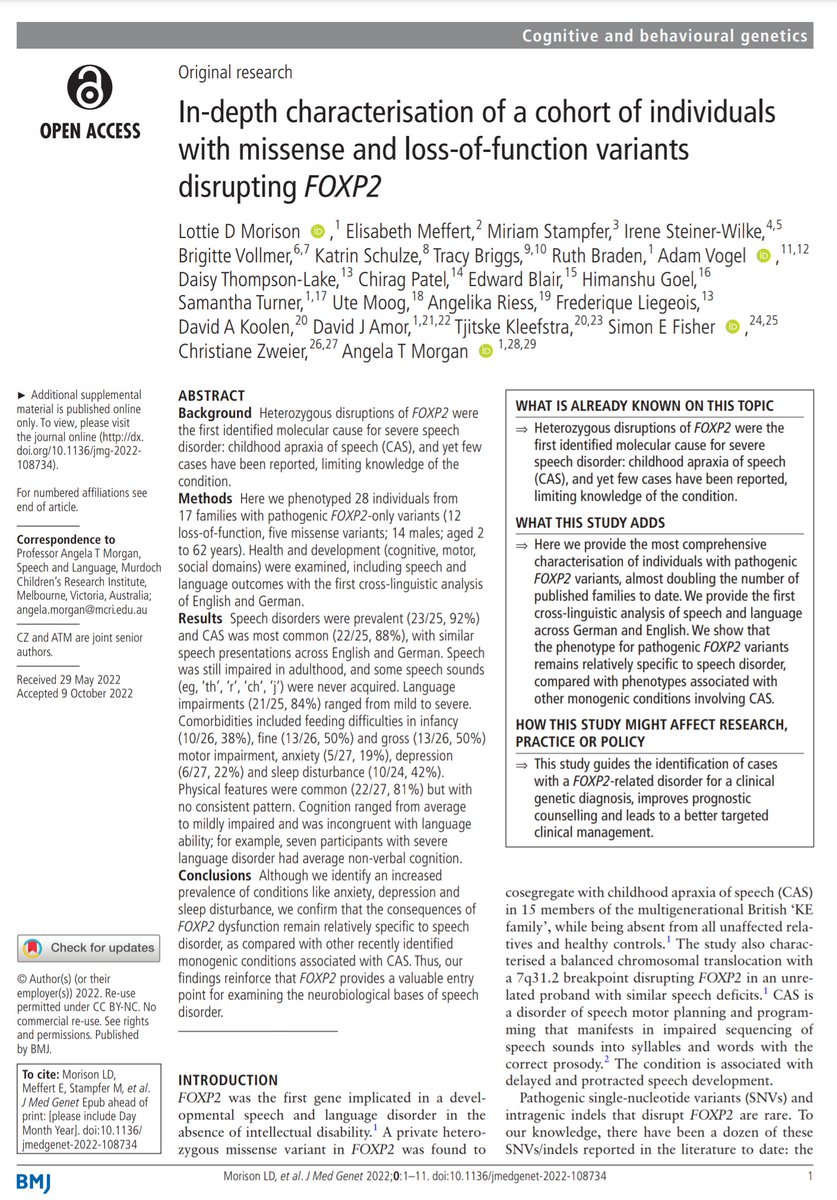
In-depth study of 17 families with loss-of-function or missense variants in the FOXP2 gene confirms links to speech/language impairments, & also suggests elevated risk of anxiety, depression, sleep disturbance. Led by @Lottiedmorison, out now in @JMG_BMJ: https://t.co/rfz654xXOh
If you're curious about how we originally discovered this gene, here's an explainer thread that I posted on the 20-year anniversary of our first FOXP2 publication:
https://t.co/QrwFiJDvI8
Twenty years ago today, our paper “A forkhead-domain gene is mutated in a severe speech & language disorder” was published: https://t.co/RVWeXsp16s. To mark the occasion, a personal thread about the journey we took to get to that point.
1/n
In-depth study of 17 families with loss-of-function or missense variants in the FOXP2 gene confirms links to speech/language impairments, & also suggests elevated risk of anxiety, depression, sleep disturbance. Led by @Lottiedmorison, out now in @JMG_BMJ: https://t.co/rfz654xXOh
Our International Max Planck Research School is offering two PhD fellowships, funded by @maxplanckpress, for innovative research in the language sciences. Includes the theme “Genetic pathways in (a)typical speech/language development”! Apply by 2 Jan '23: https://t.co/eEHpDKm8Kz
@GaryMarcus The idea that innateness & learning are competing accounts in a zero-sum game is reminiscent of the false dichotomy of "nature versus nurture", another popular myth which we can't seem to shake off. https://t.co/NNAGEy1bVF
With so much talk of "nature versus nurture" these days, another thread on why the phrase is fundamentally flawed & should be retired. The science of genetics can offer key insights into human biology but findings from this field are often misunderstood or misinterpreted..1/11
@michelnivard Thanks! The genetic correlations were largely run together a couple of years ago with the data available in LDHub at the time. (As often the case, long journey from analysis to publication!) Follow-up work is underway by @drmluciano & co including updated rg with newest sumstats.
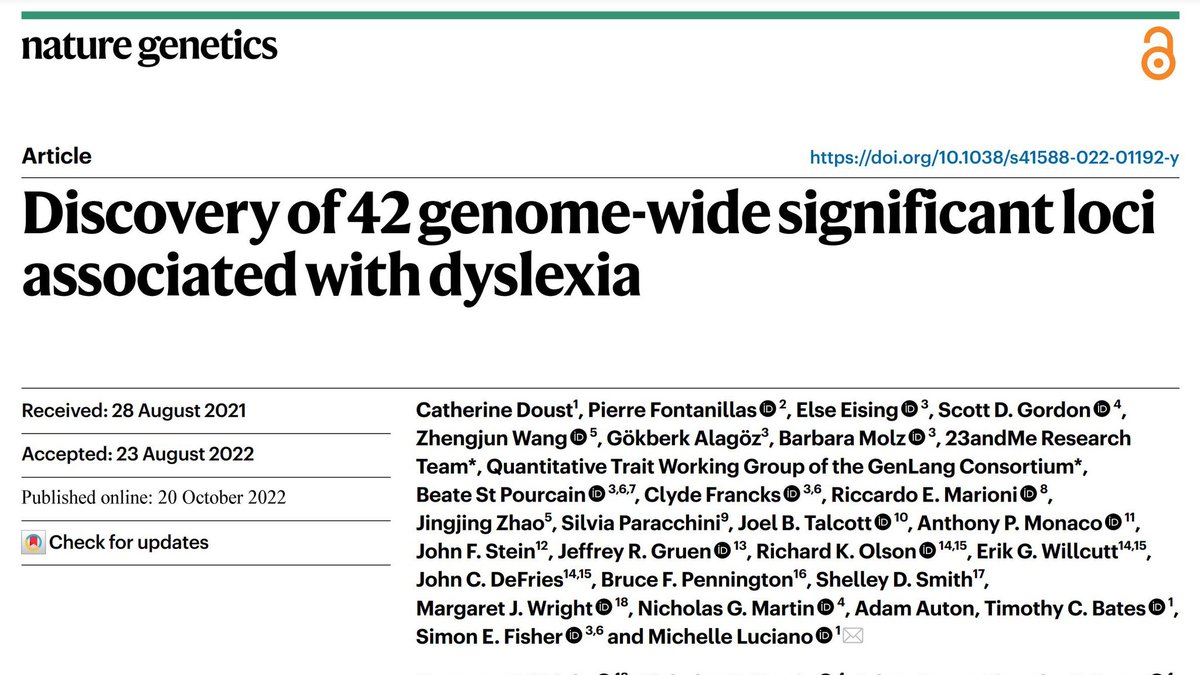
Out now in @NatureGenet, our study of DNA from 51,800 adults answering "yes" to question "have you been diagnosed with dyslexia?" compared to >1 million who responded "no", led by team of @drmluciano @EdinburghUni. We found 42 associated genetic loci. https://t.co/Uk3NuKiDiz 1/n
Out now in @NatureGenet, our study of DNA from 51,800 adults answering "yes" to question "have you been diagnosed with dyslexia?" compared to >1 million who responded "no", led by team of @drmluciano @EdinburghUni. We found 42 associated genetic loci. https://t.co/Uk3NuKiDiz 1/n
An international team of scientists, including researchers at the Max Planck Institute for Psycholinguistics has for the first time pinpointed a large number of genes that are reliably associated with dyslexia.
https://t.co/KgsW8bwj22
@ProfSimonFisher@23andMeResearch
@drmluciano
For more explanations about what molecular genetic research can & cannot tell us about dyslexia, please have a look at this FAQ website that we made to accompany the study: https://t.co/xaaiPMYXz0 13/13
Polygenic index from this work is too inaccurate for individual prediction & captured genetic effects might make different contributions in different learning environments. But scientists can use findings to test ideas about how nature & nurture interact as we learn to read. 12/n