The vision, the leadership, the dedication – they’ve left a legacy that will not only be remembered at #Afreximbank, but across the continent and the diaspora.
At #AAM2025, delegates from across the continent shared heartfelt words of gratitude for outgoing Afreximbank President, Professor Benedict Oramah.
From championing the Africa Credit Rating Agency to supporting creation of Afro Champion institutions like Lilium Capital, his leadership has transformed the African finance ecosystem.
One delegate recalled how Afreximbank’s capital has grown significantly under his leadership - a testament to his steadfast vision and commitment.
For many, this isn’t farewell, it’s a new beginning.
As Simon Tiemtore put it, “You will be freer to unleash more of that vision to help us Africans do what we need to do, to take back our continent.”
👏🏾 A job well done. A legacy built. A future inspired.
#GlobalAfrica #BuildingTheFuture #Leadership #AfricaForward
Read | African multilaterals must be given preferred creditor status if they are to fulfil their mandate of boosting economies.
https://t.co/14nPFiP71f
@afreximbank@_AfricanUnion@Prof_Mish
At #AAM2025, the message was unequivocal: Africa will not trade its financial sovereignty.
In a commanding plenary session, leaders tackled a pivotal question:
How can African institutions remain resilient amid tightening global finance and shifting geopolitics — and why must Preferred Creditor Status (PCS) hold?
PCS is not a courtesy. It is a legal, structural, and strategic imperative. It sits at the heart of Africa’s financial architecture ensuring our institutions can raise affordable, long-term capital to deliver real impact across the continent.
Key takeaways echoed with clarity and urgency:
PCS guarantees certainty; making African-led finance viable and effective. Undermining it weakens the entire development ecosystem.
It is backed by law; a treaty-based right, not subject to perception or preference. Challenging it is a direct affront to African legal sovereignty.
Bias was exposed — Afreximbank’s downgrade, despite PCS protections, is a clear example of systemic blind spots in global credit assessments.
African institutions are rising not as recipients, but as competitors. And that rise is disrupting outdated hierarchies in global finance.
Real impact was shown like the Standard Gauge Railway in Tanzania, financed by Afreximbank when others turned away. That is what serving Africa looks like.
Resilience goes deeper it’s not just about capital; it’s about robust governance, sound policy coordination, and legal integrity.
Africa is not asking for recognition. It is asserting it.
PCS must stand: not for prestige, but for the right to develop on our terms.
#AfricaFinance #PreferredCreditorStatus #FinancialSovereignty #Afreximbank #InstitutionalResilience #PanAfricanLeadership #LegalFrameworks #CreditRatings #DevelopmentInstitutions #MacroeconomicPolicy #AAM2025
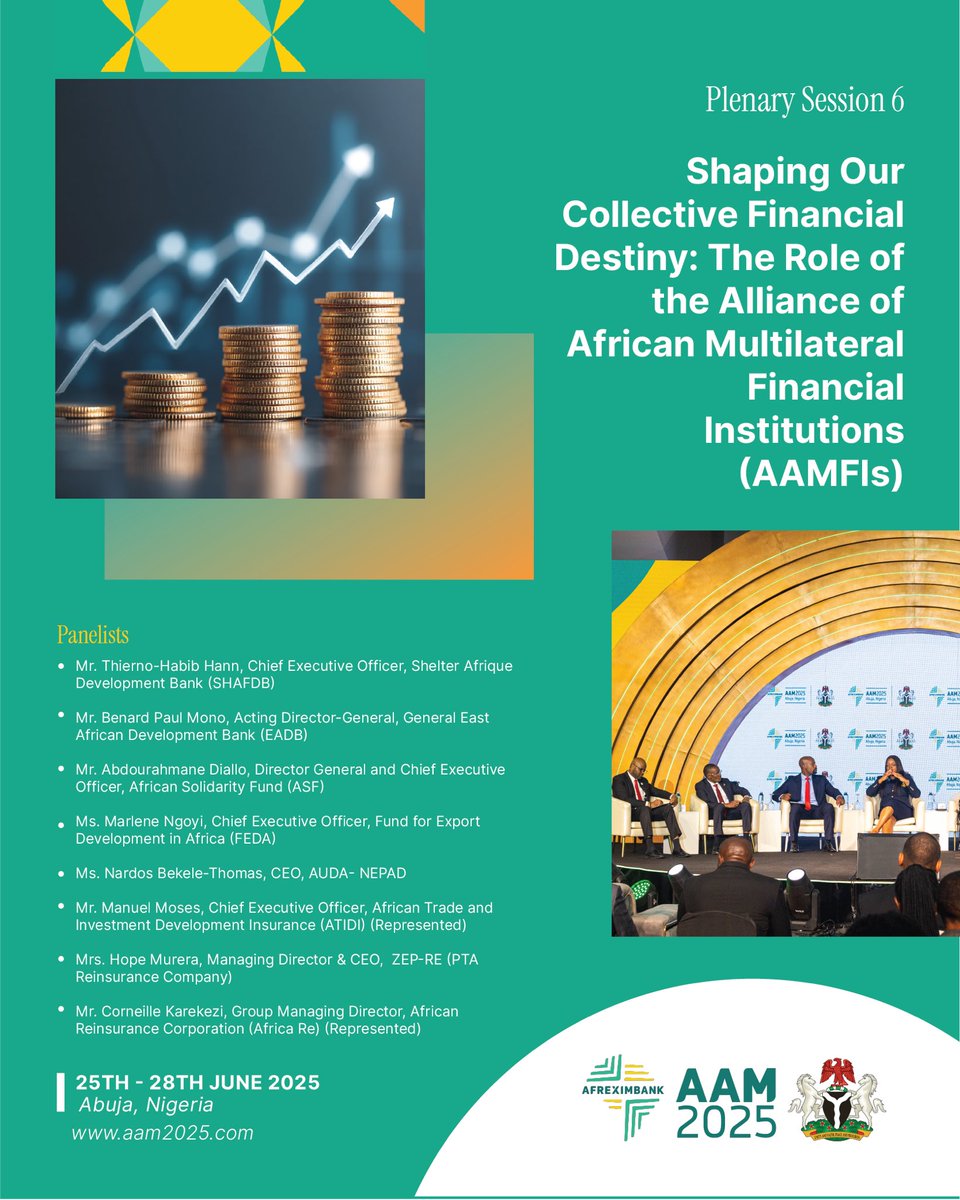
Plenary Session 6 at #AAM2025 explored:
“Shaping Our Collective Financial Destiny”
Panelists from top African financial institutions discussed how multilateral collaboration is key to the continent’s growth and resilience.
#Afreximbank#GlobalAfrica#AAMFIs#AfricanFinance #BuildingTheFuture
Last week, Zambia and Ghana reclassified Afreximbank from a preferred creditor to a commercial lender. This changes the terms of Afreximbank's loans to these countries, removing its priority repayment status over other lenders.
Read https://t.co/lWtRrXDzZ1
Eurobond Trap - Fact #4: African Debt Management Offices Outmatched in Bond Issuance
Most African debt management offices lack technical expertise in primary bond issuance, with minimal intelligence systems for market data or formal investor relations programs. Few have in-house quantitative analysts or pricing specialists to engage investment banks effectively during roadshows and negotiations. These offices struggle to challenge assumptions, simulate pricing, or conduct comparative market analysis with financial intermediaries.
Eurobond Trap - Fact 1: Overreliance on Western Advisors Costs Africa Billions
African sovereigns enter the Eurobond market with weak negotiating power, heavily reliant on a few Western investment banks as technical advisors for bond issuance. These banks prioritize their global investment clients, with incentives misaligned to secure the lowest yields for issuers. Thread
#AfCRA
Eurobond Trap - Fact #3: Political Pressure and Poor Timing of Bond Issuance
African governments often issue debt for political reasons rather than strategic timing, leading to rushed or poorly prepared market entries. This typically occurs when global debt costs rise, during election cycles, or amid financial strain from declining reserves.
Eurobond Trap - Fact 2: African Sovereigns Rarely Engage Investors Beyond Bond Issuances
Advanced economies regularly engage investors through briefings, roadshows, and timely reports. Most African governments do not interact with bondholders in the secondary market or monitor bond performance post-issuance. This disengagement creates a feedback loop where poor market intelligence leads to high coupons on new issuances.
African governments’ communication is often ad hoc and limited to new bond issuance periods, hindering investors’ ability to form informed, long-term views and resulting in a default risk premium in pricing.
@LennonMonyae@APRMorg@APRM_MarieRose@Thivhunets
📚Check out our latest publication on Africa's Sovereign Credit Rating Review! It compares how ratings are applied in Africa versus other regions and offers recommendations for improving credit ratings to Credit Rating Agencies and @_AfricanUnion member states.
Download here:https://t.co/fM9IfJScTV
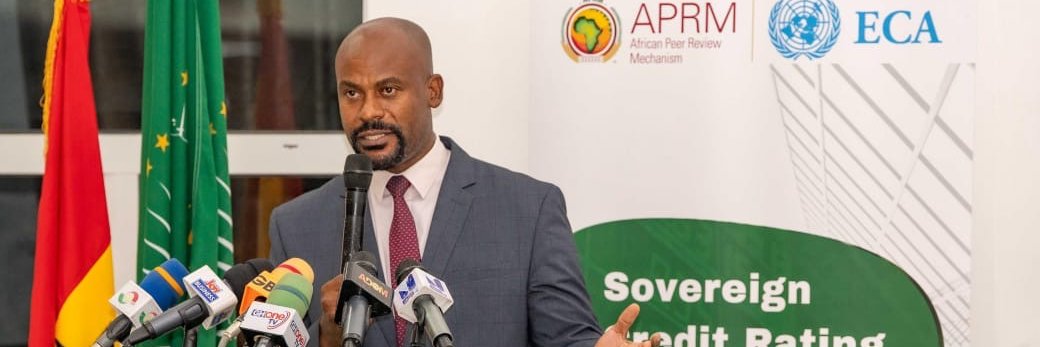
📢 Media Alert: 𝙋𝙧𝙚𝙨𝙨 𝘽𝙧𝙞𝙚𝙛𝙞𝙣𝙜 𝙤𝙣 𝙎𝙤𝙫𝙚𝙧𝙚𝙞𝙜𝙣 𝘾𝙧𝙚𝙙𝙞𝙩 𝙍𝙖𝙩𝙞𝙣𝙜𝙨 𝙒𝙤𝙧𝙠𝙨𝙝𝙤𝙥.
Join us this afternoon at 14Hrs (GMT) at the Ministry of Foreign Affairs for a press briefing ahead of our Sovereign Credit Ratings Methodology Transparency Workshop. We will update the public on the findings of our Technical Support Mission on credit rating to Ghana and progress on the establishment of the Africa Credit Rating Agency.
Representatives from APRM, @ECA_OFFICIAL , @GhanaMFA , and members of the media will attend.
Stay tuned for updates! #AfCRA
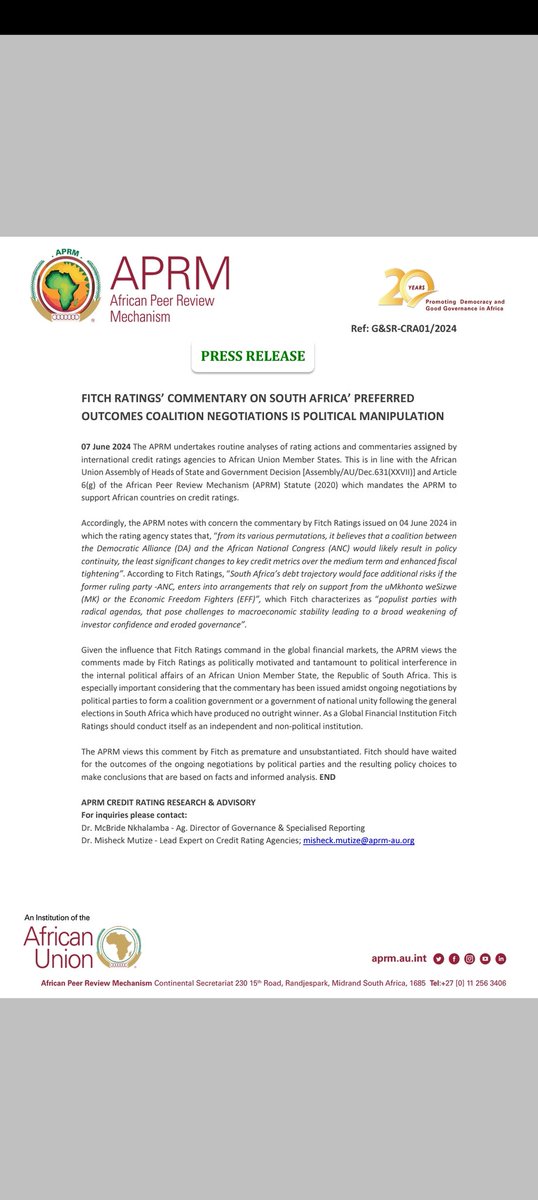
📍BREAKING | "The AU’s African Peer Review Mechanism (APRM) has denounced ratings agency Fitch for what it sees as inappropriate attempts to manipulate SA’s internal politics by suggesting that the ANC tie up with the DA to form a government."
@hmryder@FofackHippolyte We have done a couple of scientific studies showing evidence of inaccuracies in ratings to Africa. We also present empirical evidence in our Sovereign rating reports biannually.
📢 Tomorrow, the African Network of National Regulators on Credit Ratings will convene in Nairobi for their 2nd Meeting! 🤝 Organized in collaboration w/ @ECA_OFFICIAL , this gathering promises to foster collaboration & enhance credit rating regulations across Africa
Stay tuned