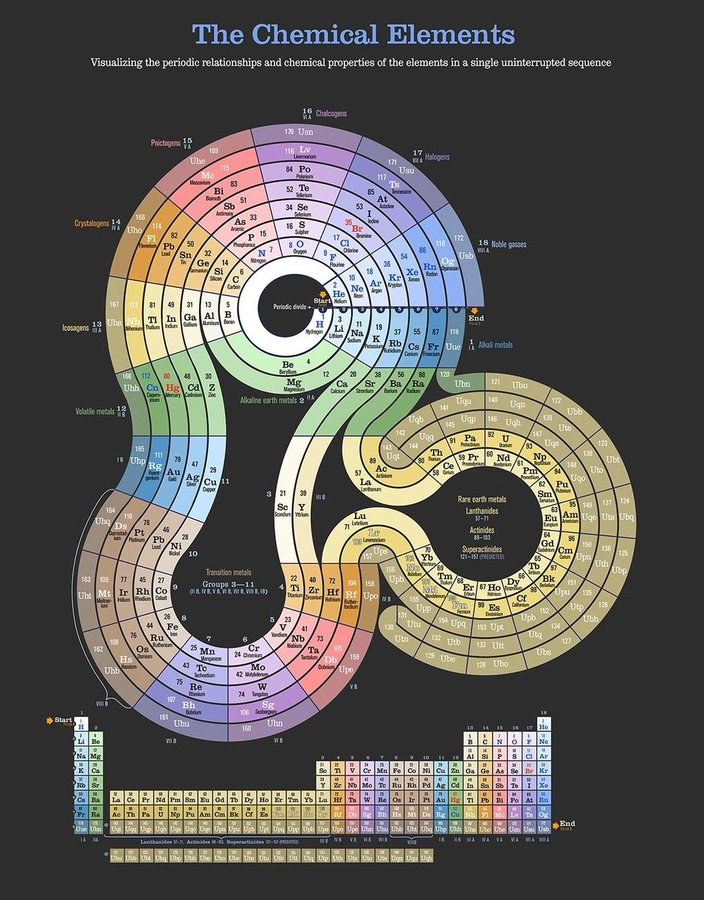
Theodor Benfey created "Spiral Periodic table" in 1964.
The elements in this spiral is a 2D spiral starts with hydrogen in the center and flows outwards as the atomic number increases.
In 2014, a woman won the Fields Medal for the first time since it was established.
Her story is fascinating because she was representing ordinary girls from all over the world.
Her name was Maryam Mirzakhani, and she was from Iran.
When Maryam was studying in Iran, there were separate schools for boys and girls. This did not make it easy for her to pursue science.
Still, she did not give up. She worked hard and became one of the first Iranian girls to take part in the International Mathematical Olympiad, where she won a gold medal. The following year, she won another gold medal.
She completed her early studies in Iran and later went to the United States, where she earned her PhD from Harvard University in 2004.
Ten years later, she was awarded the Fields Medal for her important work in the geometry of Riemann surfaces and their moduli spaces.
Stories like hers help inspire more women to be included in the world of mathematics.
I like pages from old articles on science and math. Here, the 1911 publication date gives the page a historical allure. Reading something from over a century ago (especially in a magazine like Popular Science Monthly that aimed to bridge cutting-edge science with public understanding) feels like uncovering a hidden gem.
The continued fraction displayed on the page is famously associated with the golden ratio (φ), which in turn governs logarithmic spirals: seen in the arrangement of sunflower seeds, pinecones, and flower petals. These naturally arising spirals are visually beautiful and mathematically profound. They're also aesthetically timeless.
From Popular Science Monthly, Volume 79, 1911
Phi (Φ) ✍️
This diagram illustrates a neat method to create the golden ratio, known as Phi (Φ). Three circles are arranged side by side on a straight red baseline. The left circle is 1 unit tall, marked by the vertical line from A to B. The total length from A to C measures 2 units. A blue line starts at B, lightly touches the middle circle at D, and ends at E on the right circle. This thoughtful arrangement of touching circles and the diagonal blue line ensures that the length BE equals the golden ratio, approximately 1.618. In simple terms, by using basic circles and lines with heights and lengths of 1 and 2, the image naturally produces the golden ratio without any complex math. It visually demonstrates how this unique proportion appears in geometry.
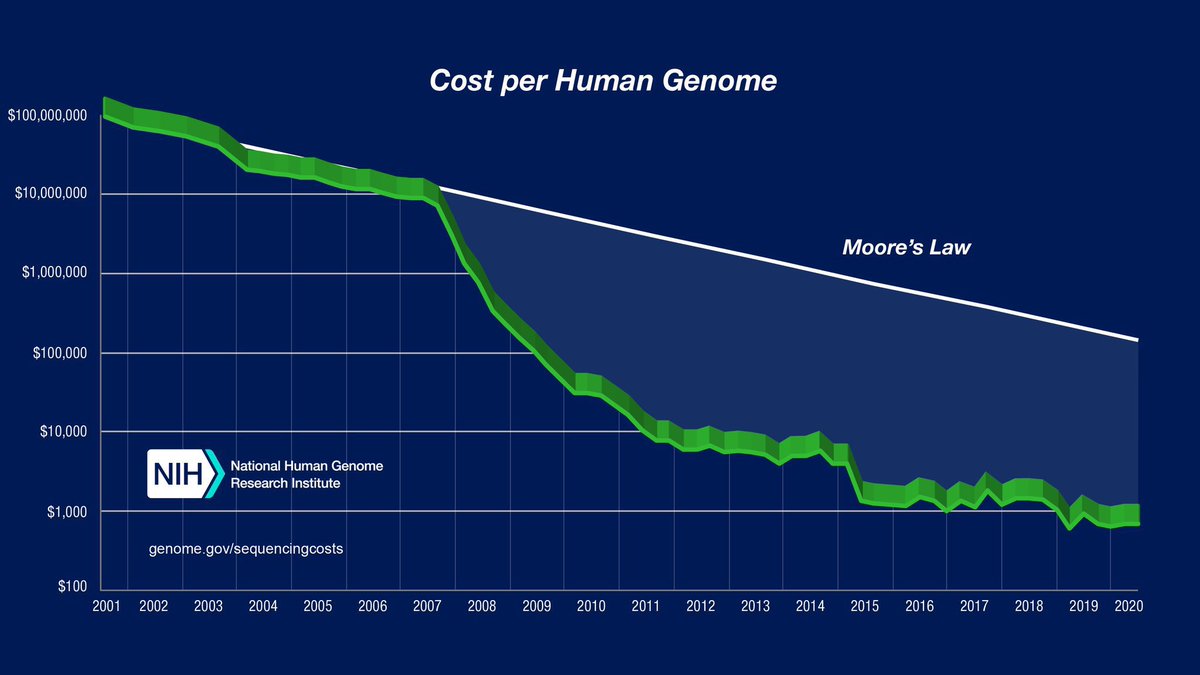
In 2000, the first human genome sequence cost between $500M & $1B
In 2006, the cost was $20M
Two years ago, the cost is around $600.
Now it is $100.
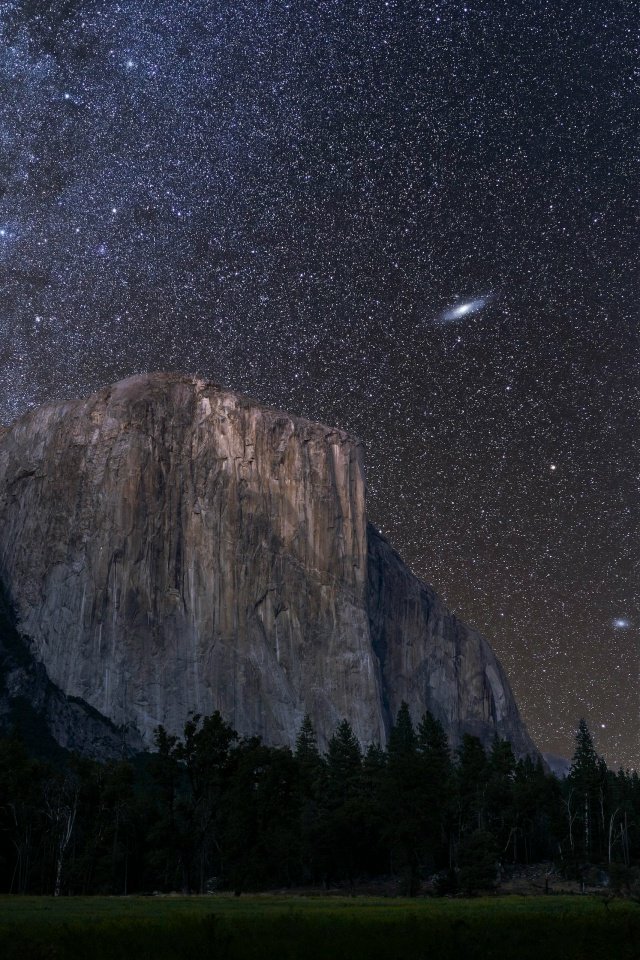
While attempting to photograph the iconic El Capitan in Yosemite National Park, a photographer captured something truly extraordinary—the Andromeda Galaxy! 🌌
📸 jtmess
How much of planet Earth is made of water? Very little, actually. Although oceans of water cover about 70 percent of Earth's surface, these oceans are shallow compared to the Earth's radius. The featured illustration shows what would happen if all of the water on or near the surface of the Earth were bunched up into a ball. The radius of this ball would be only about 700 kilometers, less than half the radius of the Earth's Moon, but slightly larger than Saturn's moon Rhea which, like many moons in our outer Solar System, is mostly water ice. The next smallest ball depicts all of Earth's liquid fresh water, while the tiniest ball shows the volume of all of Earth's fresh-water lakes and rivers. How any of this water came to be on the Earth and whether any significant amount is trapped far beneath Earth's surface remain topics of research.
Illustration Credit: Jack Cook, Adam Nieman, Woods Hole Oceanographic Institution; Data source: Igor Shiklomanov
A 2024 Science study in mice identifies a novel non-synaptic signaling mechanism between the brain and peripheral sensory system important for migraine.
Learn more: https://t.co/JXFEOy9hdF #SciencePerspective