"Short term speculation doesn't work"
Is what I sometimes hear. Mostly from academics who spent all their life in university.
Nothing I deem wrong. But of course they'd never teach you trading there.
Trading isn't academics.
It's where academics end and real life begins.
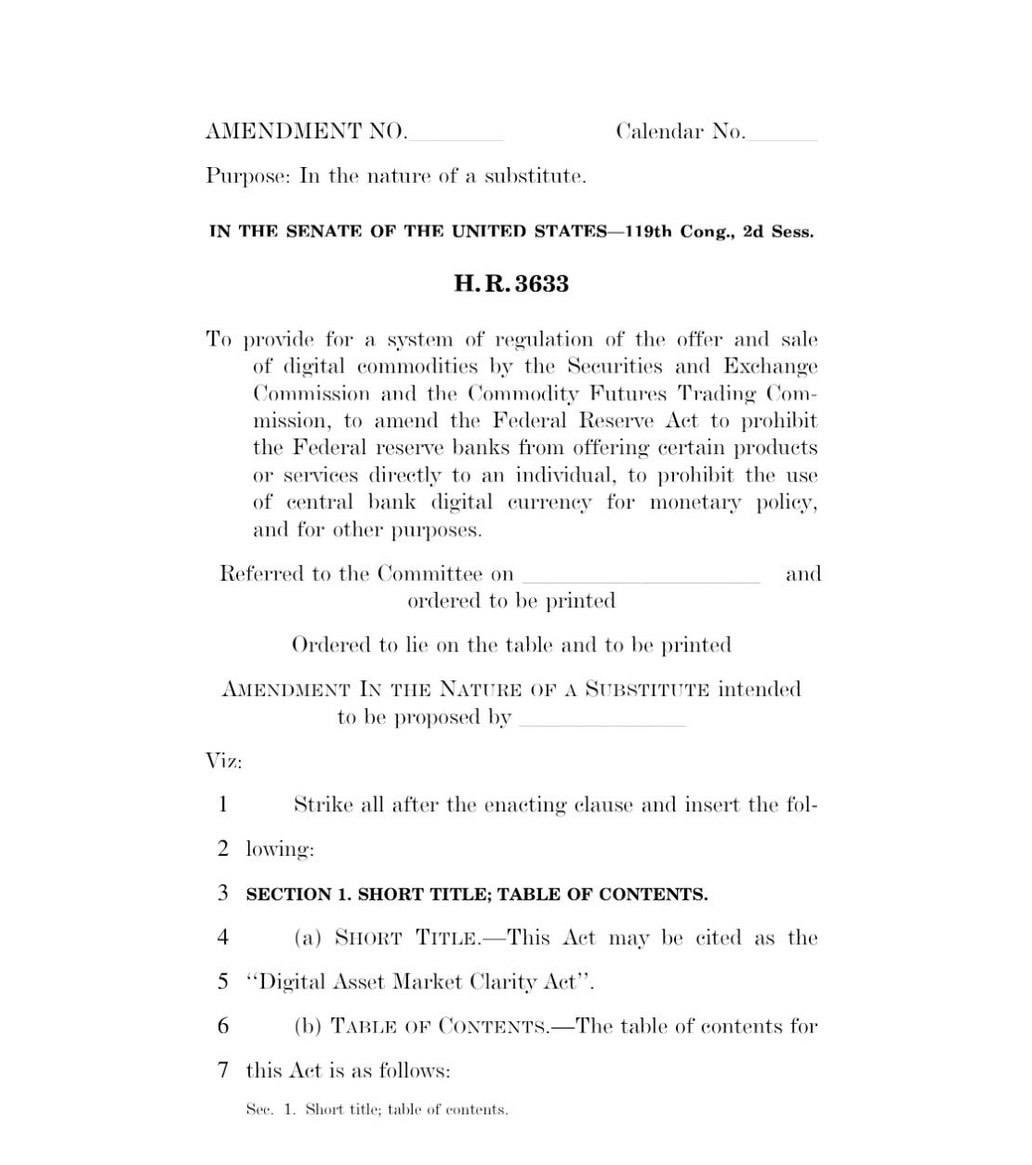
Nancy Pelosi made millions off stock trades in Congress and fought a trading ban for years. President Trump is voluntarily binding himself to the Clarity Act's conflict-of-interest rules on digital assets in ways she'd never apply to her own bottom line. Ask yourself who actually believes in accountability.
JUST IN: 🇺🇸 Asset manager Grayscale announces its support in the passage of The CLARITY Act:
"The CLARITY Act may soon clear the Senate if bipartisan negotiators can make progress on a few remaining issues." 👀
I visualized six large DeFi transactions from the past month.
Different protocols. Different assets. Different user flows. Yet when serious liquidity moves, the route keeps converging on the same place.
Efficiency isn't negotiated. Markets discover it. That's how DeFi works today.
@CurveFinance
I visualized six large DeFi transactions from the past month.
Different protocols. Different assets. Different user flows. Yet when serious liquidity moves, the route keeps converging on the same place.
Efficiency isn't negotiated. Markets discover it. That's how DeFi works today.
@CurveFinance
LATEST: Goldman Sachs CEO David Solomon said he supports advancing the CLARITY Act despite acknowledging the legislation is "not perfect."
Read the full story from @HeleneBraunn on CoinDesk.
Let me be clear about the CLARITY Act
From my perspective as a criminal defense lawyer, the failure of the CLARITY Act to pass and get signed into law would likely be a win for my bottom line. The absence of a crypto market structure law would leave in place the very regulatory vacuum that has driven crypto enforcement for the past decade—a landscape where the government proceeds case by case, stretching securities statutes written in the 1930s to fit digital assets and resolving through litigation and prosecution what Congress has declined to settle by statute. Legal uncertainty, in short, is bad for the market but good for my caseload—and the CLARITY Act's stalling keeps that uncertainty firmly in place.
But despite the fact that clear legislation might trigger a drop in the crypto-related criminal cases that drive my caseload, I want the CLARITY Act to pass—and here's why.
My interest in a functioning market ultimately outweighs my interest in a chaotic one. A regulatory vacuum doesn't just generate defense work; it generates victims—retail investors wiped out by frauds that flourished precisely because no one could say clearly what was legal, builders who went to prison for conduct that a coherent statute might have permitted, and an entire industry forced to guess at the rules and often guess wrong. A legal order that manufactures casualties out of confusion isn't good for anyone in the long run—not the market, not the public, and not the lawyers who make their living in its wreckage.
And that is why passage of the CLARITY Act is ultimately good for consumers, for America, and for crypto itself.
For consumers, a defined framework means the protections that ambiguity has denied them: clear disclosure obligations, a known regulator to turn to, and bright lines that let ordinary investors distinguish a legitimate project from a scam before their savings are gone rather than after.
For America, it means reclaiming the ground the country ceded by governing through enforcement instead of law—ending the exodus of builders and capital to friendlier jurisdictions, restoring the United States as the place serious innovators want to operate, and reasserting that Congress, not a patchwork of after-the-fact prosecutions, sets the rules of the road.
And for crypto, clarity is the precondition for legitimacy: an industry that has spent a decade defending itself against the charge of being a lawless casino finally gets the chance to be treated as a mature asset class, with the regulatory certainty that unlocks institutional adoption, banking access, and mainstream trust.
The paradox is only apparent. What looks like a loss for a defense lawyer's caseload is a win for the very things the law is supposed to serve—and a legal system that produces fewer victims, a stronger country, and a healthier market is one I'm glad to see arrive.
But wanting the law to arrive and watching it actually arrive are two very different things—and the CLARITY Act's journey from principle to statute has been anything but clear.
The CLARITY Act passed in the House 370 days ago with a margin of 160 votes. After clearing the House in July 2025, the CLARITY Act moved to the Senate, where it has stalled amid partisan disputes over stablecoin yield, ethics restrictions, and DeFi and self-custody protections. The White House's target of a July 4, 2026 signing ceremony came and went because Senate Republicans failed to persuade enough Democrats to cross the aisle and overcome the 60-vote filibuster threshold.
Now, the CLARITY Act is up against a narrow window before Congress breaks for the August recess. In an effort to thread that needle, lawmakers and White House officials have tried to reach a compromise on the most contentious section—ethics limitations on what Trump, his family, and other federal elected officials can do in crypto. This week a meaningful compromise was proposed.
On July 20th, the White House reached an agreement on an ethics/conflict-of-interest package with President Trump personally signing off on a provision designed to bar senior officials from holding or profiting from digital assets they regulate—a concession notable because it curtails Trump's own crypto activities, following his disclosure of more than $1 billion in crypto income last year. A White House official called it the most comprehensive ethics provision in history and pushed Senate Democrats to accept it before the August 7 recess.
This morning Senate Republicans released an updated version of the CLARITY Act which included the proposed ethics language that the White House approved. Sentiment across crypto Twitter turned and the odds of the CLARITY Act passing started to jump on prediction markets.
But by late this afternoon seven Democratic senators—Alsobrooks, Booker, Cortez Masto, Gallego, Hickenlooper, Warner, and Warnock—released a statement declaring that the Republican-proposed CLARITY Act text as it currently stands falls short, citing weak provisions on ethics for elected officials, consumer protection, illicit finance, conflicts of interest, and market integrity. They said they've been working in good faith with Republicans for the past year and will keep negotiating to strengthen the bill and get it over the finish line, signaling that the current draft lacks the Democratic support needed to reach the 60-vote threshold.
So the paradox I opened with resolves, for now, into a stalemate. The one provision that would have curtailed the President's own crypto activities wasn't enough to win the seven votes the bill needs, and the same ethics, consumer-protection, and market-integrity gaps that make me a living are the ones keeping CLARITY off the Senate floor.
The window before the August recess is closing fast, and if it shuts, the regulatory vacuum I described—the one that generates victims faster than it generates clients—survives another year, maybe until 2030 by some senators' math.
The House did its part 370 days ago. The Senate needs to finish what the House started and get this bill to the President's desk. Otherwise, the consumer, the country, and crypto all lose—and the only winners will be lawyers like me who profit from the confusion, which is exactly the wrong reason for a law this important to fail.
This will be huge for @ripple and $XRP - 🇺🇸 UPDATE: Goldman Sachs CEO David Solomon says it’s time to advance the CLARITY Act. Expect some bigger announcements today!