Family Guy | Founder - E3 Performance Lab | Human Performance Scientist | ex-McKinsey | Ex-Start-up Accelerator CEO | Ex-Professor | Black Belt | Bike Racer
Get to know Instructor Blain Harrison and see how the online M.S. in Applied Physiology and Kinesiology at University of Florida can take your skills to the next level. Fully online, STEM-focused, and finish in just 1 year full-time—no GRE needed.
Learn more: https://t.co/Vrm7gul2HM
@Polymarket A smart addition would be to include his daily recovery score since his stress might be higher on a particular day just because HIS physiology is compromised. A simplistic approach that’s going to create a bunch of false positives and bad decisions.
Most people don’t know who they are.
They know their résumé. Not their patterns.
Identity = what shows up under pressure.
Answer the question: "Do I know who I am?" here:
https://t.co/qLuGgZDeWx
Most performance advice is tactical.
Work harder.
Optimize your schedule.
Dial in your routines.
That works—for a while.
At higher levels, performance problems aren’t tactical.
They’re structural.
In F1, a car can be fast…
But if the system isn’t aligned, it runs hot, burns fuel, and falls apart over time.
The same thing happens with people.
Three questions that determine how far (and how long) you can perform:
• Do you know who you are?
• Do you know what you want?
• Are you in control of your life?
Most people don’t fail.
They drift.
If performance feels harder than it should, this might be why.⬇️
https://t.co/XS5GcWcXkM https://t.co/XS5GcWcXkM
Most performance advice is tactical.
Work harder.
Optimize your schedule.
Dial in your routines.
That works—for a while.
At higher levels, performance problems aren’t tactical.
They’re structural.
In F1, a car can be fast…
But if the system isn’t aligned, it runs hot, burns fuel, and falls apart over time.
The same thing happens with people.
Three questions that determine how far (and how long) you can perform:
• Do you know who you are?
• Do you know what you want?
• Are you in control of your life?
Most people don’t fail.
They drift.
If performance feels harder than it should, this might be why.
"The Core": Three Questions That Shape How We Perform Every Day https://t.co/XS5GcWcpve
Most performance advice is tactical.
Work harder.
Optimize your schedule.
Dial in your routines.
That works—for a while.
At higher levels, performance problems aren’t tactical.
They’re structural.
In F1, a car can be fast…
But if the system isn’t aligned, it runs hot, burns fuel, and falls apart over time.
The same thing happens with people.
Three questions that determine how far (and how long) you can perform:
• Do you know who you are?
• Do you know what you want?
• Are you in control of your life?
Most people don’t fail.
They drift.
If performance feels harder than it should, this might be why.
"The Core": Three Questions That Shape How We Perform Every Day https://t.co/XS5GcWcpve
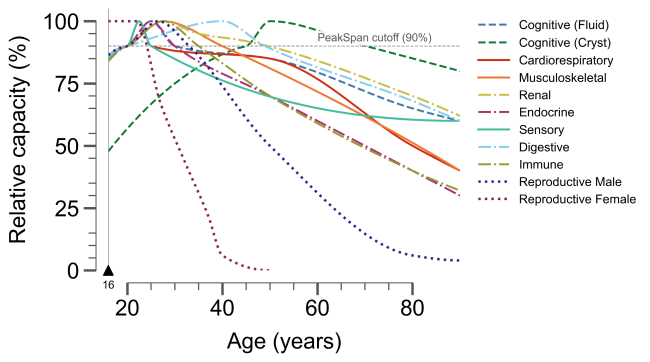
Instead of "healthspan," we should be thinking about "Peakspan."
How long can you maintain ~90% of your peak physical or cognitive function?
According to a new paper, different systems reach their “Peakspan” at very different times.
Fluid cognitive abilities like processing speed and working memory peak early, around ages 20–30, while crystallized intelligence doesn’t peak until the late 40s or early 50s and can remain stable into the 70s.
Cardiorespiratory fitness peaks from adolescence to the mid-20s and then declines steadily, while muscle strength peaks in early adulthood and falls sharply after 60. Bone density, kidney function, hormone levels, sensory function, immunity, digestion, and reproductive capacity all follow their own trajectories too—some peaking in the 20s, others in the 40s or 50s.
In other words, human aging is asynchronous. We don’t simply age “overall,” but instead age system by system.
It’s called a whoop. There’s no story here other than a dead ayotallah and a green recovery.
Whoop is an NSA approved PED without a microphone, without GPS, and without cellular capability. World leaders wear it to monitor their performance. Get your facts right.
On my bike ride this morning, it struck me that a good exercise strategy for almost anyone, except a world-class competitive athlete or similarly elite operator, comes from the Toby Keith song “As Good As I Once Was” (2005):
I ain't as good as I once was
But I'm as good, once, as I ever was
Translation:
It’s OK that, as we get older, our typical performance in a workout (or recovery) doesn’t match our younger self. Physiology comes for us all, and checking our ego prevents burnout and injury.
However, it pays to go hard enough once in a while to approach our all-time best performance to stave off the rapid decline that can come from not pushing hard enough.
Mostly Zone 1-2 (build the size of your engine), sometimes Zone 3-4 to nudge lactate threshold (get used to being “comfortably uncomfortable” for metabolic flexibility), very occasionally “See God” to protect top-end capability (“open the valves”) and mental toughness.
Keep your easy days truly easy so your “See God” days can be truly hard!
Burnout isn’t a motivation problem.
It’s a systems problem.
Most high performers run on borrowed energy…
and are shocked when the bill comes due.
I just published a new essay on performing under real constraints—not hustle or motivation, but energy, time, stress, and durability.
🔗 https://t.co/donRsm5kq6
#HighPerformance #Burnout #EnergyManagement #Productivity
This post explains what my Substack, 10X'ers: Using Sports Science to Build Better Companies, is for, what it isn’t, and why most high performers quietly run into the same problems.
It’s about running the season — not surviving the week.
If you want to kill it without killing yourself, start here.
https://t.co/c5e9KGiGOu
On Scott Adams.
A man finds, to his astonishment, that he exists. After the elation of childhood wears off, he asks, who am I, why am I here, how does this work? These are hard questions, so after a brief struggle, he selects a readymade answer and goes about the motions of life.
Scott Adams was not such a man. He was a live player, ever curious, intent on figuring out this simulation that he found himself in. From first principles, Scott unraveled, understood, and ultimately controlled his own reality. He hacked himself with affirmations, others with persuasion, the world with simultaneous sips. He explained people as moist robots, two movies happening on one screen, his world as Gods’ debris. He carved a personal mission to “be useful,” and made us all better writers, public speakers, and persuaders. He preached the footwear theory of motivation, the Adams Law of slow-moving disasters, the skill stack, systems over goals, and of course, the Dilbert Principle.
Besides cartooning, philosophizing, and teaching, Scott rose to the occasion and displayed, “the one virtue that cannot be faked” - courage. Scott had the courage to speak honestly as he saw it - about Trump, about his nation, and about his time, even though it cost him friends, audience, money, and his ticket to polite society. Scott had true courage, the kind that makes you unpopular, the kind that is always and everywhere in short supply,
At the end, as any hacker of reality, Scott covered all of his bases - he left as a Buddhist, a Christian, and a player in the Simulation.
Scott, we didn’t get enough time with you, but you were a mentor and a marvel. You were useful and you were courageous. You were incompressible and indivisible. One of a kind, and generous with your drawing, writing, and speaking. Unlike your squealing critics in the chattering class, you will be read generations from now.
On this earth there are many long-lived hells but no lasting heaven. Each heaven must be created and nurtured, ex-nihilo, from mind and from mud. Scott, you created a small heaven for us all, and to a larger heaven you go.
A man finds, to his astonishment, that he no longer exists. He asks why, what it was for, and how will the new reality work? When the rest of us get there, we’ll find Scott, ever useful, ready to explain, having figured it all out.
Notes:
• First line paraphrasing Schopenhauer.
• Courage quote via Taleb.
@anothercohen@anothercohen Paradoxically, in an age of AI, one of the last remaining competitive advantages for companies will be optimizing talent performance, particularly focused on those generating the biggest impact (e.g., profit centers). How are you intervening for those not at peak?
Listening to Rat Pack Radio on @Spotify. I feel sorry for a whole generation that doesn’t appreciate the greatness of Frank, Dean, Sammy, and the lyricists, composers, and musicians who supported their talents. #ratpack
Dream dinner line-up: @JeremyClarkson, @JerrySeinfeld, @rickygervais, and @davidgoggins. One, to see if they can make Goggins laugh. The other, to go deep on the discipline of greatness. Guys: Name the time and place, and I’ll pay!