My Bro/Sis, you see that thing you’ve been waiting on God for and almost thinking it would never happen, eh? very soon, much sooner than you think, It will happen. And you will come back to this particular tweet, to say “IT HAS HAPPENED.” IN JESUS’ NAME.
You are blessed !
SIM-swap fraud remains a major concern in Nigeria’s digital economy despite years of industry discussions and regulatory efforts. Now, MTN Nigeria says it has a long-term solution that could help tackle the problem.
https://t.co/dATZzYSTyi
Can structured venture capital unlock Nigeria’s underserved markets?
Join us on X Spaces tomorrow at 5 PM WAT as we explore opportunities beyond Lagos.
Set a reminder to join the conversation: https://t.co/OOYPnrTGVX
@Queeneth01olx@oma22k It's not after 90 days. You line has to be inactive for 365 days for a network provider to churn it. ALSO, with just N1,000 you get to keep your number if you're travelling or won't be making any activity on the line.
Interswitch, Flutterwave, and Paystack trace back to the 2001 GSM licence auction. From 400,000 phone lines for 120M people to 10M subscribers in four years. Today, Nigeria has the Africa largest fintech market.
https://t.co/07ebqqrYl4
A fake audio went viral before Nigeria’s 2023 election. It was a deepfake.
Now 2027 is closer, and AI makes it easier to spread fake voices, videos, and results fast, especially on WhatsApp.
Read the full breakdown of what needs to happen before 2027 election: https://t.co/4R7Aoa99GK
After Xara went viral, this Nigerian founder caught the attention of Elon Musk’s xAI. Built as a WhatsApp banking assistant, the startup now has 45,000 users and ₦8 billion in transactions.
https://t.co/TNdaUixR13
Education is one of the toughest sectors to build in and one of the most important to get right.
Join us this Pitch Friday as founders and leaders share what works in African edtech.
Register to attend for free: https://t.co/NUkyKih1Of
Nigeria’s first private phone call was made on a CDMA network in 1998. By 2022, CDMA had 0% market share. Here’s how it all declined.
https://t.co/txD5BdRzuj
Remote work in Nigeria comes at a high cost.
Some tech professionals spend up to ₦390,000 monthly on power to stay online, highlighting the infrastructure challenges behind global work.
What does this really mean for remote tech workers? Get the full insight here: https://t.co/age2Z3D49s
In this edition of After Hours, Eunice Olubayo shares the challenges of pursuing a career in space despite limited opportunities.
https://t.co/y2G0qlbPfU
Africa already shapes global social media through its content and creativity. The next step is structural: building platforms that capture value, amplify African narratives, and compete globally.
https://t.co/aszBveazYU
Help us serve you better 💙
Take 3 minutes to tell us what you love, what you want more of, and how we can improve.
Lovers of Techpoint Africa, this is your chance to shape the content you see.
Share your thoughts here: https://t.co/NFln5nJQIi
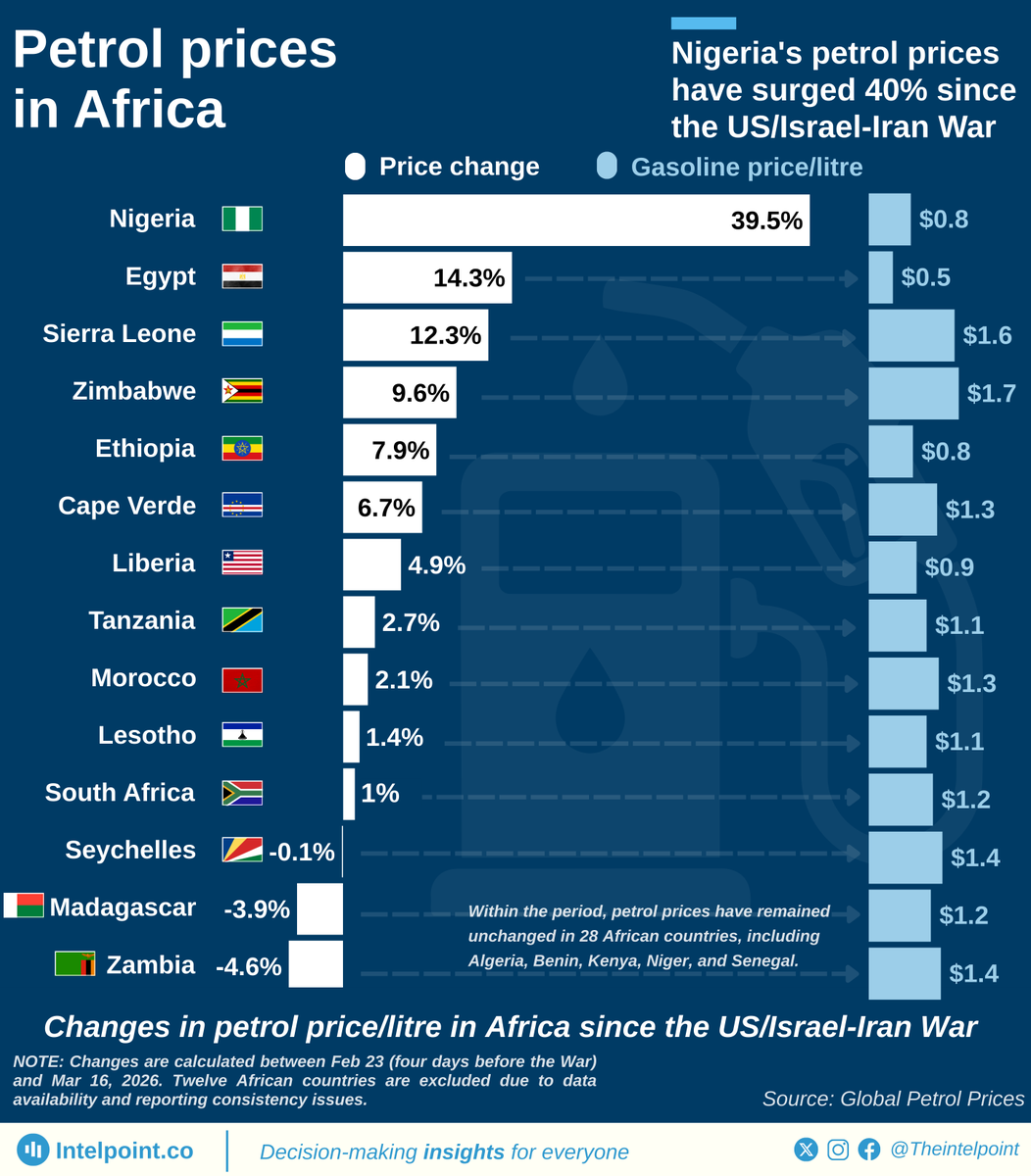
Global tensions often ripple through energy markets, but the recent price movements show that the impact has not been evenly distributed. Since the start of the US/Israel-Iran War, petrol prices in Nigeria have surged by about 39.5%, the largest increase in Africa.
Across Africa, the pattern is mixed. Some countries have seen moderate increases, while others have experienced minimal changes or even slight declines. The disparity highlights how fuel pricing structures, subsidy policies, exchange rates, and supply chains shape how global shocks filter into domestic fuel markets.
Geopolitical conflicts involving major oil-producing regions often create uncertainty in global crude markets. The current war involving the US, Israel, and Iran has added pressure to energy supply expectations and shipping routes. While these tensions broadly affect global oil prices, the local policy environment and market structure determine how sharply prices move in each country.
From Olusegun Obasanjo’s early victories in the Nigerian presidential elections to Bola Tinubu’s 2023 win, the share of votes secured by the winner of the election has declined. Tinubu’s 36.6% share of valid votes is the lowest since 1999, continuing a downward trend that has been building for over a decade.
The absolute number of votes has also dropped sharply. While earlier winners like Umaru Musa Yar'Adua and Goodluck Jonathan secured 22–24 million votes, recent winners like Muhammadu Buhari and Tinubu have seen that number fall to 15 million, then to under nine million.
This decline occurs despite a growing population and rising voter registration, suggesting that turnout, voter engagement, and vote distribution have shifted significantly.
Another layer to this story is the number of candidates. In 1999, there were just two candidates, making it easier for votes to consolidate. By 2019, that number had surged to 73 candidates; in 2023, there were 18 candidates on the ballot. This expansion has split votes among more contenders, meaning the “other candidates” now collectively command a larger share of the vote than in earlier elections. In 2023, for instance, over 63% of valid votes went to candidates who lost.
As Nigeria drafts its AI strategy, Ghana and South Africa offer key lessons on what works, and what doesn’t, highlighting that success depends less on policy design and more on execution, governance, and institutional capacity.
https://t.co/Xp1X4rNb8x
Nigeria’s unreliable electricity is making remote work expensive for tech pros, with some spending up to ₦390,000/month on generators and inverters. Rising fuel costs and grid issues are hitting productivity.
https://t.co/Yc9xVmhqSv