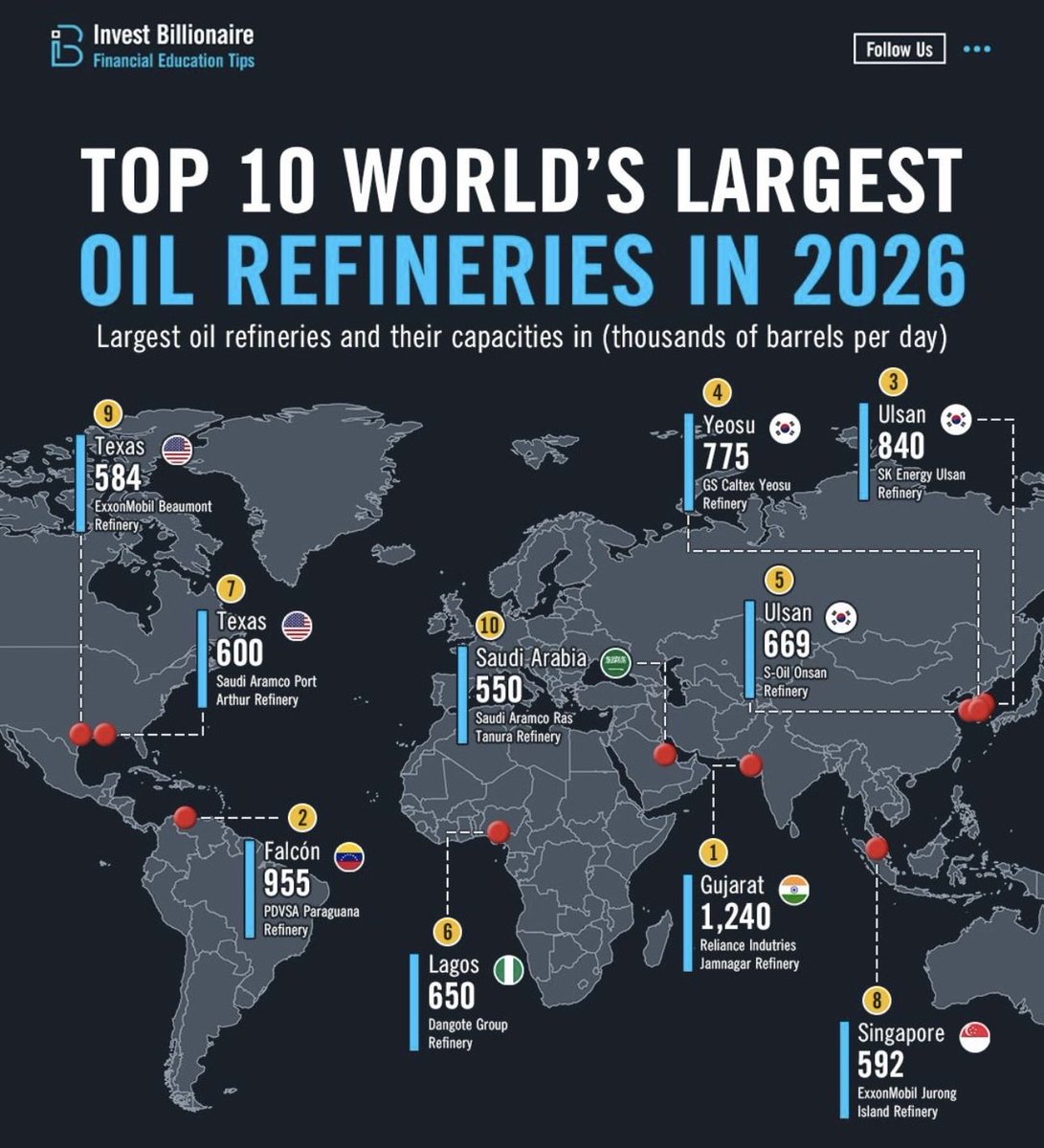
Refining Capacity Is Strategic Power🛢️🏭
Crude oil only matters if you can turn it into usable products.
That is why refineries are so important.
-Gasoline
-Diesel
-Jet fuel
-LPG
-Naphtha
-Petrochemicals
The world’s largest refineries are not just industrial assets.
They are strategic chokepoints in the energy system.
India, South Korea, the US, Nigeria, Singapore, Saudi Arabia, and Venezuela all show the same thing:
Energy security is also about having the capacity to process it.
AI infrastructure is becoming a power trade, not only a chip trade
The Defiance AI & Power Infrastructure ETF, $AIPO, focuses on companies building the physical backbone required for AI data centers: power generation, grid equipment, cooling systems, construction, utilities, nuclear fuel, and AI hardware.
The fund has around $780M in AUM and holds 78 companies. Its structure is different from many AI ETFs because it is not dominated only by software or semiconductor names. Industrials account for about 56% of the portfolio, followed by technology at 19% and utilities at 16%. U.S. companies represent roughly 88% of holdings.
The top holdings show the theme clearly.
$PWR, $ETN, $GEV, and $VRT are the largest positions. Their roles are tied to transmission lines, power management, turbines, cooling, backup systems, and electrical equipment. In other words, they support the infrastructure layer behind AI compute.
$BE adds exposure to on-site fuel cells, which can help data centers bypass grid bottlenecks. $CCJ and $CEG add nuclear exposure, which is becoming more relevant as hyperscalers look for reliable, carbon-free baseload power.
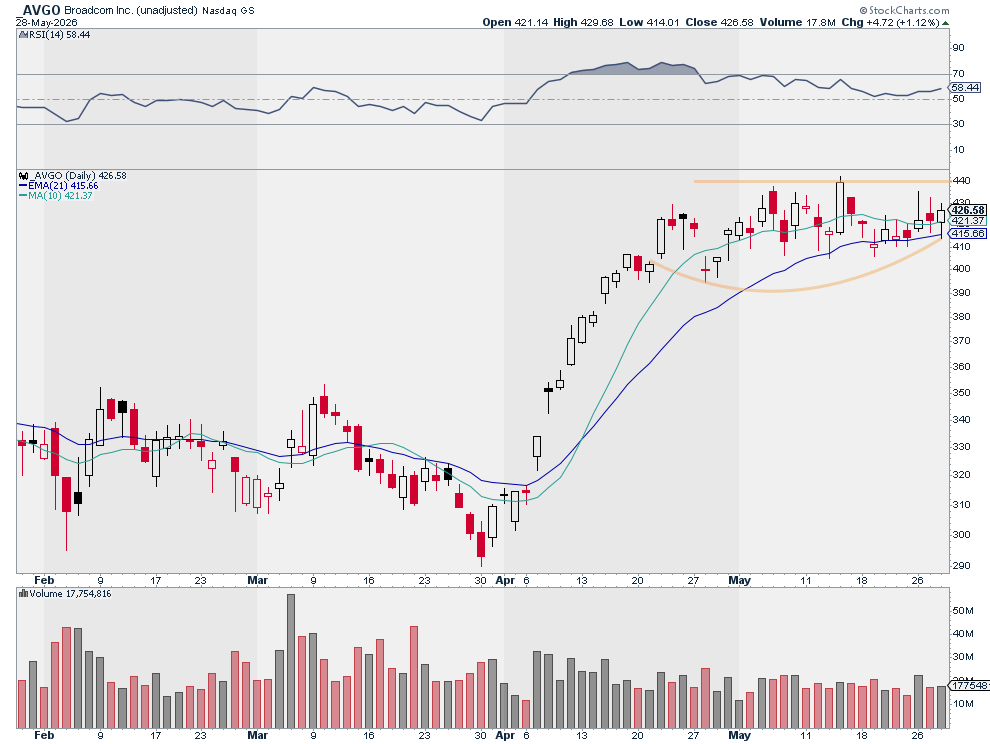
The ETF also includes AI hardware and connectivity names such as $AVGO, $NVDA, $AMD, and $MRVL. These companies support GPUs, custom accelerators, networking, and data movement inside large AI clusters.
Smaller holdings like $STRL, $MTZ, $NVT, $HUBB, $VST, and $GNRC broaden the portfolio into site development, transmission construction, rack enclosures, power distribution, merchant power, and backup generation.
AI demand is creating pressure across the entire physical stack. More models require more data centers. More data centers require more electricity, cooling, transmission, and backup power.
$AIPO offers a concentrated way to track this infrastructure theme. The main risk is that many holdings already reflect strong AI-related expectations, so valuation discipline still matters.
One of the biggest requests I’ve gotten is for more short-form video content, so we launched a new FE YouTube series with 5–10 minute earnings breakdowns and company deep dives.
So far, we’ve covered:
• Everything you need to know about the SpaceX IPO
• Why $MELI is one of the best opportunities in the market
• Why Jensen Huang thinks $MRVL can 5x to a $1T valuation
• How $TE, $NVTS & $IREN fits into the AI power bottleneck
• Earnings reactions for $PLTR, $DOCN, $AMD, $ARM, $DDOG, $TMDX, $ASTS, $HIMS, $NBIS, $EOSE, $ONDS, $ZETA, $SNOW, $AVGO & $NVDA
I plan to keep posting 5-6 videos per week so let me know which earnings or companies you want me to cover next!
"If all you ever did was buy high-quality stocks on the 200-week moving average, you would beat the S&P 500 by a large margin over time. The problem is, few human beings have that kind of discipline."
- Charlie Munger
$MA
This rule has proven success, & will guarantee your portfolio to outperform the S&P 500 year after year…
Buy stocks when $VIX is $30.
Buy even more stocks when $VIX is above $45+
Sell stocks when $VIX is $14.
& simply repeat the cycle!
I’ll say this once. These 8 stocks are going to make generational wealth for many by year end…
1. ServiceNow ~ $NOW
2. Cipher Digital ~ $CIFR
3. Nebius ~ $NBIS
4. CoreWeave ~ $CRWV
5. Iren ~ $IREN
6. USA Rare Earth ~ $USAR
7. Rocket Lab ~ $RKLB
8. Palantir ~ $PLTR
These names will be your next wave of opportunities that you need to take advantage of.
Save this to look back on later…
The AI-Revolution is heavily compute constrained.
Hyperscalers are paying billions of dollars to accalerate the buildout.
These are the best positioned businesses across the AI-Infrastructure buildout stack.
Layer 1: Data centers
- $CRWV
- $IREN
- $ORCL
Top pick: $NBIS
Layer 2: Connectivity
- $AOI
- $ALAB
- $LITE
Top pick: $CRDO
Layer 3: Energy
- $OKLO
- $FLNC
- $EOSE
Top pick: $BE
Layer 4: Supply Bottlenecks
- $AXTI
- $IQE
- $COHR
Top pick: $WOLF
Layer 5: Thermal Management
- $NVT
- $MOD
- $PH
Top pick: $VRT
What are your top picks?
Ouster $OUST has broken out...
+71% move in May on highest monthly volume ever.
OUST now starting to climb out of a four-year Stage 1 base.
Chart is beauty. Theme is also hot.
Ouster builds the "eyes" for robots, autonomous vehicles, drones, etc.
$3B market cap.
Robotics theme leader, alongside $VPG
🚨 BREAKING: The Netherlands has approved a controversial 36% tax on unrealized gains starting in 2028.
That means if your Bitcoin, stocks, or crypto go up in value… you could owe taxes even if you NEVER sell.
📈 Paper gains = taxable
💸 No cash-out required
Critics say this could trigger capital flight, hurt long-term investors, and force people to sell assets just to pay taxes.
The Dutch Senate still needs to finalize the proposal, but the backlash is already massive.
Would you stay invested in a country that taxes unrealized gains? 👀
#Bitcoin #Crypto #BTC #Ethereum #Investing
Becoming a Millionaire on an Average Salary.
Here's how, in 10 steps.
No crypto gambles.
No inheritance.
No luck.
Just mathematics, patience, and a savings plan.
1. Live below your means
Most millionaires drive used cars, live in ordinary neighborhoods, and don't wear a Rolex. Their wealth is invisible because it's invested, not on their wrist. Lifestyle inflation is the biggest enemy of building wealth.
2. Budget like a millionaire
Median net salary: ~$4,000/month.
Typical expenses:
– Rent: $1,200
– Insurance: $250
– Living: $700
– Leisure: $450
That leaves around $1,400/month.
You don't need extreme sacrifices. You need conscious decisions.
3. Automate your savings
The rule: pay yourself first.
Not "I'll save whatever is left at the end of the month."
But "I'll spend whatever is left after saving."
$1,000/month automatically invested on the 1st. Set it up once. Never think about it again.
4. Understand compound interest
$1,000/month at 7% return over 31 years:
– Amount invested: $372,000
– From compound interest: $628,000 (63% of the total)
The money works harder than you do. Einstein called it the eighth wonder of the world. He was right.
5. The price of waiting
– Start at 25 → $500/month is enough
– Start at 35 → $1,000/month needed
– Start at 45 → $2,200/month needed
Every decade you wait doubles or triples the monthly amount required.
Start early = easy mode. Start late = hard mode.
6. Use tax advantages
– US: 401(k), Roth IRA, HSA
– UK: ISA, SIPP
– Switzerland: Pillar 3a
– Add a regular brokerage ETF savings plan on top
Three benefits: deductions today, tax-free growth, optimized exits.
7. Avoid status symbols
The neighbor with the Porsche? Often $30,000 in the bank.
The neighbor with the Skoda? Often $800,000 in the portfolio.
The people who look the richest usually aren't. The ones who actually are, you don't notice.
8. Keep educating yourself financially
Millionaires spend more time on financial planning than on consumption.
– Understand ETFs
– Learn tax optimization
– Use every allowance available to you
– Review your strategy once a year
Ignorance is the biggest return killer.
9. Think in decades, not months
The million doesn't come overnight. It comes through 20–30 years of consistent action.
The most boring strategy is the most profitable. The tortoise beats the hare. Every single time.
10. Start now
You don't need a higher salary. You need an earlier start.
$1,000/month + 7% return + 31 years = $1,000,000.
Of which $628,000 is a gift from compound interest.
It's simple mathematics.
The summary
Becoming a millionaire on an average salary is not a fantasy. It's mathematics plus habits.
– Live below your means
– Budget consciously
– Automate saving
– Harness compound interest
– Start early
– Use tax advantages
– Skip status symbols
– Keep learning
– Think long-term
– Start today
The hardest part isn't the math.
It's starting.
The most boring trade on Wall Street is up 3-5x in a decade.
– CSX: +370% since 2015
– Norfolk Southern: +296%
– Union Pacific: +192%
– Canadian Pacific: +171%
– Canadian National: +123%
Five rail networks. No new entrants. No disruption. No fancy story.
The land was already gone in 1900.
That's why Buffett paid $44 billion for BNSF in 2009 and called it "the best business I've ever seen."
10 US megacaps with the highest operating profit margins.
📱 AppLovin 77% $APP
🚬 Altria 76% $MO
💳 Visa 67% $V
🏦 CME Group 66% $CME
🟢 NVIDIA 64% $NVDA
💳 Mastercard 60% $MA
🏨 Marriott 59% $MAR
⛏️ Southern Copper 55% $SCCO
🥇 Newmont 54% $NEM
💾 Micron 48% $MU
The interesting part is how different these businesses are. The list includes payments, tobacco, exchanges, hotels, copper, gold, and memory chips.
Offshore Oil Is an Engineering Stack🛢️🌊
The deeper the water, the more complex the platform.
Shallow water uses fixed structures.
Mid-depth needs flexible towers and TLPs.
Deepwater moves to spars, semisubs, and FPSOs.
That’s the whole offshore story:
🔸More depth.
🔸More engineering.
🔸More capex.
🔸More specialized equipment.
Offshore production is about building the machine that can reach more oil🛢️
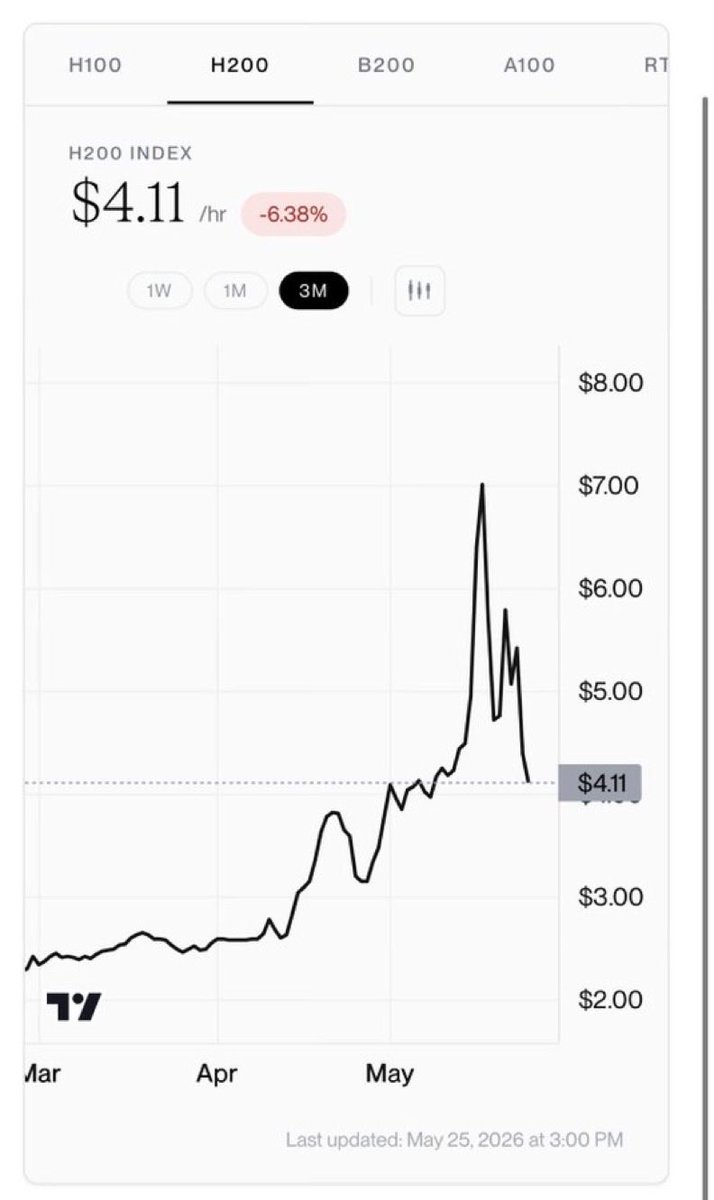
The price to rent an Nvidia H200 just collapsed from $7/hr to $4/hr in three weeks.
A -40% drop in the cost of the single most strategic asset in tech.
When the underlying commodity that powers your entire thesis loses 40% of its value in a month, that usually means one of two things: supply finally caught up, or demand was never as deep as the headlines said.
Either way, somebody is selling.
So why is the AI trade still pricing in scarcity?