Gymshark is taking fitness to the streets of New York."We’re curating ourselves to be relevant in the markets and cities that our consumer is in.” - Hannah Mercer, Global GM of Wholesale, Retail, and Franchise, Gymshark.
@OpenAI and @AnthropicAI are moving into deployments. It's worth pausing on why.
Two reasons, I think. First, models are converging faster than expected. The differentiation is increasingly in how they are applied, not the models themselves. Second, deployment is a critical learning loop. Real enterprise usage generates the kind of signal that shapes better models and more reusable tools. Getting close to deployment isn't just a revenue play, it's a strategic one.
We have seen this firsthand. A product recommendation agent we deployed for a CPG company's sales team improved meaningfully with every field visit logged, every transaction initiated and every minute of rep attention tracked. The deployment itself was the R&D.
This raises a more interesting question: who actually creates the most value at the deployment layer?
The contenders each have a genuine claim. Model companies integrating forward, firms like Palantir that were built for exactly this and consulting firms developing adjacent capabilities. It's too early to call.
What I think makes this moment different from the digital transformation era isn't the technology. It's the nature of the problem. Digital transformation was largely about encoding existing processes into software. AI deployment, done seriously, requires questioning whether the process should exist at all. That's a fundamentally different and much harder organizational challenge.
At @Propheusai, we've been long on this thesis from the very beginning. When early conversations were almost always about models, we would gently steer back to what actually mattered: the workflow, the problem, the RoI.
Physical AI: An Ecosystem that means so much more than Robotics
If you've been following the Physical AI space, you must have noticed that VC funding in the sector has seen a meaningful uptick lately. But behind the scenes of the current glamor and spectacle around Physical AI, those who have keenly followed the industry know that the category has always been a difficult one.
There was a time when Physical AI simply meant robotics. And when that was true, it meant building narrow, pre-programmed machines - brittle, single-task, controlled-environment experiments.
But today, the promise of Physical AI is that robots, embodied machines, and even software agents can act in the real world, conduct meaningful tasks, and do so at scale.
Physical AI is playing out in the physical world - where, as @NextBigTeng puts it, "AI perceives, decides, and acts." And this time, the potential seems more promising than ever, because critical parts of this system are being built in parallel, compounding toward several real-world use cases, all at once.
Here's what's really compounding:
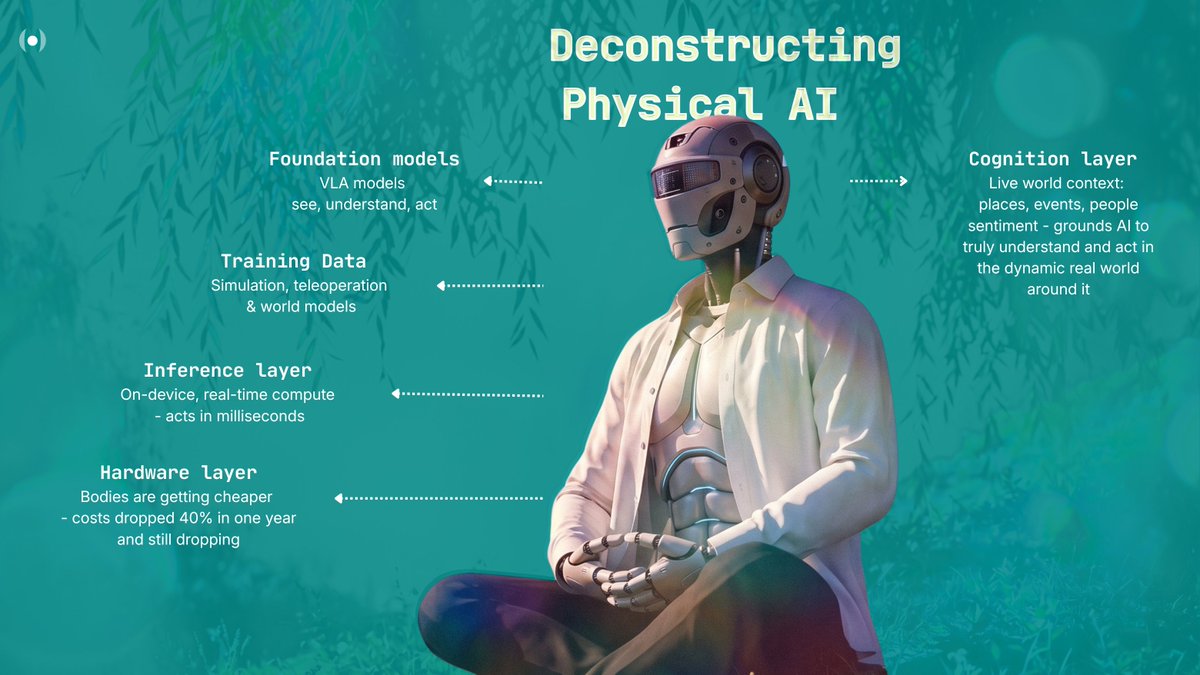
1. Foundation Models for the Physical World
We're seeing the emergence of a new class of AI models purpose-built for physical action - Vision-Language-Action (VLA) models that let a robot see an environment, understand a command in natural language, and translate that into a physical motor action, in real time.
Key players: Physical Intelligence (π), Figure AI (Helix), Google DeepMind (Gemini Robotics), NVIDIA (GR00T), Amazon
2. Breaking the Training Data Bottleneck
This was the hardest wall in robotics for years. LLMs got trained on the entire internet. Robots don't have that luxury. Teaching a robot to pick up a cup requires actually doing it thousands of times - capturing every sensor signal, every motor torque, every failure. That's slow, expensive, and doesn't generalize.
The wall is finally breaking, from multiple directions at once. Simulation lets companies train robots in photorealistic virtual environments at massive scale. Teleoperation platforms let humans demonstrate tasks that get recorded as training data. Synthetic data generation creates realistic scenarios programmatically.
Investment in world models, which enable robots to predict and plan autonomously - surged from $1.4B in 2024 to a record $6.9B in 2025. Deployed robots continually feed back data to retrain and improve the model, forming a continuous learning loop.
Key players: NVIDIA (Cosmos, Omniverse, Isaac Sim), Cortex AI, Scale AI, Skild AI, Axis Robotics, World Labs
3. The Inference Layer
Making Intelligence Fast Enough to Act Even the best robot brain is useless if it can't act in real time. A robot on a factory floor or a surgical table cannot wait 2 seconds for a cloud server to respond. It needs to think and move in milliseconds, locally, on the device itself.
This is the edge inference problem, and it's being solved now. New chips and on-device compute architectures are making it possible to run complex foundation models directly on the robot, with no cloud dependency.
Key players: NVIDIA (Jetson AGX Thor), Figure AI, Tesla (custom AI chips for Optimus), Qualcomm
4. The Hardware Layer: Bodies Getting Cheaper and Better None of the above matters if the physical robot itself costs $500K, breaks constantly, or can only do one thing. Hardware has historically been the expensive, slow-moving constraint. That's changing.
Goldman Sachs reports humanoid manufacturing costs dropped 40% between 2023 and 2024. Bank of America projects material costs falling from ~$35,000 in 2025 to $13,000–$17,000 per unit within the decade. Multiple form factors are maturing simultaneously - humanoids, quadrupeds, arms, mobile manipulators - each suited to different environments.
Key players: Tesla (Optimus), Unitree, Figure AI, Boston Dynamics (electric Atlas), 1X Technologies, Agility Robotics
5. The Cognition Layer: Understanding the World They Operate In This is the most underappreciated layer, and in my view, very important for real-world deployment at scale.
A robot can have a great foundation, fast inference, cheap hardware, and rich training data, and still fail the moment it steps into an environment it wasn't trained on. Why? Because the physical world is dynamic. It changes constantly. Weather shifts operations. People move differently at different times of day. Events disrupt normal patterns. Sentiment affects how humans interact with machines.
This is exactly the gap @Propheusai is building for, a live knowledge representation of the real world (weather, demographics, people movement, sentiment, events) that gives both embodied AI systems and software agents the contextual grounding to truly act, not just execute.
Physical AI systems can only fully compound when this layer is complete. And our team including @Sumanth_n83 , @sachinjose, @michellemzhou and @sreejan_c are excited to be building this layer - the Digital Atlas - the most comprehensive knowledge representation of every place on earth.
Stay tuned. I'm also digging into what I'm calling the blue collar vs. white collar applications of Physical AI, and why I believe the ROI of Physical AI isn't decades away. It's already here - and we’re seeing it everyday. Enabling this is the cognition layer and its foundation is our Digital Atlas. More on this coming soon!
We had done a benchmarking study a few months ago testing 20+ models for Enterprise AI performance at @Propheusai and even then, while Qwen was not mainstream (and Kimi/GLM didn’t mean anything), it was still neck and neck with Claude and GPT.
It’s no surprise now that it has become a model of choice given its open source roots and highly versatile family of models.
If someone had said in 2023 that China would lead in open source models while US would be primarily closed source, we’d have laughed. Yet, here we are..
@michellemzhou@Sumanth_n83
Great essay by @drfeifei on world models. At @Propheusai, @michellemzhou and I have a strong belief that this is the next frontier of AI innovation in the coming decade.
A major application of using real world representations is to guide and simulate the next state (actions and impact) on Enterprise businesses that exist in the physical world - Retail, Consumer Goods, Real Estate. LLMs lack the context and the grounding needed to solve these large scale problems.
Excited to see what comes next from @theworldlabs !
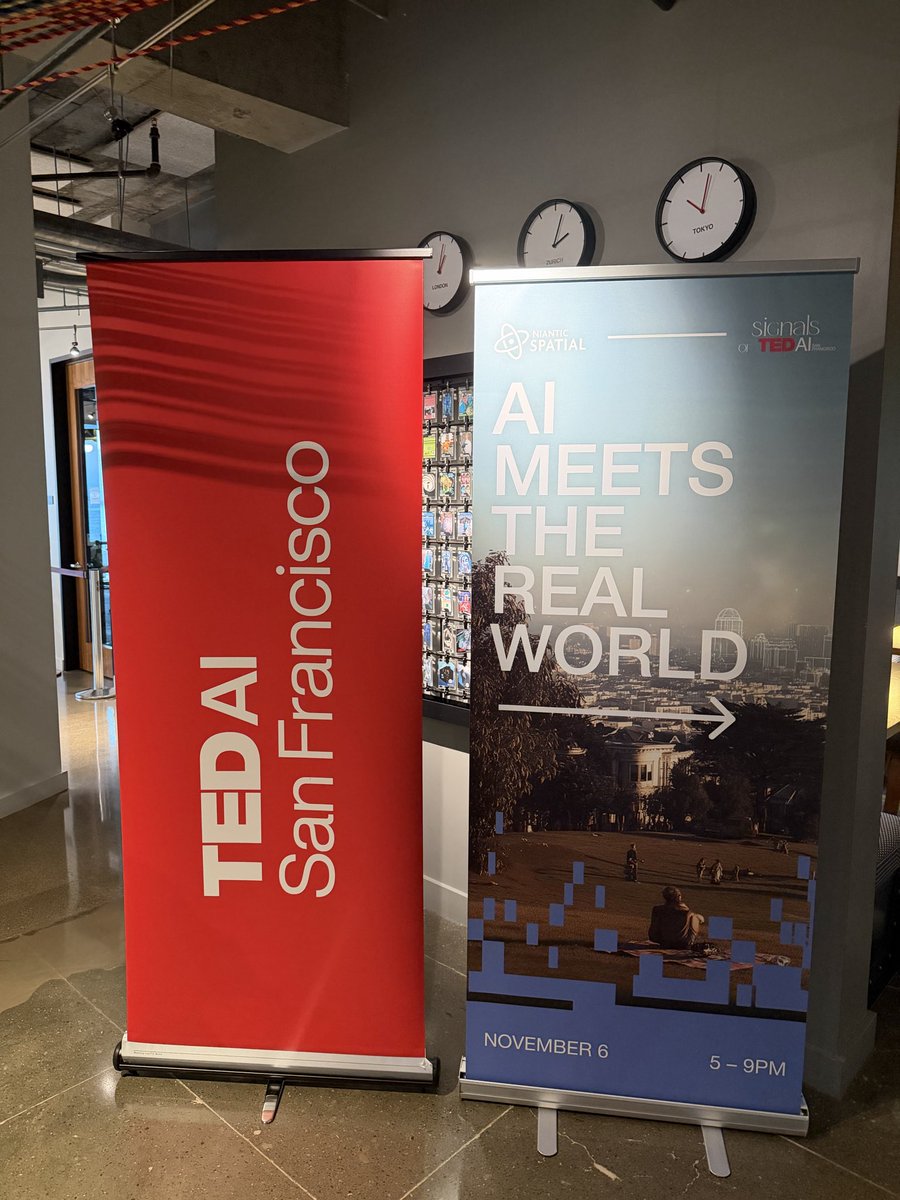
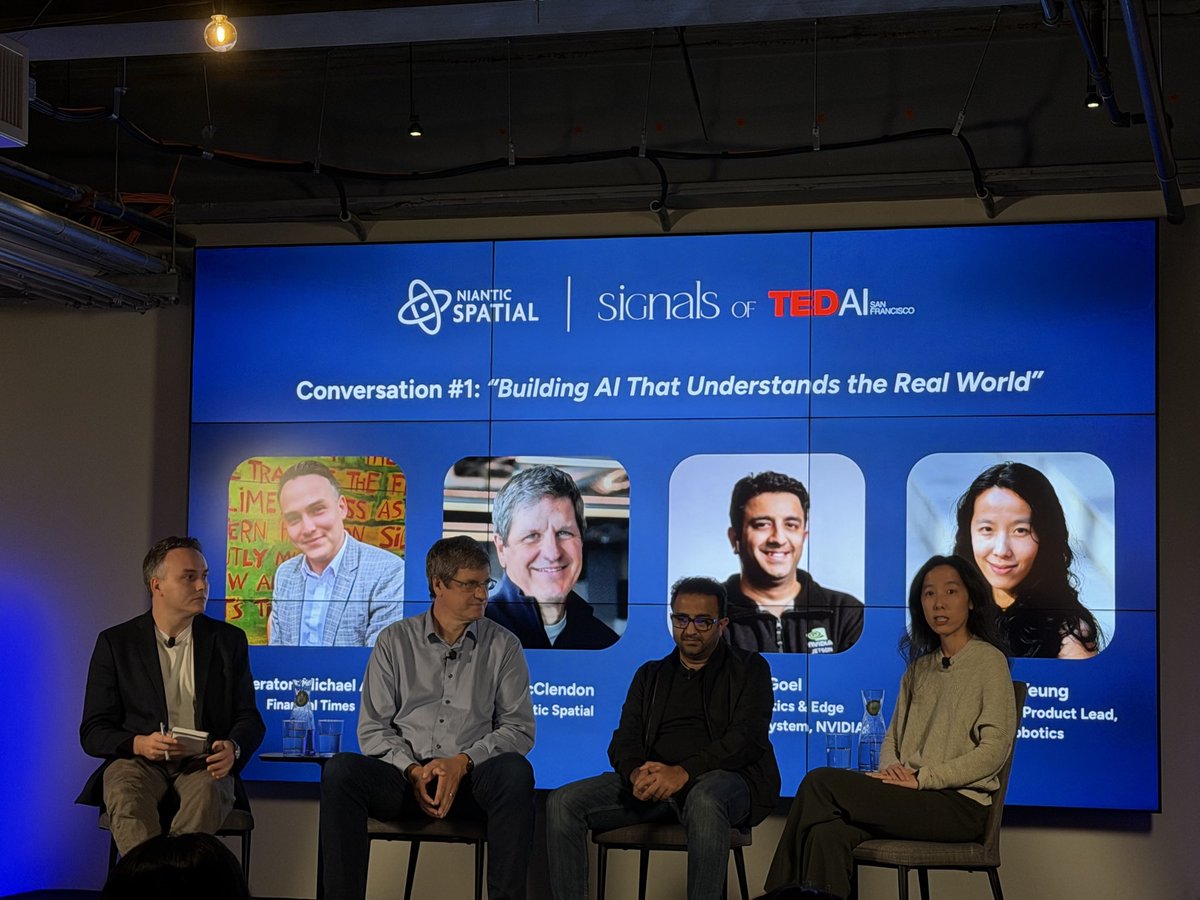
I'm grateful to be invited to AI Meets the Real World, hosted by @NianticSpatial, and @TEDAISF today.
It was great to see Niantic taking a very similar approach to bringing AI into the physical world - one that deeply resonates with what we’re building at @Propheusai. The panelists not only discussed what it means and the challenges we face in building real world models, but also touched on social questions like how we can enable robots to safely coexist in the cities where humans live.
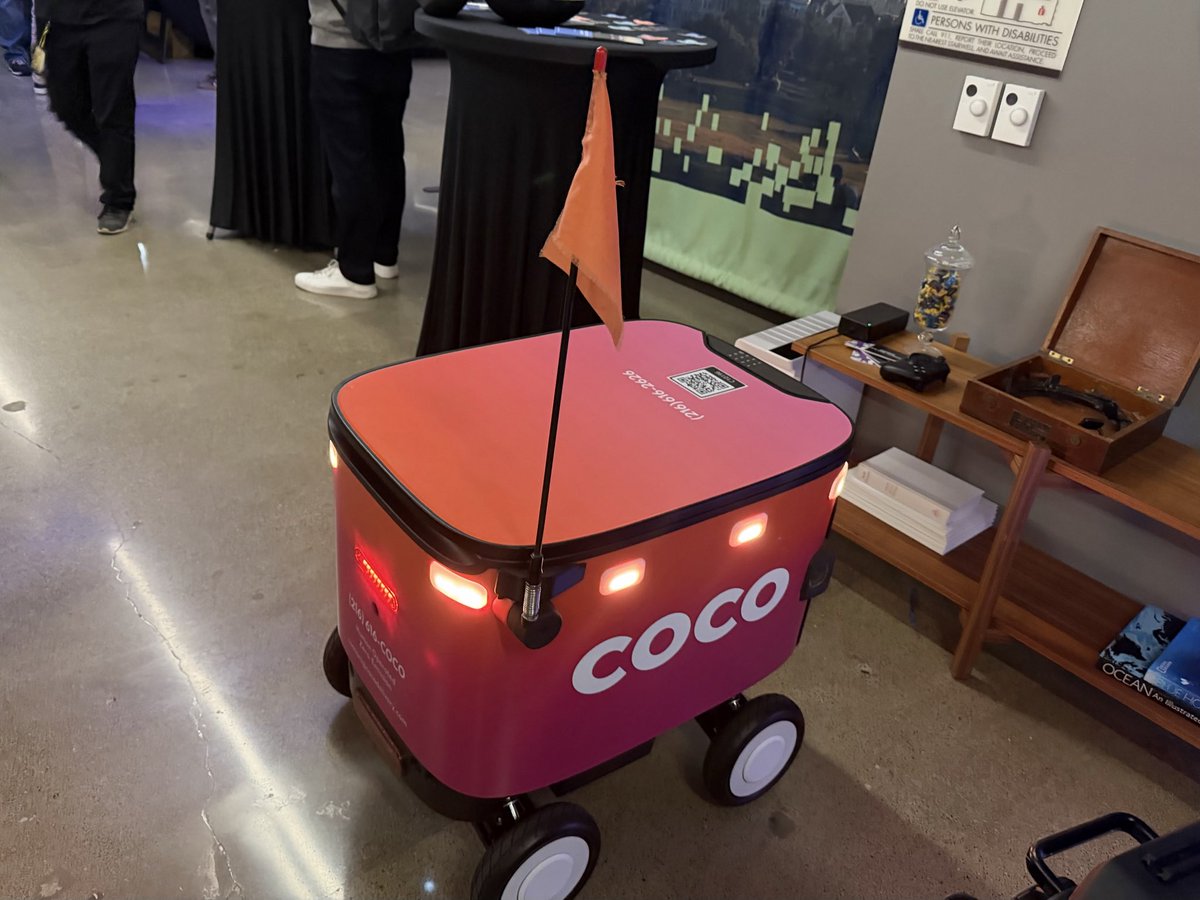
We also had some fun moments playing with Peridot, Coco, G1, and seeing how training data is generated by teleoperating robots.
Such a vibrant community of people shaping the future of Physical AI. We’re excited to continue the conversation and build real-world use cases where spatial intelligence can make a big impact.
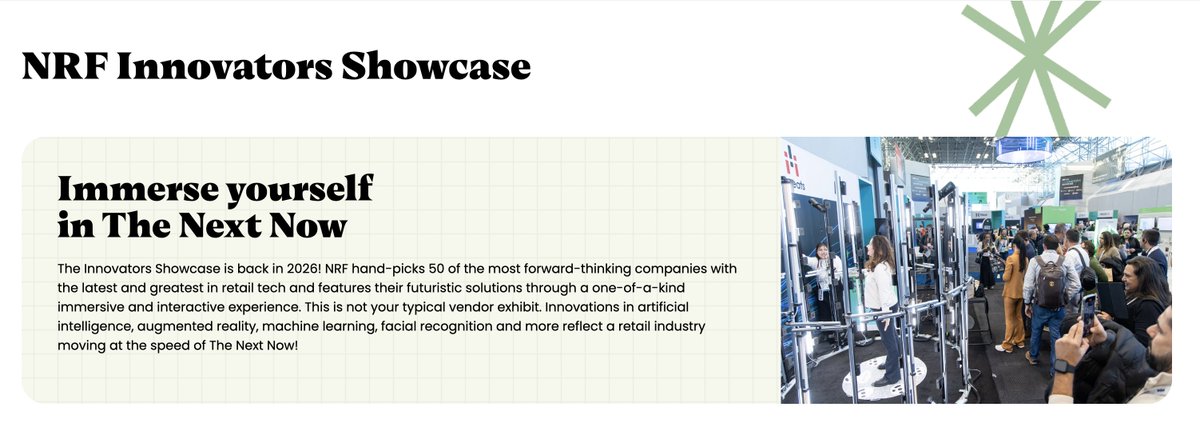
🚀 I'm thrilled to share that @Propheusai has been selected by the National Retail Federation @NRFnews to be part of the Innovators Showcase at Retail’s Big Show 2026!
We are super excited as this recognition reflects the momentum we’re seeing from brands and retailers who are ready for a new era of Physical AI. Stores, shelves, supply chain, field teams - the real world is where decisions happen, and we’re excited to show how Propheus unlocks intelligence in every inch of it.
We’ll see you in NYC the coming January. If you’re attending NRF, let’s connect and explore what’s possible.
#NRF2026
Retailers can now align staffing, inventory, and marketing with the world outside their doors, adapting dynamically to changes as they happen. Powered by Physical AI, this isn’t just data, it’s context, turned into action.
Bonus — Hyperlocal Assortment: Use neighborhood-level data to fine-tune inventory - Lighter fits near campuses, heavier Power lines in strength-heavy zones.
Gymshark is taking fitness to the streets of New York."We’re curating ourselves to be relevant in the markets and cities that our consumer is in.” - Hannah Mercer, Global GM of Wholesale, Retail, and Franchise, Gymshark.
👏 Huge congratulations to the @Figure_robot team! Figure 03 is an incredible leap in humanoid robotics. What excites me most isn’t just what it can do, but what it signals: robots are starting to perceive the world more like humans.
Its new design pushes sensory intelligence in remarkable ways:
- High-speed, wide-FOV vision
- Embedded palm cameras for close-up perception
- Tactile fingertips sensitive to just a few grams
- Wireless charging and ultra-fast data offload for continuous learning
Beyond perception: context is the next frontier. For robots to truly operate in streets, stores, and homes, they’ll need context - understanding how the world works beyond raw sensors:
🌍 Places & spatial context - how environments are structured and evolve
🌦 Weather & conditions - how rain, fog, or heat affect mobility
🚶 Human mobility - anticipating crowd flow and behavior
🚗 Traffic & routing - dynamic access and congestion patterns
💬 Behavioral context - where people go, what they prefer, how patterns shift
This is what drives us at @Propheusai: A contextual layer that enables AI agents, robots, and moving systems to understand the world the way humans do - to see the streets, stores, and spaces around them as living, changing places, and act with that awareness.
We’re building this shared layer of intelligence - a Digital Atlas of the world, so that both humans and AI can make smarter, more context-aware decisions grounded in the real world.
Stay tuned for more updates on our approach to Physical AI.
Industry veterans stop at robots and embodied systems, but there’s much more to Physical AI.
At Propheus, we see Physical AI as the real-world intelligence that helps humans, digital agents, and embodied systems truly understand and respond to their surroundings.