Finally, our book chapter about detecting surface proteins has been published! Thanks to @CsabaMatta and the excellent research colleagues!
https://t.co/Y7KmlAwpwe
It was a great pleasure for me to be involved in the work led by @andrewfuredi by exploring the cell surface proteome of senescent cells. The results is here: https://t.co/b5d6zPnBaN #cancer#CancerResearch
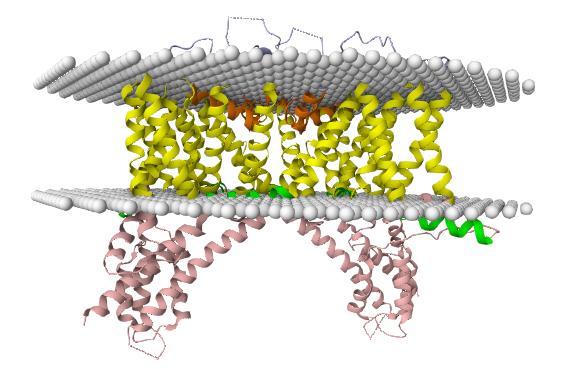
I am thrilled to announce that our completely redesigned TmDet algorithm has just been published in @NAR_Open ! Simple, double, curved membrane or even erroneously modeled tm proteins are no problem!
https://t.co/P8qz18wiiY
We are delighted that our article about the completely redesigned TmDet algorithm has just been accepted by the Nucleic Acids Research. Check it here: https://t.co/iGtr4LfRkH
Do you know how to use the AlphaFold predicted structures correctly for upstream predictions? If not, @dobsonlaszlo1 recent paper from our group in @BriefingBioinfo about BETA is for you. https://t.co/cj28okE3w1
🚀 New in AlphaFold DB: Structural domains at a glance! 🔍✨
AFDB now integrates TED (The Encyclopedia of Domains) to classify functional protein domains.
🔗 More
https://t.co/S0A9tkgp5w
🔗 Explore
https://t.co/eHswi5usAX
#AlphaFold#TED#ProteinStructures
The new TmDet server has been launched! It can determine the orientation of membrane proteins to the membrane, even in the case of double membranes or curved membranes, and can also detect errors in modeled transmembrane structures. Check it out in UniTmp: https://t.co/iGtr4LfRkH
Regularly updated benchmark sets for statistically correct evaluations of AlphaFold applications
• This paper introduces BETA (Benchmarking Evaluation Test for AlphaFold), a rigorously curated dataset designed to eliminate data leakage in AlphaFold (AF)-based applications by excluding structures and sequences used in AF training.
• BETA enables statistically sound evaluations of AF predictions by providing datasets with no homologs in the training set, ensuring more reliable and unbiased results.
• The study highlights that many current AF-based studies inadvertently suffer from data leakage, compromising the accuracy of their conclusions. BETA addresses this by using deep homology searches to exclude potentially leaked data.
• BETA supports multiple use cases, such as predicting protein disorder, antibody epitopes, phase-separating regions, effects of missense mutations, and ranking interactions involving short linear motifs.
• A case study on predicting intrinsically disordered regions (IDRs) demonstrates the impact of using BETA, with optimized pLDDT thresholds leading to significant improvements in prediction accuracy and statistical robustness.
• The dataset is continuously updated to adapt to new AF versions and training datasets, ensuring ongoing applicability in the evolving field of structural biology.
@PeTompa@dobsonlaszlo1
💻Code: https://t.co/XpvUuk6MxH
📜Paper: https://t.co/eO1orc9qiZ
#AlphaFold #ProteinStructure #Benchmarking #Bioinformatics #MachineLearning
Thrilled to announce Boltz-1, the first open-source and commercially available model to achieve AlphaFold3-level accuracy on biomolecular structure prediction! An exciting collaboration with @jeremyWohlwend, @pas_saro and an amazing team at MIT and Genesis Therapeutics. A thread!
Excited to share that the AlphaFold 3 model code and weights are now available for academic use.
Looking forward to seeing what new research this unlocks and how the research community builds on AlphaFold 3 for scientific discoveries https://t.co/GKIOGHm317 1/2
Our manuscript about MFIB 2.0 database has just been accepted in @NAR_Open . Thanks to all authors and anonymous reviewers and the executive editor @DanielRigden !
MFIB 2.0 is out! The new database has almost tripled in size. New classifications, new features in the old, familiar environment. Check it here: https://t.co/8diWmJKuRY