@kisPocok Mi most ruháztunk be egy All-Adagio GT-N, félkemény matracra, mindenhogy is alszunk, imádjuk. RS bútorban lehet fetrengeni rajta, aztán megvenni onnan, ahol olcsòbb. Táskarugòs, ez szempont volt, a bonellrugòst elvetettük, mert felkeltjük egymást, "átrezeg".
We are pleased to announce our new partnership with @MDPIOpenAccess that will see 10 of MDPI’s journals benefit from an enhanced presence on ResearchGate through our innovative Journal Home offering.
@markogabor88@kovacsbalint A Parking Time-ra ha ráböksz a térkép felett, ami mutatja h 3 óra múlva leáll úgyis, tudsz időtartamot beállítani, 15 perc a legkevesebb, ami neked pont elég, de mégse 3 óra.
@eszter_barany Team Gombok a Lábnál! + minden extra csomagolást leszedek, ha pakolom el a bevásárlást, pl 5sével csomagolt sütőpor szétbontva rakandò el :)
a new AlphaFold model: in AI for biology, you get what you train for
since the release of AlphaFold in 2020, a once-hypothesized revolution in drug discovery has failed to materialize. while accurate at predicting protein structure, the utility of AF for drug discovery has been limited. new AF models published this week by isomorphic labs change this.
a useful case study for understanding the difficulty of translating protein structure algorithms like AF to drug development is molecular docking. docking is a computational method for predicting the orientation and position of a ligand when it binds to a protein with the goal of generating new small molecule drugs, and is the workhorse of structure-based drug design. the docking process requires the crystal structure of a protein bound to ligands, however these structures are expensive/difficult to generate.
there was a lot of excitement after AF’s release about the replacing crystal structures with AF in docking in order to discover drugs more quickly and cheaply. many expected this to work because AF-generated structures closely match the crystal structures of protein binding pockets. however, several recent papers [1-3] have found that despite AF’s ability to predict protein structure, the accuracy of molecular docking decreases significantly when using AF-generated structures.
why didn't AF-generated structures translate to an ability to predict drug binding? generating a structural model for a small molecule binding to a protein turns out to be a much more difficult problem than protein structure alone. the space of possible small molecules (10^60) and structures is much larger than that of proteins. further, ligand binding changes protein structure, and AF wasn't trained on ligand-protein complexes.
a white paper out this week [4] describes a new iteration of AF that achieves stronger performance on molecular docking. the paper is intentionally short on methodological details, but from what we can tell, new AF models were trained on protein complexes with non-protein elements, including small molecule ligands. the model achieves SOTA accuracy on molecular docking benchmarks, outperforming both non-ML and ML based methods. importantly, comparison methods used ground truth bound protein crystal structures as input.
what’s the takeaway? one important, obvious lesson is that in AI for biology, you get what you train for. to predict ligand-protein interactions, you must train on train on ligand-protein complexes. to predict antibody-antigen interactions, you must train on antibody-antigen complexes. simply training on proteins (first generation of AF) is not sufficient for many applications in drug discovery, where the goal is to model complex interactions between many biological molecules. the capabilities of AI models in biology will only continue to advance as we incorporate specific and relevant biological data into model training to bridge the gap towards real-world impact.
@maxjaderberg@tfgg2@demishassabis@IsomorphicLabs
BREAKING NEWS
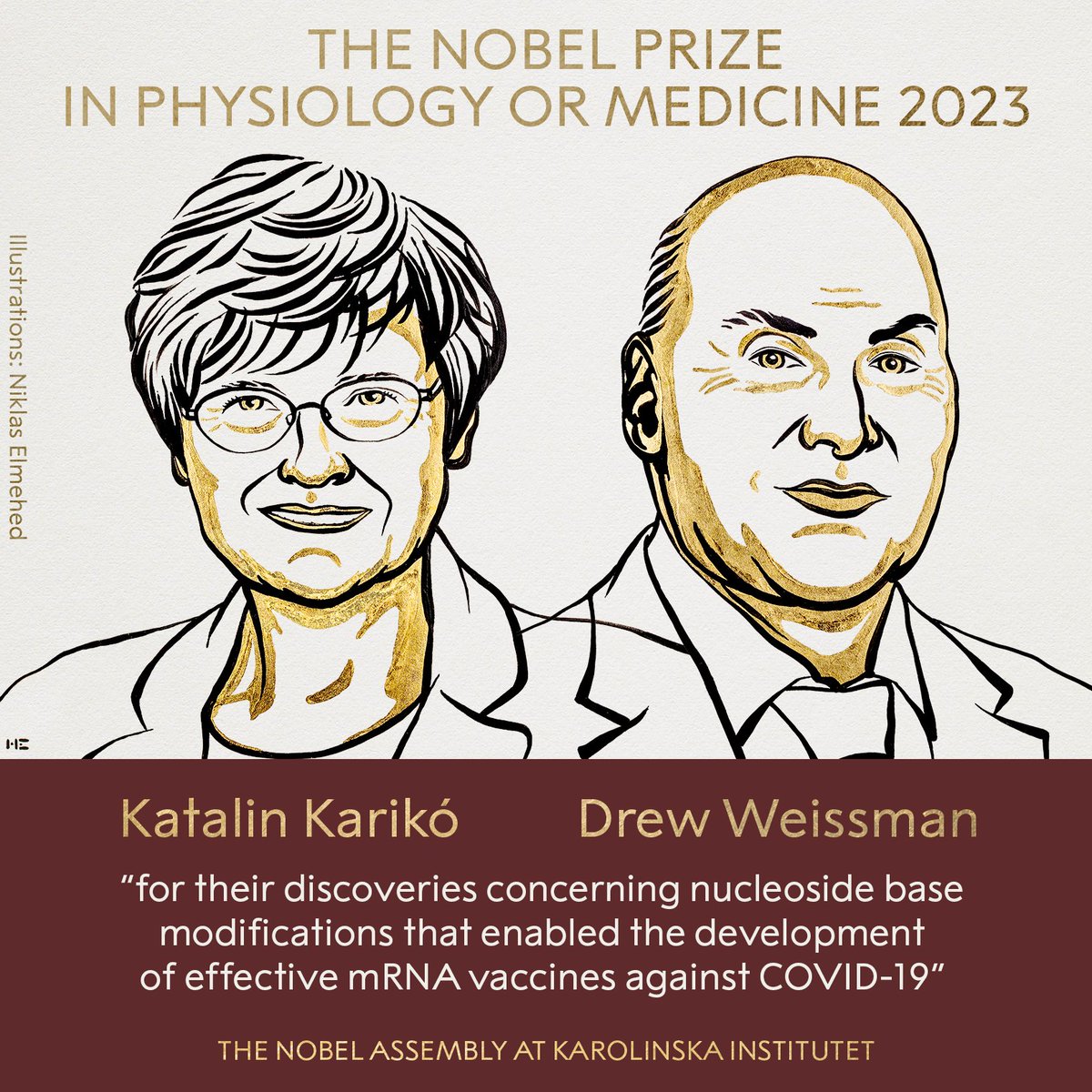
The 2023 #NobelPrize in Physiology or Medicine has been awarded to Katalin Karikó and Drew Weissman for their discoveries concerning nucleoside base modifications that enabled the development of effective mRNA vaccines against COVID-19.
@zafimafi TeamB jelen, fazontól függően A, de megbékéltem, nem zavar sportban, bármilyen ruhát veszek fel, sosem lesz too much a dekoltázs kb, mindenhol van méret az üzletben stb.
@catgyoung After 6 years, I traded academia for a non-related arthitect/PO job at a big tech company, get my mental health back on track after the PhD (we all should!), aaand back to research, using my corporate experience, being a bioinformatics researcher/manager at a startup :)



![patricksmalone's tweet photo. a new AlphaFold model: in AI for biology, you get what you train for
since the release of AlphaFold in 2020, a once-hypothesized revolution in drug discovery has failed to materialize. while accurate at predicting protein structure, the utility of AF for drug discovery has been limited. new AF models published this week by isomorphic labs change this.
a useful case study for understanding the difficulty of translating protein structure algorithms like AF to drug development is molecular docking. docking is a computational method for predicting the orientation and position of a ligand when it binds to a protein with the goal of generating new small molecule drugs, and is the workhorse of structure-based drug design. the docking process requires the crystal structure of a protein bound to ligands, however these structures are expensive/difficult to generate.
there was a lot of excitement after AF’s release about the replacing crystal structures with AF in docking in order to discover drugs more quickly and cheaply. many expected this to work because AF-generated structures closely match the crystal structures of protein binding pockets. however, several recent papers [1-3] have found that despite AF’s ability to predict protein structure, the accuracy of molecular docking decreases significantly when using AF-generated structures.
why didn't AF-generated structures translate to an ability to predict drug binding? generating a structural model for a small molecule binding to a protein turns out to be a much more difficult problem than protein structure alone. the space of possible small molecules (10^60) and structures is much larger than that of proteins. further, ligand binding changes protein structure, and AF wasn't trained on ligand-protein complexes.
a white paper out this week [4] describes a new iteration of AF that achieves stronger performance on molecular docking. the paper is intentionally short on methodological details, but from what we can tell, new AF models were trained on protein complexes with non-protein elements, including small molecule ligands. the model achieves SOTA accuracy on molecular docking benchmarks, outperforming both non-ML and ML based methods. importantly, comparison methods used ground truth bound protein crystal structures as input.
what’s the takeaway? one important, obvious lesson is that in AI for biology, you get what you train for. to predict ligand-protein interactions, you must train on train on ligand-protein complexes. to predict antibody-antigen interactions, you must train on antibody-antigen complexes. simply training on proteins (first generation of AF) is not sufficient for many applications in drug discovery, where the goal is to model complex interactions between many biological molecules. the capabilities of AI models in biology will only continue to advance as we incorporate specific and relevant biological data into model training to bridge the gap towards real-world impact.
@maxjaderberg @tfgg2 @demishassabis @IsomorphicLabs](https://pbs.twimg.com/media/F92rfy-bUAANDDC.jpg)