Elder financial exploitation steals $28.3 BILLION yearly and 90% of the time it’s by someone known and trusted - often family. 😔
Swipe through for eye-opening insights:
1️⃣ Family dynamics & predatory roots
2️⃣ Coercive control & undue influence tactics
3️⃣ Ideas on safeguards to help prevent POA abuse.
Share to protect loved ones. Always consult experts! 💙
#ElderAbuse #ProtectOurParents #FinancialExploitation
“That’s how you have a woman from Zimbabwe running elder care facilities that are highly questionable and the people who are meant to hold them accountable or investigate turn a blind eye.”👇
Here’s the deal, there IS cronyism within the department. He’s doubling down complaining that people are finding out about it - but people already know. It’s so corrupt, it’s NO SECRET!
That’s how you have a woman from Zimbabwe running elder care facilities that are highly questionable and the people who are meant to hold them accountable or investigate turn a blind eye. I back the blue and these guys are giving law enforcement a bad name. That is disrespectful to ALL law enforcement who follow the law and do right.
Furthermore, this crime isn’t hard to prove and a lot of the time, people are sitting in jail until their court date. Innocent until proven guilty is no more than words from television. The reality is the system treats you guilty until you prove innocence and NO ONE IS ABOVE THE LAW.
I wish I had understood the importance of involving a financial investigator and an attorney familiar with criminal financial exploitation while my father was still alive.
We were seeing repeated ATM withdrawals, sometimes the same amounts withdrawn more than once in the same month, and far more cash coming out of my father’s accounts than he needed each week.
His caregiver was making the withdrawals, keeping cash in a drawer in her bedroom and doling it out to him. Dad informed us of the cash drawer and that the caregiver was “helping him manage his cash”. He believed she was honest.
Then, quite by accident, we discovered something else.
My father had asked my son to fix a paper shredder. When my son opened it, he found financial documents jammed inside and called me into the room. Among them were the caregiver’s bank statements and employment payment records. I photographed what we found.
Those records appeared to show cash deposits into her personal account that exceeded her earnings. As the funds accumulated to approximately $2,000, she would write a check to Fidelity for her IRA.
I could see a pattern, but proving where that cash came from was another matter.
Looking back, there are two things I wish I had done much earlier.
First, hire an experienced accountant to examine the transactions. Finding a forensic accountant isn’t easy, but even a qualified CPA familiar with financial investigations might have helped us establish what was happening and what additional evidence we needed.
Second, consult an attorney experienced in criminal financial exploitation. I wish I had understood the difference between pursuing a probate or civil case and exploring whether suspected financial wrongdoing warranted a criminal investigation.
We spent years trying to address what happened through the legal system. I often wonder what might have been different had we pursued those two avenues while my father was living.
That’s why I’m sharing this information from #NCEA. Families need to know these options exist before they become overwhelmed by legal proceedings, mounting expenses and the challenge of trying to reconstruct what happened years later.
Recognizing suspicious activity and knowing how to investigate it, preserve evidence and get the right help is another.
I hope sharing what I wish I had known helps another family act sooner.
#Aging #ProtectOurParents
Financial exploitation is one of the most hidden forms of elder abuse. Read our latest blog to learn how forensic accountants strengthen #ElderAbuse multidisciplinary teams and support investigations early on.
https://t.co/sHKuFD3XZe
Tony Bennett's daughters say he earned over $100 million from live shows in his last 15 years. They were told his estate was worth less than $7 million.
He set up a family trust in December 1994, with his son Danny, also his manager, as a co-trustee. In 2016 he was diagnosed with Alzheimer's. He died in July 2023, at 96, leaving Danny as sole trustee.
His daughters Antonia and Johanna say he "expressed a clear intention and direction in his estate plans that all four of his children be treated equally."
The court record, from the daughters' filings:
$4.2 million is what they say Danny got in lifetime gifts, "more than double" what each of the other three children got.
$2.6 million (just under) in commissions paid to Danny's company.
$245,000 is what each daughter has received from the trust.
July 2022: Tony's catalog and likeness rights were sold to the firm Iconoclast.
June 2024: the daughters sued for a full accounting.
March 2025: they sued again to remove Danny as trustee.
They say Tony left Antonia his piano. When she was finally let into his apartment, it "was in terrible condition." They say Danny's lawyer later told them most of Tony's clothing "was donated to charity without notice."
The case for Danny: he managed his father's career and money from the 1970s until Tony retired in 2021, and his lawyers say Tony credited him with reviving his career. "He trusted me to manage his career, to manage his money, and to serve as his trustee." "There is nothing to fight about."
The case for the daughters: their father was diagnosed with Alzheimer's six years before the catalog sale, and they say Danny served as sole trustee "with no oversight."
In the video below Johanna says: "My biggest fear is that for the rest of our lives... our father... will continue to make money and that his wishes will not be validated."
Did Tony Bennett trust the right child with his money, or were his daughters cut out?
@JaceClipz@DemonJin86848 Exactly. People often think having that power of authority is protection and it can work as long as the grantor has oversight. But the danger I often see is when the older person’s oversight weakens and there’s no plan to monitor substitute authority.
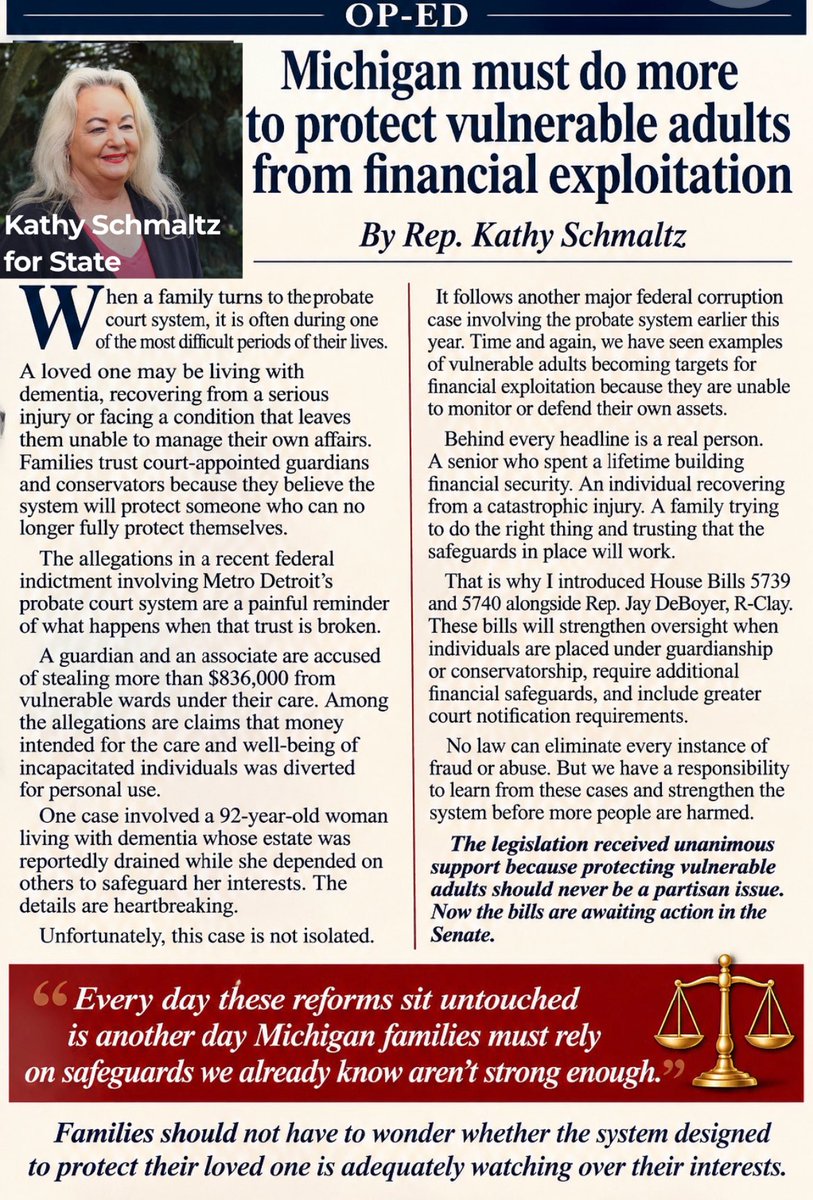
🙄REP. KATHY SCHMALTZ JUST MADE MY POINT FOR ME
I read Rep. Kathy Schmaltz’s op-ed claiming Michigan must do more to protect vulnerable adults from financial exploitation, and I couldn’t help but notice the contradiction.
She writes that families trust court-appointed guardians and conservators because they believe the system will protect their loved ones.
She acknowledges that vulnerable people are being financially exploited.
She acknowledges that safeguards have failed.
She even writes that families should not have to wonder whether the system designed to protect their loved one is adequately watching over their interests.
Exactly.
So why does the solution continue to be MORE LAWS without addressing what happens when the people responsible for enforcing those laws — including probate judges — fail to follow them?
I personally spoke to Rep. Schmaltz during a Families and Veterans Committee meeting and told her exactly this:
We don’t simply need more laws. We need accountability when the laws already on the books are ignored.
That is the part I believe Lansing continues to avoid.
Schmaltz congratulates the House for passing HB 5739 and HB 5740 and says these bills will provide additional financial safeguards and accountability.
But accountability for whom?
What happens when a guardian violates the law?
What happens when a conservator fails to protect someone’s assets?
And most importantly, what happens when a probate judge approves it, overlooks it, or fails to enforce the safeguards already required by law?
Passing another bill does not answer that question.
You can require another notice.
You can require another accounting.
You can establish another financial threshold.
You can require another court approval.
But if the ultimate safeguard is still “the judge will make sure the law is followed,” what protection does that provide to a family whose complaint is that the court itself failed to enforce the law?
That is the disconnect I have been trying to explain.
And I say this as someone who lived through the probate system with my own mother.
I am not arguing that every new safeguard is bad. I am saying a safeguard without enforcement is only words on paper.
Where is the independent oversight?
Where is the meaningful review when a probate court gets it wrong?
Where are the consequences when statutory protections are ignored?
Where is the fast, affordable remedy for a vulnerable adult whose money, home or rights are being lost while a family spends years trying to appeal?
Rep. Schmaltz ends her article by saying:
“Families should not have to wonder whether the system designed to protect their loved one is adequately watching over their interests.”
On that, I completely agree.
But that means we have to be willing to examine the entire system — including the courts themselves.
Passing more laws and then congratulating legislators for passing them does not solve the underlying problem if nobody is willing to address what happens when those laws aren’t followed.
Real reform is not measured by how many bills Lansing passes.
It is measured by whether the vulnerable person standing at the center of a probate case is actually protected.
And until we have meaningful judicial oversight and accountability, families like mine are going to keep asking:
Who holds the court accountable when the court fails to follow the law? 🤯⚖️
#Michigan #probate #guardianship #abuseofpower #isolation #dementia #accountability #justiceforbettyhayes
Aging well isn't measured simply by the years we live, but by the life we continue to enjoy.
This thoughtful article from the American Society on Aging reminds us that joy, belonging, and having a say in how we live deserve just as much attention as the challenges of growing older. 👀
https://t.co/Co9u8JVPqh #PositiveAging #HealthyAging #AgeismAwareness
I know what it feels like to fight for your mother while professionals hold the authority and your family bears the consequences. I refuse to accept that asking these questions is somehow more offensive than the suffering that makes us ask them.
A probate court holds power over someone’s freedom, money, home and family relationships. That demands extraordinary transparency.
The public deserves a court whose independence can withstand scrutiny.
When a family challenges a professional fiduciary’s fees, conduct or treatment of a loved one in probate court, how can that family feel confident that longstanding professional loyalties will carry no weight?
“Trust us” is not an oversight system.
These are not merely historical connections. The people involved were fired as public administrators, yet they remain connected through the same professional network. They have been in the fortress since 2019—and they are still connected today.
And now look at the campaign connections.
Elisabeth Dery’s own endorsement page lists Judge Daniel O’Brien, John Yun, Jon Munger and Jennifer Carney, alongside attorneys from Kemp Klein. It identifies Yun as a partner at Yun Dery & Morgan.
Jon Munger was a senior partner at Kemp Klein. Alan May is listed as a shareholder there, with a practice involving guardianships and conservatorships. Jennifer Carney also worked at Munger’s firm.
Judge Linda Hallmark previously worked at May & May. Her longtime judicial staff attorney, Ryan Deel, is married to attorney Melinda Deel, whose guardian-ad-litem work is documented in court records. Ryan joined their private practice in January 2025 after Hallmark retired.
Judge Jennifer Callaghan worked for John Yun. Her own 2016 candidate statement identified her as a public administrator working at his firm, taking appointments as guardian, conservator, trustee and personal representative.
In my view, this is an incestuous professional circle—and families have every right to question it.
Our loved ones are human beings. Their lives must never become business as usual for a tightly connected legal circle—especially one that has remained connected inside the fortress since 2019.
If this touches your heart and you want to understand what families endure when guardianship becomes abuse, please order a copy of Julie Belshe and Gretchen Rachel Hammond’s American UnPeople. These are real people, real families, and devastating stories that deserve to be heard. It’s a powerful read that will stay with you long after the last page.
#JusticeForBettyHayes #ProbateAccountability #GuardianshipReform #Michigan #AmericanUnPeople
#LasVegas
Elder financial exploitation steals $28.3 BILLION yearly and 90% of the time it’s by someone known and trusted - often family. 😔
Swipe through for eye-opening insights:
1️⃣ Family dynamics & predatory roots
2️⃣ Coercive control & undue influence tactics
3️⃣ Ideas on safeguards to help prevent POA abuse.
Share to protect loved ones. Always consult experts! 💙
#ElderAbuse #ProtectOurParents #FinancialExploitation
People who need care may have no affordable alternative to Medicaid. They still deserve a clear explanation of estate recovery before enrollment.
#ProtectOurParents#Legacy#Family
My coworker's mother passed away last November.
She left her modest $190,000 house to him clear and free, no mortgage, completely paid off after thirty years of factory work.
He moved into the home in January to finally settle the estate.
Two weeks ago, a letter arrived from the state Medicaid estate recovery office.
Because his mother spent four months in a rehabilitation facility before she passed, the state quietly slapped a retroactive $114,000 lien against the property title.
He called the state health department, frantic, asking how a hospital stay could bankrupt an inherited home that had no mortgage balance.
The caseworker sighed and told him:
"Federal law requires state programs to claw back healthcare costs from deceased estates. The house cannot be sold or transferred until the balance is cleared in full."
He offered to pay a monthly settlement.
They said no. The full $114,000 is due in 60 days, or they foreclose on the property at a public auction.
A lifetime of working-class savings, wiped out overnight by a retroactive healthcare lien.
You don't own generational wealth.
You're just holding a property title until the state finds a legal mechanism to repossess it the moment you die.