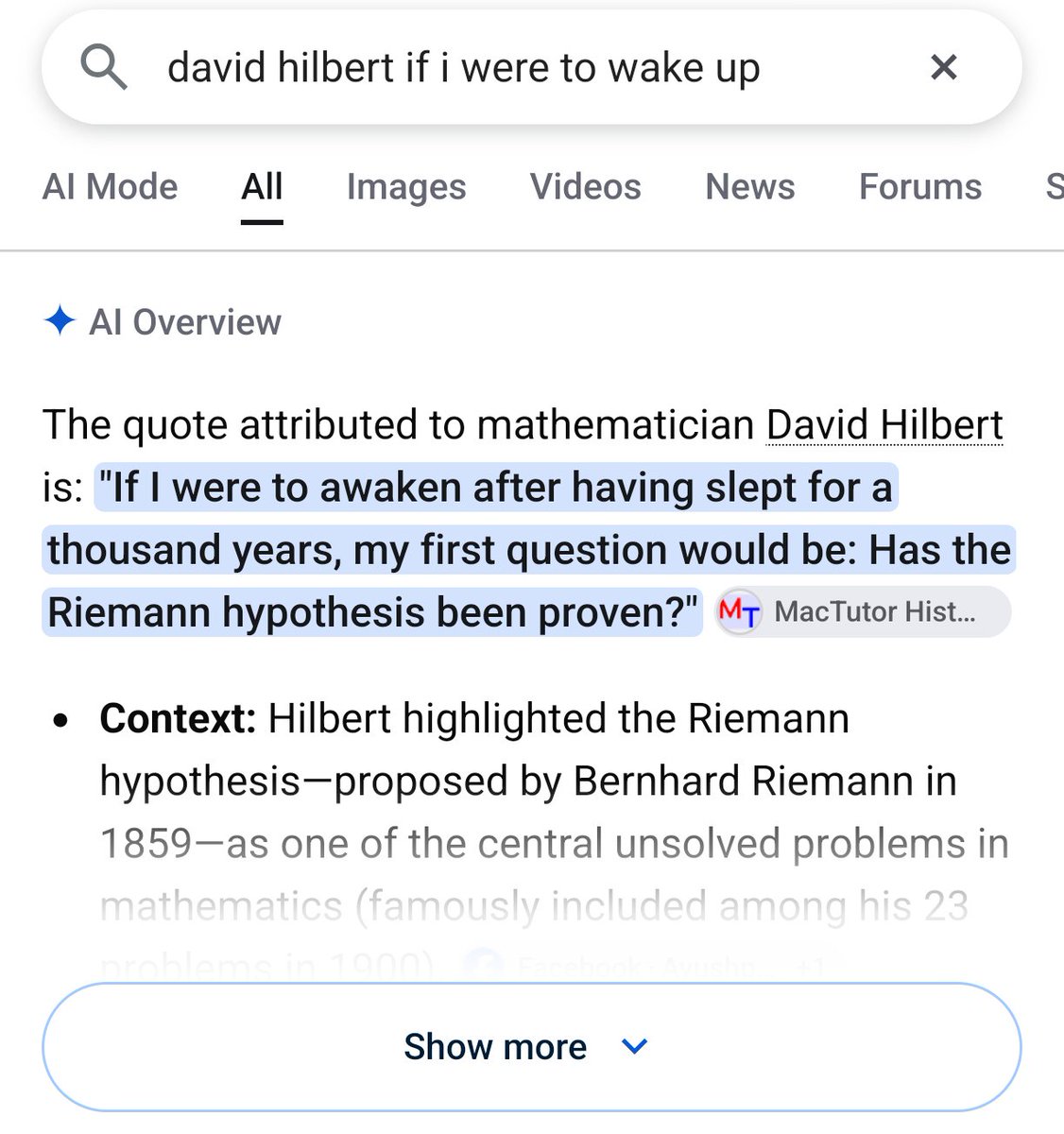
Mathematicians be like “there will be nothing left for us to do” and then like “I’ve been studying the reimann proof for 94 hours straight without a pee break”
She arrived in America struggling with English and became an MIT-trained neuroscientist at Princeton. Now ICE has her LOCKED in a Virginia detention center.
Eva Yi Xie, a third-year Ph.D. student at the Princeton Neuroscience Institute, presented a poster at the Society for Neuroscience annual meeting in Washington on Wednesday. On Thursday, November 19, she was detained at Reagan National Airport, according to her lab. She sent her lab mates a call for help on Slack. Then they lost contact with her for hours.
She is believed to be held at an ICE facility in Chantilly, Virginia. ICE's online detainee locator lists her as in custody but doesn't say where. ICE has not answered multiple requests for comment and has given no public reason for detaining her. Her immigration status has not been made public.
Xie came to the U.S. from Shanghai in 2016 and at first struggled with English. At the Bronx High School of Science she became a finalist in the Regeneron Science Talent Search for genomics research aimed at improving heart disease treatment. She graduated from MIT in 2024 with a double major in computer science and math. She has interned at Meta, Microsoft AI and IBM Research, and she now studies how the brain makes decisions. She is also helping organize an international computational neuroscience conference in Edinburgh for 2027.
"Here, if you are brave enough to step out of your comfort zone, you can definitely achieve something," she told her high school paper in 2020.
Her adviser, Princeton neuroscience professor Carlos Brody, called her "a brilliant law-abiding student and wonderful person."
"Detaining her, with the intent of deporting her, makes no sense whatsoever. It is cruel, and it is our country shooting itself in the foot," Brody said.
She is the first Princeton student known to have been detained by ICE. Her detention comes in a year when ICE made more than 491,000 arrests, the most in the agency's history.
Princeton has arranged lawyers for her, and they are working to get her released, as Luke Grippo first reported in The Daily Princetonian.
Her lab is asking people to call their senators and urge them to demand her immediate release.
#ICE
@renononx@moarbugs OP said the 1966 paper was “60 years” before any brute-forcing controversies. I pointed out such a controversy happened in 1976. Last I checked, 1976 - 1966 was not 60, so either OP can’t subtract, or they just straight-up ignored all objections in the intervening years.
@ebarcuzzi@harryh The mathematics behind an LLM is largely accessible to undergraduates and was developed between the 19th century and the 2010s, with the last bit (attention mechanisms) appearing in 2014. The main advances were in hardware and software engineering: using this math for a purpose.
Typical topologist doesn’t know his place, probably because he has no notion of “length” (it’s OK, not all are equally endowed).
Geometry predates topology by ≥2000 years; the word “sphere” comes from the ancient Greek meaning “ball” or “globe”. We knew bubbles, planets, and sports long before your “equivalence relations” and “quotient topologies” (notions dreamed up by the utterly Deranged).
Therefore, the geometric definition of a sphere – as the locus of all points a given distance from a center – is superior. Not just because it’s more intuitive, but also because geometry is just… dare I say… 😌 better than topology.
Go play with your donuts some more.
We are used to thinking of the sphere Sⁿ as the natural generalization of the circle S¹.
But one of the standard ways to define a circle is as the quotient ℝ/ℤ, where
x ∼ y ⇔ x − y ∈ ℤ.
It's not at all clear how one would arrive at a sphere by generalizing this construction. If we instead generalize it in the most obvious way, taking ℝⁿ/ℤⁿ, we get a torus Tⁿ.
So which definition of the circle do you consider the most fundamental? And how does it generalize?
@TheLovinator AI may eventually overtake us in these areas, but it has not done so yet. Even if it does, the joy will always be ours. Hope you’re doing well my dude :)
@TheLovinator Don’t be too quick to equate problem solving with all of math. There are aspects of math whose value cannot be given a Lean certificate – formulating conjectures, building theories, application, and more. It has the potential to become very exciting.
https://t.co/mEr7BykVJu
One thing feels clear to me from Alpöge’s statement claiming a Lean proof of the Generalized Riemann Hypothesis, see
https://t.co/OX2oRb8MjX
and it is something the various controversies of the past few months hadn’t necessarily made evident to me: he is someone who loves mathematics and will work to advance human understanding.
I can’t reconcile a different reading of the situation with his four-page statement.
I also think that a human showing up with a Lean proof and pledging their time to understanding and explaining it is immensely more productive and appropriate than the mass generation of hundreds of papers for benchmarking/PR purposes. The difference is immense.
Kudos to @__alpoge__ :)
Alessandro Masullo has a human-generated proof of the Generalized Riemann Hypothesis that has been under review for months.
He's coming out of stealth mode today because of the announcement of an AI-generated Lean proof.
https://t.co/09oYrEncj5
@elrocki08@vibeonX69 Just buy routers, modems, etc. that support the speeds you paid for or higher. These should be listed by manufacturers.
Interference matters most on wireless, not wired. Try to stay off the 2.5 GHz band which gets crowded. Instead, set up networks on 5 or 6 GHz if possible.