📣 Puffer is collaborating with @Anchorage to offer institutional exposure to pufETH! 🐡
Anchorage Digital is a regulated digital asset platform serving institutions with custody and onchain participation infrastructure.
Together, Anchorage and Puffer unlock institutional access to Ethereum-native staking and restaking yield, supported by institution-grade custody.
📚 Learn more: https://t.co/vdkBMoPNYM
Composable appchains mean apps can get their own execution environment without making users feel like they left Ethereum.
Fast backend. Ethereum-aligned frontend experience.
@amironchain on how @puffer_unifi brings 10ms transactions to appchains 👇
📖 Glossary: Based Sequencing
Based sequencing means transaction ordering is handled by Ethereum L1 proposers, not by a separate rollup sequencer or sequencer network.
In many rollups, sequencing happens outside Ethereum. That can create a separate layer of trust around ordering, censorship resistance, and MEV.
A rollup can have multiple sequencers and still not be based. Other decentralized models create a new sequencer network.
UniFi's ased sequencing uses Ethereum itself.
This keeps rollups more closely aligned with Ethereum’s security, neutrality, and decentralization. 🐡
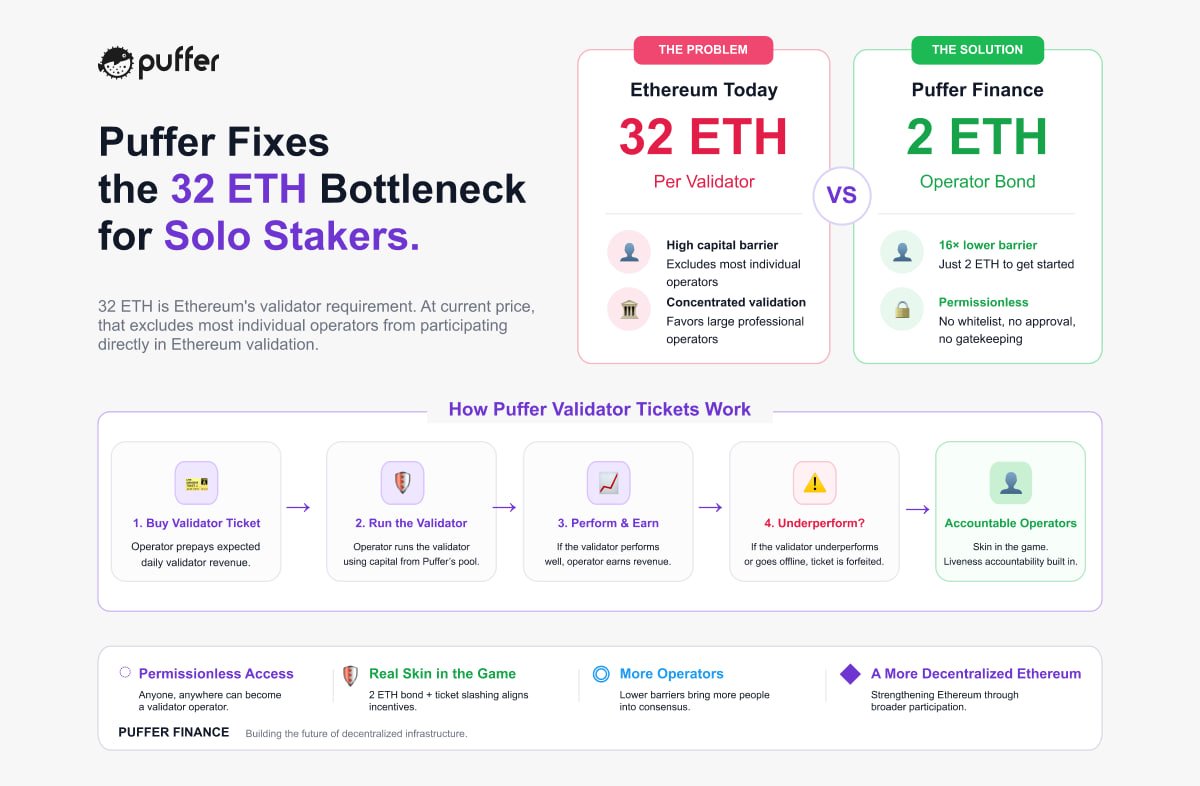
Puffer Fixes the 32 ETH Bottleneck for Validators. 🐡
A 32 ETH requirement keeps many capable node operators out of Ethereum validation.
Puffer’s 2 ETH bond lowers the entry barrier, while Validator Tickets create a prepaid operating model that helps keep validators accountable and aligned with the protocol.
👔 Institutional Staking #3 - Where Institutional ETH Yield Comes From
Puffer Institutional does not treat ETH yield as one blended return stream.
Institutions deposit ETH into a dedicated vault and receive ITokens representing their specific staking and restaking position. This matters because their exposure can be tracked separately instead of being blended into a generic pooled position.
From there, institutions can choose their exposure based on risk appetite: vanilla staking only, or staking plus restaking through EigenCloud AVS participation. ETH can generate yield through two main flows.
First, Validator Ticket revenue. NoOps purchase VTs to operate validators backed by institutional ETH — that upfront payment flows to the vault as yield. Institutions earn from VT sales rather than directly from block rewards.
Second, restaking rewards. Through the Restaking Operator architecture, institutions access additional yield from EigenCloud AVS participation.
Validator rewards and restaking rewards are handled through separate flows, giving institutions clearer accounting across where yield is generated.
The result is a more structured ETH yield framework: ITokens representing the position, validator participation, AVS exposure through restaking, separated accounting flows, and configurable operational control.
This flexible architecture allows institutions to configure restaking exposure, define permission boundaries, and separate yield accounting to match their own risk profile and reporting requirements. 🐡
🧩 Preconf Series #8: Roadmap
Puffer Preconf is rolling out in phases, moving from initial launch to a fully slashable security model.
🟢 Phase 1: Gateway Delegation
@gattacahq serves as the first production gateway, enabling ~100ms execution preconfs for OP Stack rollups. Validators can opt in through @eigencloud, delegate to the gateway, and earn ETH-denominated rewards, with reward forfeiture for missed proposals.
🟡 Phase 2: Multiple Gateways
More gateway providers come online, improving redundancy, competition, and service quality. Enhanced lookahead helps gateways coordinate more predictably and reduce gaps between handoffs.
⚪ Phase 3: Full Slashing
The complete slashing model goes live, with 1 ETH penalties for liveness failures and 1,000 ETH penalties for malicious MEV extraction. Slashed funds are redistributed to affected parties, not burned.
Puffer Preconf gets stronger with every phase. 🐡
When institutions stake ETH, operator accountability matters.
That is why Puffer requires a 2 ETH bond per validator: if downtime or slashing happens, operators are the first line of defense. 🛡️
@AmirOnchain on the security design behind Puffer Institutional. 👇
⚛️ Synchronous Composability on UniFi #6 - The Endgame for Ethereum Appchains
Ethereum’s next scaling challenge is keeping appchains connected to the state, liquidity, and composability that make Ethereum powerful.
UniFi is built for this: synchronous composability across L1, L2, and UniFi appchains, allowing dedicated execution environments to interact atomically instead of becoming isolated networks.
The stack works across four layers 👇
1️⃣ Real-time TEE proving
Verifies L2 state on L1 and enables L2 → L1 proof-generated bridging.
2️⃣ Signal Service
Passes L1 state to UniFi appchains in the same Ethereum slot, without off-chain verifiers.
3️⃣ Based sequencing + @Puffer_Preconf
Adds timing and execution guarantees, making L1 ↔ L2 composability trustworthy, not just possible.
4️⃣ Shared sequencing root across UniFi appchains
Enables L2 → L2 synchronous composability through state-aware gateways and proof-generated bridging.
UniFi uses Ethereum L1 DA to keep appchain data anchored to the same canonical truth used for settlement, sequencing, and state access.
For builders, synchronous composability means dedicated appchains without isolation. For users, it means apps that can interact across environments with one transaction, one outcome, and no async gap.
This is the endgame for Ethereum appchains: scalable execution that stays synchronously composable with Ethereum. 🐡
Today’s rollups often clone what exists on L1, then ask users to move into another isolated network.
That deepens fragmentation.
@AmirOnchain on why Ethereum scaling needs to reconnect users, liquidity, and execution 👇
"The way we constructed rollups today is that we clone whatever is on L1 onto this rollup, and now we say, 'I solve user problems.' But you’re not solving anybody’s problem. You’re just cloning a network, making it super centralized, and saying, 'Okay, come use my network, forget about L1 itself.'
That’s where, in my opinion, the main problem that happened with Ethereum was user fragmentation even before liquidity fragmentation."
📖 Glossary: Dedicated Execution
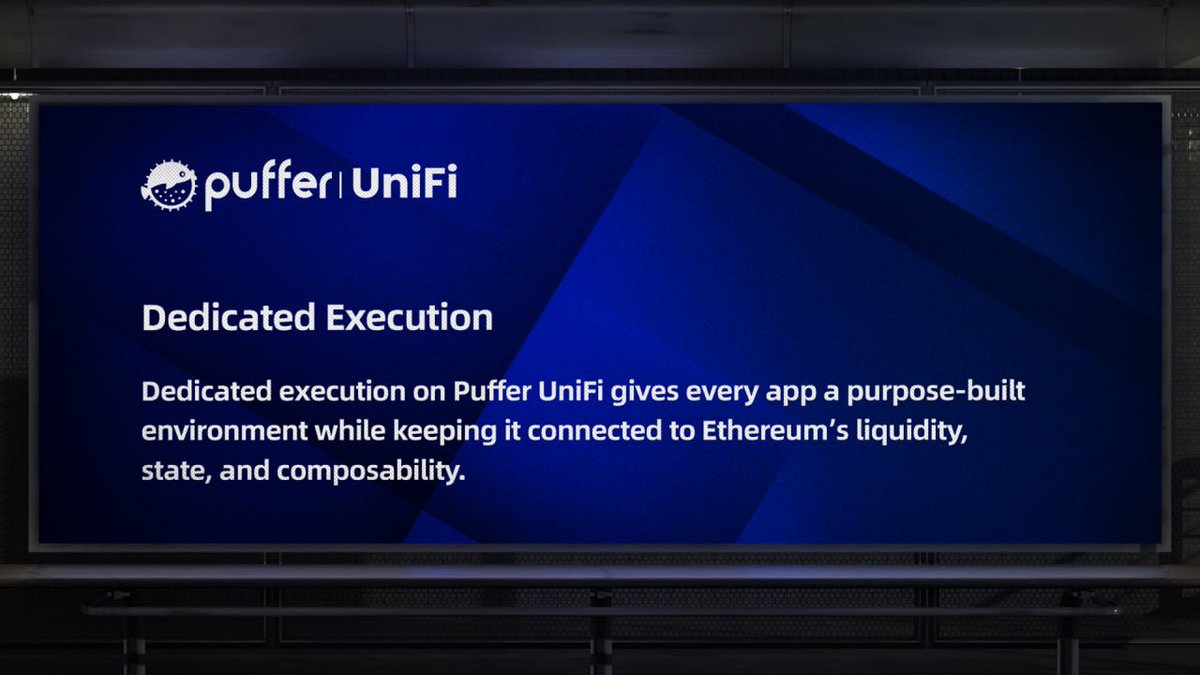
Dedicated execution means an app gets its own execution environment, designed around its own needs.
In a traditional rollup, every application shares the same execution environment. Trading, gaming, payments, social apps, and AI agents all compete for the same blockspace and performance profile.
But not every application needs the same thing.
Some need low latency. Others need high throughput. Others need specialized execution environments.
UniFi based appchains are designed differently.
They give applications dedicated execution without turning them into isolated chains. Through synchronous composability, appchains can remain connected to Ethereum L1 liquidity, state, and coordination.
Dedicated execution for apps.
Ethereum liquidity and composability for the ecosystem. 🐡
Puffer is security-first yield infrastructure for Ethereum. 🛡️🐡
Puffer's goal is to give ETH holders access to stronger yield through a staking architecture where security is built into the system from the beginning.
Let's dive in 🧵
1/11
Congratulations to @ethereuminsti on the launch of Ethereum Institutional!
An independent non-profit now live and focused on accelerating institutional adoption across Ethereum, its Layer 2 scaling solutions, and the broader ecosystem.
This is a meaningful step as institutions continue to evaluate onchain infrastructure, tokenization opportunities, stablecoin frameworks, and long-term settlement layer decisions.
Puffer is proud to support the broader Ethereum ecosystem. 🐡
1/ Announcing Ethereum Institutional
An independent non-profit dedicated to accelerating the institutional adoption of Ethereum, its L2s, applications and overall ecosystem.