Civilization. Accelerated.
Construction superintelligence that multiplies what humanity can build | Centuries of infrastructure in decades. Starting on Earth.
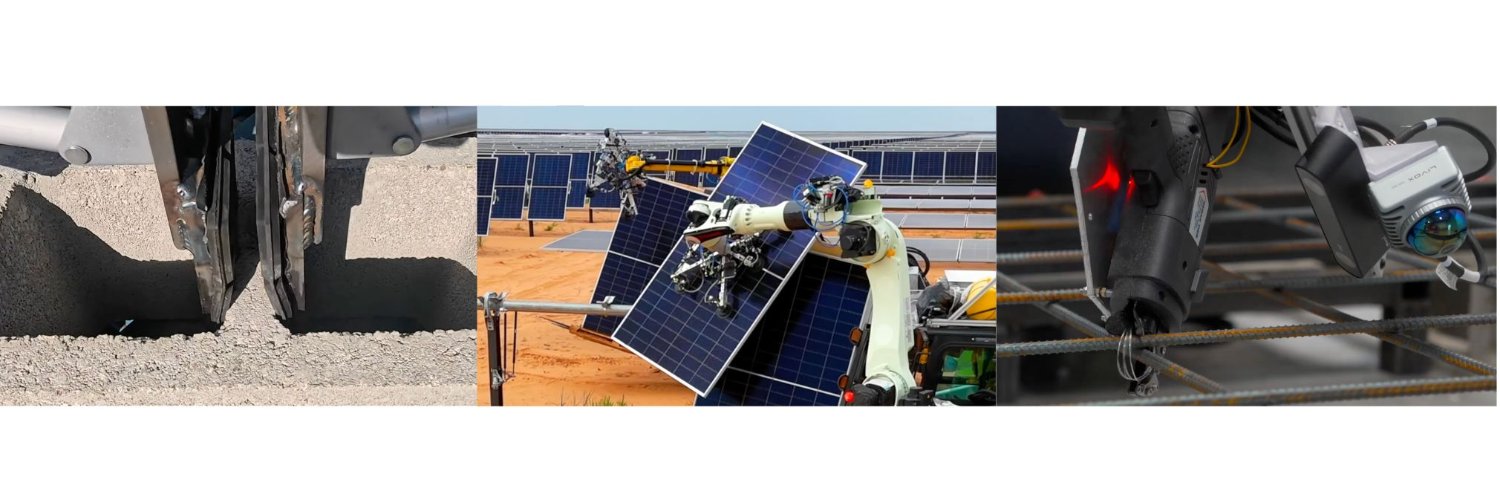
In house models which are learning representation of construction sites. Out thesis is that a lot is common on construction sites. People wear hard hats, material comes on pallets, all materials gets hammered by weather like snow rain dust and we learn these representations, so little classical robotics.
We have spent a sizable effort in creating construction based in house simulation infrastructure where our systems gets trained.
Given the teams DNA of CMU robotics institute folks are core AI/ML with hardware being mostly MIT and ex marines on deployment!
Gritt AI is now installing 1 MW of solar capacity per day at 4× the speed of a typical installation crew. And our daily installation rate keeps accelerating.
At our active site, each day’s installation adds enough solar capacity to meet roughly 200 homes’ annual electricity needs once operational.
That’s the milestone: every day, more infrastructure built. Every increase in speed, more capacity to meet America’s growing energy demand.
Solar is just the beginning. Next, we aim to bring Gritt’s construction superintelligence to data centers, water treatment plants, and pipelines.
Our mission: enable humanity to build centuries’ worth of infrastructure in decades.
Civilization. Accelerated.
@Jason@andrewbeebe@albertwenger@hayleybay@CleanVC@rebeccakaden@Rajil@GrittRobotics
At @GrittRobotics we are building a construction superintelligence with the mission to build centuries' worth of infrastructure in under decades. We're starting first with large solar farms, moving to data centers, and then moving to other projects such as pipelines, water treatment plants, and transmission line infrastructure. Our thesis is that a generalized intelligence designed to work outdoors, which does simple tasks like picking and placing, simple repetitive assembly, and simple transport, is key to unlocking the scale.
41% of skilled workforce in construction will retire by 2031 in US
We are seriously short of workforce which can build infrastructure.
Having an intelligence which is designed to work in chaotic outdoor setting can help speed up many step and repeat labor tasks.
@GrittRobotics we have a mission to help civilization build infrastructure faster by creating an intelligence which understanding the variation of outdoor: rain dust snow.
We have actively deployed our robots and handled over 35,000 placements of panels in real production settings.
Thanks for a great conversation @JayKapoorNYC
And thanks to @obviousvc@usv@albertwenger@Rajil@CleanVC@hayleybay@active_impact for supporting us
"We have a giant fusion reactor in the middle of the solar system. It never shuts down. And we can print solar panels like newspapers."
The only problem is solar panels got 40 lbs heavier, sites got 9x larger, and the crews stopped showing up.
So @PuneetP wrote the software that lets rented construction equipment build solar farms by itself. 35,000 panels installed, zero broken. @GrittRobotics software is how America actually gets to energy abundance.
His ever first long-form interview. On our 100th episode of CLIMB. The latest in our Dirty Jobs series:
Leadership in AI will be solely dependent on who can get more hardware out. Chips, power, those are the things which will make any kind of corporation or country more powerful. That's where the battle is: Can you build that hardware? Can you build intelligence which can build that hardware quickly?
Three days ago I left autoresearch tuning nanochat for ~2 days on depth=12 model. It found ~20 changes that improved the validation loss. I tested these changes yesterday and all of them were additive and transferred to larger (depth=24) models. Stacking up all of these changes, today I measured that the leaderboard's "Time to GPT-2" drops from 2.02 hours to 1.80 hours (~11% improvement), this will be the new leaderboard entry. So yes, these are real improvements and they make an actual difference. I am mildly surprised that my very first naive attempt already worked this well on top of what I thought was already a fairly manually well-tuned project.
This is a first for me because I am very used to doing the iterative optimization of neural network training manually. You come up with ideas, you implement them, you check if they work (better validation loss), you come up with new ideas based on that, you read some papers for inspiration, etc etc. This is the bread and butter of what I do daily for 2 decades. Seeing the agent do this entire workflow end-to-end and all by itself as it worked through approx. 700 changes autonomously is wild. It really looked at the sequence of results of experiments and used that to plan the next ones. It's not novel, ground-breaking "research" (yet), but all the adjustments are "real", I didn't find them manually previously, and they stack up and actually improved nanochat. Among the bigger things e.g.:
- It noticed an oversight that my parameterless QKnorm didn't have a scaler multiplier attached, so my attention was too diffuse. The agent found multipliers to sharpen it, pointing to future work.
- It found that the Value Embeddings really like regularization and I wasn't applying any (oops).
- It found that my banded attention was too conservative (i forgot to tune it).
- It found that AdamW betas were all messed up.
- It tuned the weight decay schedule.
- It tuned the network initialization.
This is on top of all the tuning I've already done over a good amount of time. The exact commit is here, from this "round 1" of autoresearch. I am going to kick off "round 2", and in parallel I am looking at how multiple agents can collaborate to unlock parallelism.
https://t.co/WAz8aIztKT
All LLM frontier labs will do this. It's the final boss battle. It's a lot more complex at scale of course - you don't just have a single train. py file to tune. But doing it is "just engineering" and it's going to work. You spin up a swarm of agents, you have them collaborate to tune smaller models, you promote the most promising ideas to increasingly larger scales, and humans (optionally) contribute on the edges.
And more generally, *any* metric you care about that is reasonably efficient to evaluate (or that has more efficient proxy metrics such as training a smaller network) can be autoresearched by an agent swarm. It's worth thinking about whether your problem falls into this bucket too.
@elonmusk Love our tesla MYP
Picked up a vehicle two months ago. Was promised a small portion as refund for 30 days delayed processing and specific problems with our VIN. The partial refund never came in despite follow ups. This breaks some amount of trust in sales team.