Save the Date! Dementia; Understand Together are holding a community champion welcome workshop on 25th March online from 12.30-1.30pm with guest speakers speaking on the importance of inclusive communities. email [email protected] to register #understandtogether
Listen to @SPKennelly speak on "The many faces of Alzheimer's" which is a 12 part series, with guest speakers. Launched with @TUH_Tallaght - you can listen https://t.co/Oyew3whtCw
Palliative care is not widely offered to neurology patients across the world. Prof. Janis Miyasaki speaks about the importance of palliative care for movement disorder patients and their families. https://t.co/2XDcmKmRyQ
🚨New @tilda_tcd study. How prevalent are modifiable dementia risk factors in Ireland 🧠 🇮🇪? 12-year observational study in community-dwelling older adults. Massive opportunity to optimise brain health for many!! @drnire@RoseAnnekenny1@alzheimersocirl https://t.co/f24E6fVPae
🧠Are you a care partner of a person living with LBD?
✍️The Emerald Lewy project in @tcddublin is inviting current/former care partners of a person with dementia to take a survey to identify support gaps & improving quality of life.
➡️See below or go to https://t.co/1PSHxHV6Wr
🚨Major publication that proposes the varicella-zoster virus (causes shingles) is a modifiable risk factor (with vaccination) to reduce dementia risk. It’s an imperative shingles vaccine gets added to 🇮🇪 national immunisation program. @drnire https://t.co/ZH7U2xackM
🎨🎭📚🧠Don't miss this fascinating webinar on brain health and cultural spaces, taking place tomorrow from @GBHI_Fellows!
🗓️Wednesday, 17th September
⏲️14.00-15.00
See below for registration and more information ⬇️
Dementia is not an inevitable part of ageing.
Thanks to global research we now know that up to 45% of dementia cases could be prevented through lifestyle changes. Fourteen modifiable risk factors identified across early, mid, and late life are reshaping how we think about dementia prevention.
As part of the Think Again campaign launched this week by the News Corp websites, NeuRA CEO Professor Matthew Kiernan AM spoke to @newscomauHQ about the urgent need for action.
“Dementia represents a huge disability and cost burden to the community, and there is a lot of pressure on governments to address it,” said Prof Kiernan.
The 14 modifiable risk factors:
Early Life
• Not completing secondary education
Mid Life
• High LDL cholesterol
• Depression
• Hearing loss
• Traumatic brain injury
• Obesity
• Physical inactivity
• Type 2 diabetes
• Smoking
• High blood pressure (hypertension)
• Excessive alcohol consumption
Late Life
• Social isolation
• Untreated vision loss
• Air pollution exposure
By understanding and addressing these risk factors, we can all play a role in reducing dementia risk and supporting healthier ageing for future generations.
Read the full article here: https://t.co/4hadGemAm9
#DementiaAwarenessMonth #NeuRA #HealthyAgeing #BrainHealth @nervecentrals
Rehabilitation is vital for older adults to regain independence after illness or injury—yet the need remains unmet. We present a collection of our best research + expert commentary: Get Up, Stand Up for geriatric rehab. #Rehab2030#Rehabilitation2030 https://t.co/NGF3ugKRFK
Last chance to join this year's #Parkinsons Foundation MasterClass!
🗓️ 30th Sep – 1st Oct 2025
Fully booked for in-person attendance, but you can still join us virtually: https://t.co/kjf7v6LRDs
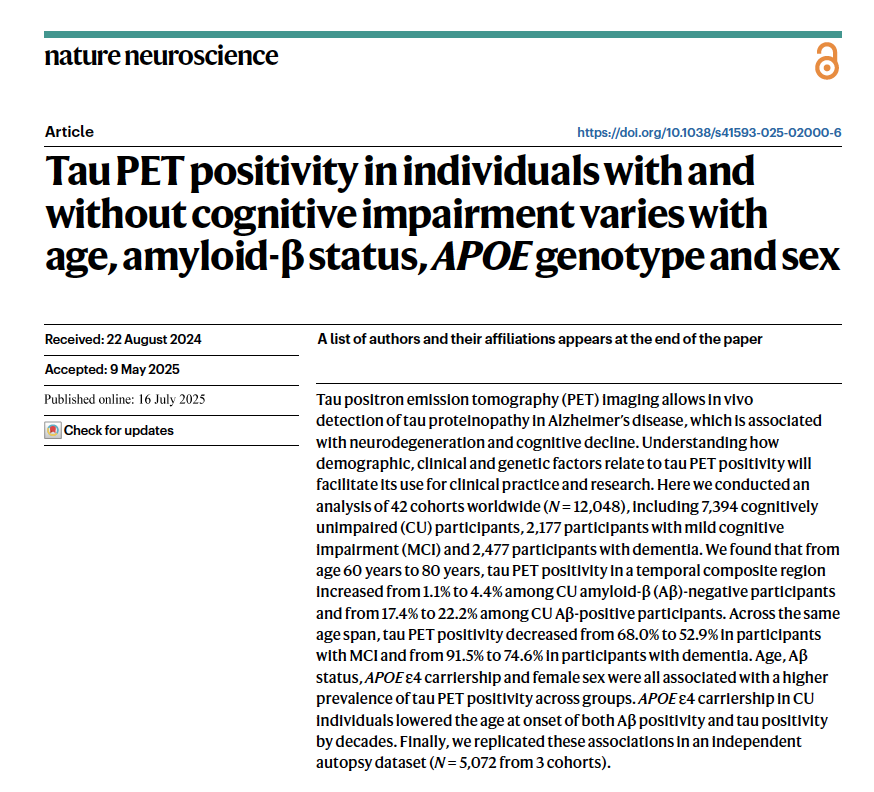
Pleased to be able to contribute to this huge international effort led by @RikOssenkoppele and colleagues @biofinder_study exploring tau PET in n=12,048 individuals *open access* paper here: https://t.co/IhgQ0meDN8
Virtual places available for #Parkinsons Foundation MasterClass 49!
🗓️ 30th September – 1st October 2025
This course is perfectly suited to the whole MDT, particularly those in the early years of their practice or new to Parkinson's.
➡️ Find out more: https://t.co/IDezkl3k37
Has clozapine been unleashed? A door opens for folks w/ movement disorders. Clozapine isn’t just a game changer for schizophrenia, it’s an underused powerhouse for tough to treat psychosis in Parkinson’s and DLB. Clozapine may also have important roles in tardive dyskinesia, dystonia, tremor and even Huntington’s. With the FDA eliminating the REMS registry, we may finally see clozapine used more frequently in movement disorders, and hopefully more carefully and thoughtfully as Palmer and colleagues point out in their new viewpoint in Movement Disorders Clinical Practice.
Key points:
- Clozapine’s benefits go far beyond schizophrenia. It’s shown strong effectiveness in treating Parkinson's and DLB psychosis, Parkinsonian tremor, tardive dyskinesia and select dystonias.
- The authors argue that the REMS registry was a bottleneck. It made prescribing clozapine harder than necessary (especially in neurology), and it limited its use despite strong evidence.
- Dismantling REMS will open the door for neurologists to have a new flexibility. Now, decisions about clozapine use can be made between a healthcare professional and patient and not dictated by a database.
My take: There were 5 points that resonated with me about the Palmer viewpoint. 1- Clozapine isn’t just for schizophrenia. It may help w/ challanging symptoms like hallucinations, tremor and uncontrolled movements in Parkinson’s and other hyperkinetic movement disorders. 2- The FDA just made access easier. No more national registry that may have blocked access for some. 3- Many patients missed out before. Because of REMS, some who could have benefited from clozapine, never got the option. 4- Healthcare professionals now have breathing room. We can use our judgment to tailor clozapine safely. We can choose potential people who may benefit w/o being handcuffed by a 'too rigid' system. 5- This is an opportunity. If you or a loved one has Parkinson’s, DLB, or another movement disorders and they are struggling w/ psychosis or hyperkinetic movements it may be worth a clozapine conversation. The REMS curtain has lifted. Let’s step forward but do it safely.
https://t.co/ZpMOyPK6F3
Some information hospitalists use to prescribe and watch for side effects:
https://t.co/Ju5cIBLPgS
#Parkinsons #Clozapine #TardiveDyskinesia #DLB #Huntingtons @FixelInstitute@ParkinsonDotOrg@MDCP_Journal
It’s time to flip the script on Parkinson’s care. Do we need more Parkinson’s Integrated Practice Units (IPUs)? The Parkinson’s Elevated Model suggests we shift from reacting to 'proacting.' Instead of chasing disability, let’s strengthen the potential for a greater 'healthspan.' Healthspan is that sweet spot where people live longer, healthier, and more independently. The Parkinson’s Elevated model by McKee and colleagues is exactly the type of blueprint we need.
Key Points:
- A new model offers a Parkinson’s Integrated Practice Unit (IPU) that prioritizes proactive, value-based care coordinated across a multidisciplinary team.
- The team includes neurologists, primary care practitioners, rehab therapists, and others.
- Exercise is medicine. High-intensity aerobic exercise is positioned not just as helpful, but some people think it may be disease-modifying.
- The model focused on sustainability by design. A shared-risk financial model was aligned w/ health system incentives.
- The model focused on what persons w/ disease need. It asks the question 'how can each person benefit?' Examples include fewer hospitalizations, better quality of life and a dignified end-of-life experience.
My take: There were 5 points that resonated w/ me about this article. 1- We don’t just need more care, we need the right care at the right time. Parkinson’s care should be personal, proactive, and patient-centered. 2- Exercise isn’t optional, it’s essential. If it were a pill, we’d be handing it out in every neurology clinic. 3- The fragmented healthcare model is failing people w/ Parkinson’s. It’s time we stop bouncing patients between providers and start building teams. 4- A better journey is possible. Early diagnosis, evidence-based exercise, and coordinated support can potentially preserve function and dignity. 5- We can’t afford to wait. As healthcare costs skyrocket, Parkinson’s Integrated Practice Units aren’t just better, they’re smarter and more sustainable. Take home point: Let’s build a future where Parkinson’s care doesn’t just manage disease, it promotes health. We need a plan for better care.
https://t.co/h5Qas12kET
https://t.co/NRJnbeX05G #Parkinsons #Healthspan #Neurology @ParkinsonDotOrg@FixelInstitute
Minister O Donnell has today announced the HSE will commission the 1st National Dementia Registry in Ireland to map services, identify need & plan the delivery of equitable access to services @kodonnellLK@HSELive@DSIDCDementia
The wonderful Anne Merriman will present her work on 30 April. Highly recommend listening to her pioneering global contribution to palliative care in particular to Hospice Africa.