President and Chief Investment Officer at Pure Portfolios, a financial services firm with an innovative, modern, and low-fee approach to wealth management.
The U.S. soccer federation is a poor return on invested capital.
I played soccer for 20+ years.
Grassroots.
Academy.
D1 college.
Pursued professionally after.
And I’ll say the quiet part out loud:
The US soccer infrastructure is broken.
In America, we treat playing D1 soccer like it is the peak achievement.
For most families, clubs, coaches, and players, the entire youth soccer machine is built around one goal:
Get recruited.
Get a scholarship.
Play college soccer.
But if the objective is to produce world-class players, D1 soccer is a terrible development path.
From 18-22, some of the most important technical development years of your career, you are preparing for a 3-4 month season built largely around athleticism, direct play, set pieces, fitness, and survival.
Now compare that to an 18-year-old in Spain, Argentina, Morocco, Italy, England, or France.
That player has likely been in a professional environment for years.
Training daily.
Playing meaningful matches year-round.
Competing against grown professionals.
Getting thousands more touches.
Learning how to solve the game under pressure.
The gap is massive.
And it shows.
American players are usually athletic.
They are usually fit.
They usually compete hard.
But at the highest levels, that is not enough.
The biggest difference is technical comfort.
We do not move the ball like Spain.
We do not combine like Argentina.
We do not play with the same fluidity, rhythm, and confidence you see from countries where the game is embedded into the culture from childhood.
That comes down to volume.
Volume of touches.
Volume of street soccer.
Volume of futsal.
Volume of unstructured play.
Volume of high-level training environments.
Volume of meaningful games.
In the US, youth soccer is expensive, overly organized, overly coached, tournament-driven, and too often built around winning games at 13 instead of developing players for 23.
Parents spend thousands.
Clubs charge thousands.
Travel teams fly all over the country.
Showcases become the product.
Recruiting becomes the scoreboard.
But the return on invested capital is poor.
We probably spend more money on youth soccer than almost any country in the world, yet the technical output does not match the investment.
That is a broken operating model.
And like any business, if the output is weak, you do not blame the customer.
You inspect the system.
The US has talent.
The US has athletes.
The US has money.
The US has facilities.
But the foundation is wrong.
We built a pay-to-play, college-recruiting machine and confused it for a world-class player development system.
Those are not the same thing.
Until we fix the grassroots layer, increase meaningful touches, make development less dependent on family income, and stop treating college soccer as the top of the mountain, the US will keep underperforming relative to its resources.
I’m not saying this to trash US Soccer.
I’m saying it because I lived it.
And if we actually want to become a powerhouse, we have to be honest about the infrastructure first.
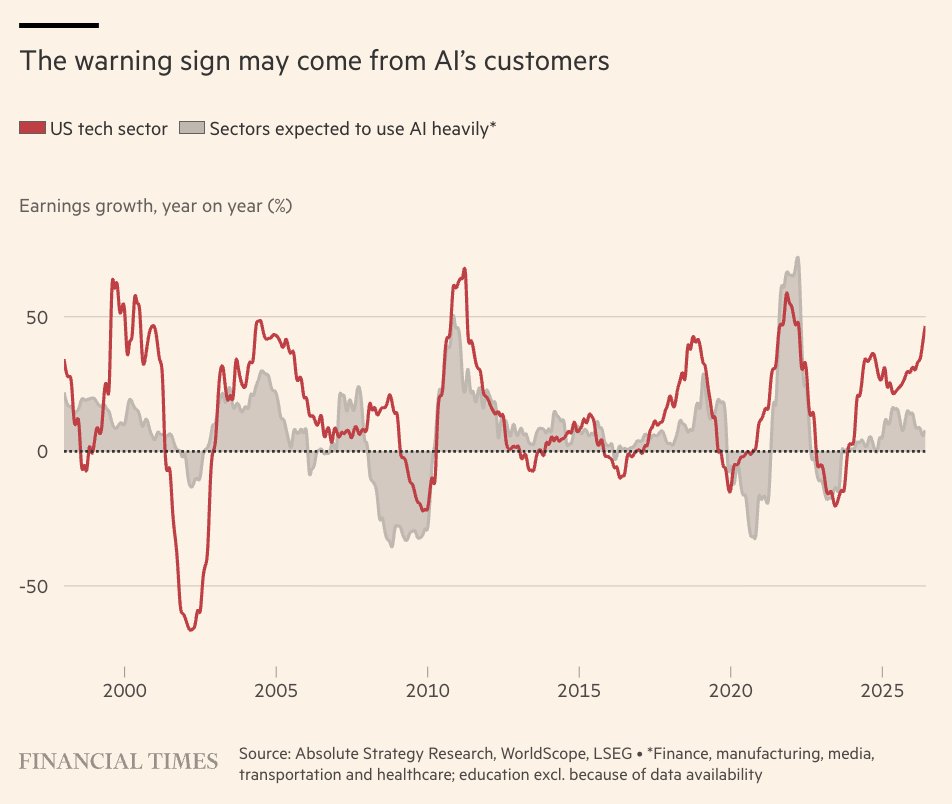
From the FT: "The key lesson from the end of the dotcom bubble is that the main risk will probably come from deterioration in the cash flow of the AI sector’s prospective customers. So, investors should be more concerned about any deceleration in the earnings and cash flow of the potentially heavy AI user sectors, such as financials, manufacturers, media, transportation, education and healthcare."
As I've written often in one form or another in my reports since launching Sage Road almost a year ago (https://t.co/Wgwz2xnvR6), I believe the market’s myopic fixation on the builders of the AI revolution has led to widespread neglect of the beneficiaries of AI’s capabilities. This matters not only to understanding how ROI will manifest and define winners/losers across sectors, but also the willingness and ability of enterprises to subsidize extraordinary AI CAPEX.
FT link: https://t.co/edwWyBYrnX
Your 90-year-old self would give anything to be where you are right now. Lift weights, walk, eat healthy, and sleep well. You are living your golden years right now. You're younger than you think you are. Don't waste it.
I'm convinced that 99% of success is just working in a flow state for 4 hours a day. The person who can stay off their phones and away from notifications will absolutely crush it.
I read this book nearly 10 years ago.
In the last decade, I’m not sure there’s a single passage from any book I’ve reflected on more than this one.
“It would be infinitely foolish of me to focus exclusively on a job that many others can do if it comes at the cost of the role that only I can fill. Before we look to be excellent anywhere else, we must first be excellent in our homes.”
Today felt like the right day to share it.
Happy Father’s Day to the men doing their best to lead well both at work and at home.
A reminder from Atomic Habits by James Clear:
“Every action you take is a vote for the type of person you wish to become. No single instance will transform your beliefs, but as the votes build up, so does the evidence of your new identity. This is one reason why meaningful change does not require radical change. Small habits can make a meaningful difference by providing evidence of a new identity. And if a change is meaningful, it is actually big. That's the paradox of making small improvements.”
Mark Manson on how to win at life:
1. Commit to doing a hard thing.
2. Do the hard thing.
3. Feel good about doing the hard thing.
4. Become someone who enjoys doing hard things.
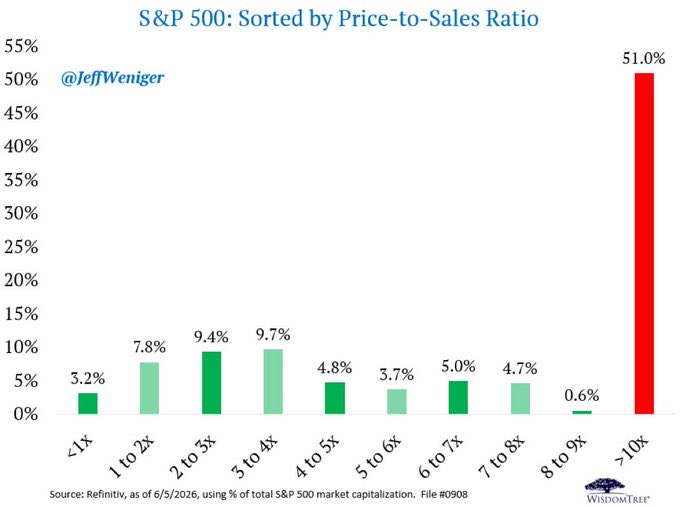
Tomorrow I'm publishing a piece on what it actually means to buy a stock at 10 times sales.
Here's the chart that started it.
Sort the entire S&P 500 by price-to-sales. Most of the index sits in the normal range, 1x to 8x. The way a normal market looks.
Then one bar towers over the rest. 51% of the index's market cap trades above 10 times revenue.
Not a frothy corner. Not one hot sector. Half of the benchmark inside most pension funds and retirement accounts.
In 2002, that exact multiple made the CEO of Sun Microsystems call his own shareholders irrational. "Do you realize how ridiculous those assumptions are? What were you thinking?"
That was one company.
Today it's half the S&P 500.
The math, the history, and what comes next. Tomorrow.
Seven Things This 63 Year Old Surgeon Would Tell My 40-Year-Old Self
I am 63 now, and I spend my days as an orthopedic surgeon watching how people's earlier choices show up in their bodies decades later. I see it in my college friends, high school buddies, and patients that I have known for 20+ years. If I could sit across from myself at 40, here is what I would want that man to understand. None of what follows is complicated, and all of it compounds over the decades… either against you… or in your favor. You are largely in control.
Kobe Bryant once said:
“Everyone wants to be a beast. Everyone wants to be the best. But very few people are willing to do what it actually takes. Because what it takes is boring. It is waking up at 4:00 AM. It is shooting the same shot a thousand times. It is watching the film when you are tired. People fall in love with the result, but they hate the process. You have to fall in love with the boredom. You have to fall in love with the repetition.
If you can find joy in the mundane work that no one else sees, the lights will eventually shine on you.”
Former BlackRock fund manager Ed Dowd on the SpaceX IPO:
"people gotta understand... [SpaceX] raised $75 billion... [and only] floated 5% of the stock... it's a very small float"
"[But its valuation], that's a different story"
"$1.7 trillion did not go to SpaceX. [It is] $75 billion. So people need to understand that"
"then when Anthropic and OpenAI, if they ever make it to IPO, they're going to raise about $100 billion each. So the total raised actual real money is about $300 billion between these three IPOs"
"Their valuations, that's a different story. And those probably won't hold and they'll probably, you know, go down 80%. So anybody buying these stocks at these prices is probably going to lose a lot of money if they hold on to them"
@ShannonJoyRadio@DowdEdward
What keeps me awake at night?
This.
This is one of the oldest froth gauges on Wall Street: the year-over-year change in margin debt. How fast investors are borrowing money to buy stocks.
When it crosses 55%, optimism has gone rampant and people are loading up on leverage in the late innings of a bull market. It has flagged every major top since the 1970s. 1972. 2000. 2007. 2021.
Today it sits at 53.34%.
Not 55 yet. But knocking on the door.
And it doesn't sit alone. Look at everything else lighting up at the same time:
– Margin debt as a share of GDP just hit an all-time high
– 70% of BofA's market-peak signals are triggered, the average seen at prior tops
– South Koreans are cashing out insurance policies at a loss to chase the rally
– Momentum is beating quality by the most since December 1999
– The largest IPO in history is hitting the tape this week
So to answer the question directly.
Is everybody nuts?
Not nuts. Just leveraged, optimistic, and quietly convinced it's different this time. Which is exactly what the late stage of every cycle feels like from the inside.
Froth is never a timing tool. The market can stay irrational, and margin debt can push well past 55%, for far longer than feels possible. People made fortunes in 1999 buying with both hands.
But here's the part worth remembering.
Leverage feels like genius on the way up.
It is the thing that turns a normal correction into a forced liquidation on the way down.
The borrowed money always gets called back.
Usually at the worst possible moment.
#IBDPartner
Jensen Huang: “The best career advice I got was from a gardener”
“Very few people know this but I don’t wear a watch,” Nvidia founder Jensen Huang begins. “And the reason I don’t wear a watch is because now is the most important time. Just dedicate yourself to now.”
Jensen explains by telling a story:
“The best career advice I got was from a gardener. I was on a family trip in Kyoto, and we went to the temple that had the largest moss collection in the world . . . All of the moss is perfect, and every species of the world’s moss is there. It was a hot summer day — anybody who’s been to Kyoto knows how incredibly hot it is during the summer — and my family walked by this old man who was squatted down working on the moss with a bamboo tweezer. His bamboo basket was nearly empty with only two or three small pieces of dead moss.”
“What are you doing?” Jensen asked the old man.
“I am taking care of my garden,” the old man replied.
The old man told Jensen that he has been working on the garden for almost 30 years.
“But this garden is so big and your tweezer and basket are so small. How can you take care of the whole garden?” Jensen asked.
“I have plenty of time,” said the old man.
Jensen reflects:
“That’s the best career advice I can give you. Most of the time I wait for things to come to me. I’m rarely chasing things. I don’t have a watch. I’m focused on now. I’m enjoying my job. I’m the longest-running tech CEO in the world . . . Dedicate yourself to learning all the time, doing the best possible work you can, and leave everything on the field. By the time I go to bed I’m exhausted, and I’m happy about my day because I did everything I could . . . You’ll be surprised. I’m not at all ambitious. I don’t aspire to do more. I aspire to do better at what I’m currently doing. I’m not reaching for more. I wait for the world to come to me.“
He continues:
“People who know me also know that Nvidia doesn’t have a long-term strategy. We have no long-term plan. Our definition of a long-term plan is, ‘What are we doing today?’ . . . You have plenty of time. Enjoy your work. Do the best you possibly can. Just keep learning every day, and good things will come to you.”
Seriously, why even buy an IPO after venture capital has picked over the equity for a decade??? Just buy the post-lockup dump-athon.
h/t Truist's Keith Lerner
cc @jimcramer@andrewrsorkin@BeckyQuick@SullyCNBC
I researched human happiness for three years while working on my first book. One thing I learned was that happiness was really about attention. The happiest people didn't have perfect lives. But the imperfections were never their focus. They found joy in ordinary days. Gratitude in small moments. Meaning in simple things. Happiness is about attention, not perfection.
Officially 1 month since I switched to a flip phone.
- Everyone is more severely addicted to their smartphones than I thought. Once you have a dumbphone, you'll frequently find yourself as the only person in the room not on their phone. It's not just teenagers, it's parents and adults of all ages. It's like everyone is stuck in a trance. 75+ year olds might be the only exception.
- All the objections I previously had for getting a dumbphone have turned out to be overblown and/or solvable. My iPhone addiction had fed my brain excuses to not do this earlier. If you really want to make the switch, you can.
- I've felt embarrassed to pull out my flip phone in public at times, for fear of being different or drawing too much attention to myself. But I have learned to just own up to it. Most people end up saying something like "Oh, I probably should do that too."
- I am using my brain more. Even though my flip phone has Waze, I find myself memorizing maps and roads. I'm more bored and get lost in my thoughts. I'm using paper and pen more. Increased desire for tangible things > digital things.
Overall, it has been a great experience and I plan on never going back.
I’m convinced that no matter how you choose to live, people will tell you that you’re doing it wrong. Wrong priorities. Wrong work. Wrong relationships. Wrong whatever. Your entire life will change the moment you learn to smile, nod, and ignore every single one of them.
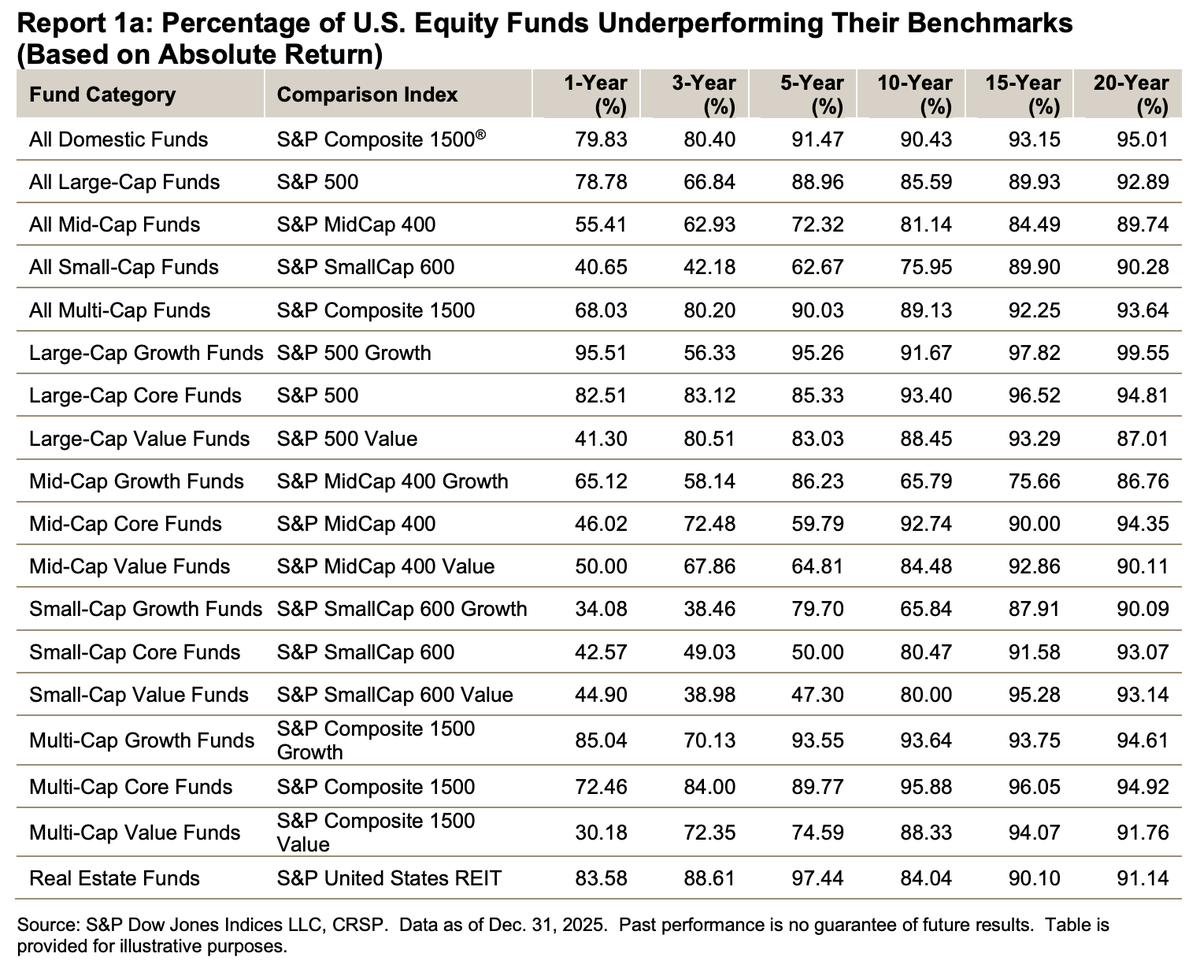
"Index fund investors are the bagholders again" is such a lazy take
Index fund investors, by definition, always hold the losers and they still win b/c the winners more than make up for the losers