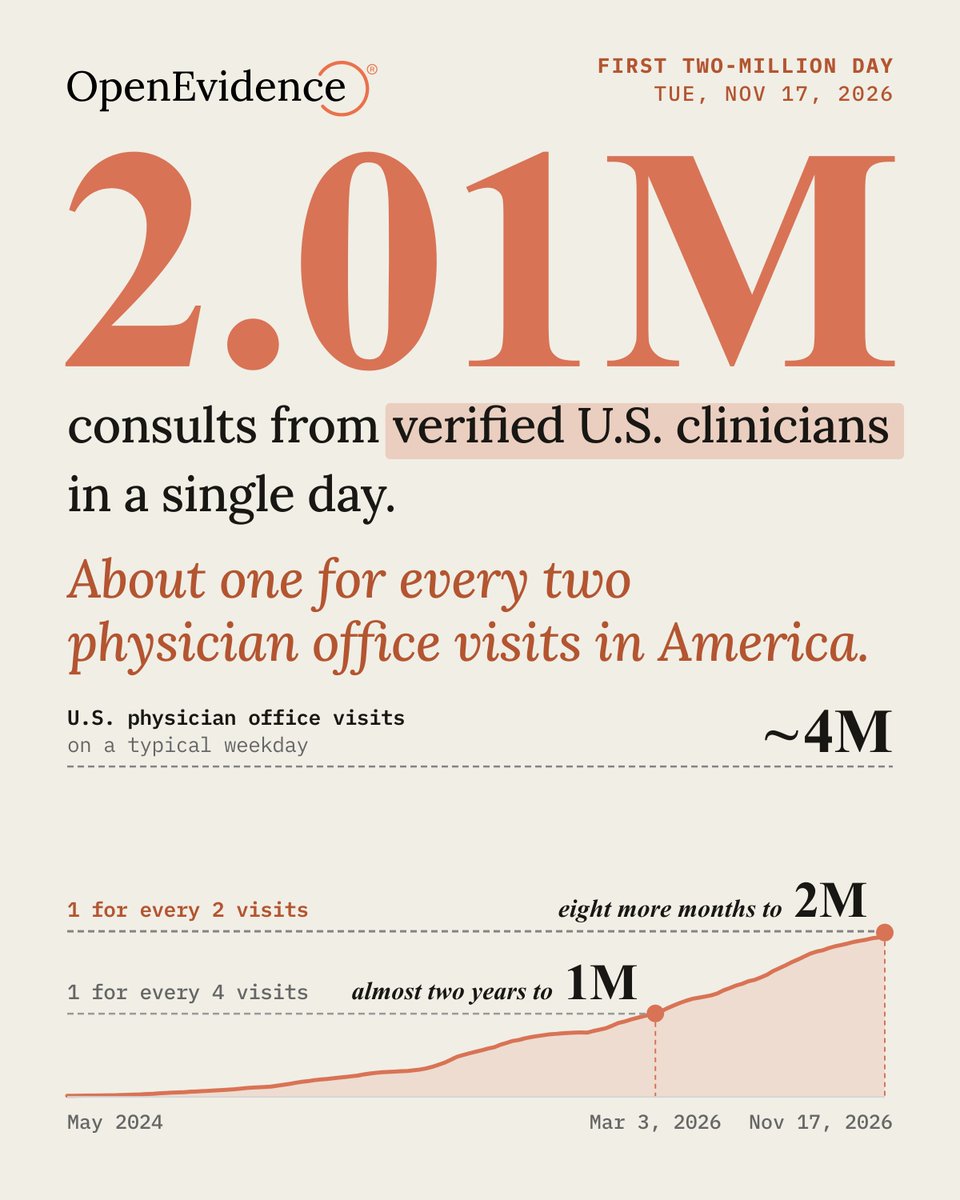
Tuesday was the first day in OpenEvidence history with more than two million consults from verified U.S. clinicians in one 24-hour cycle.
About one consult for every two physician office visits in America.
The math: Americans make over a billion visits to physicians’ offices a year, roughly four million on a typical weekday. A consult is not a visit, and one visit can involve several questions.
OpenEvidence is unequivocally the most popular AI for doctors in the United States and has become the default operating system of medical knowledge.
RVMD - Best in disease efficacy drugs in life threatening or serious diseases don’t need marketing. Patients and families come running asking for it. It’s 2026.
Since people are talking about target crowding, here's a chart from an upcoming post: <5% of new drugs entering the clinic are going after targets that haven't been tested clinically before, ~60% are going after targets with an approved drug. New ideas are hard to find!
Over the past few months, Anthropic scientists have engaged in deep research partnerships with six organizations developing new medicines. We've also begun drug discovery efforts of our own.
In doing so, we’ve learned much more about how Claude can support the many stages of drug development.
In this blog post, we share some early results from these efforts, and describe how this work fits in with our wider ambitions in the life sciences.
https://t.co/EVbxkdDTgJ
ESMO 2026 kicks off later this week - we analyzed thousands of abstracts and pulled out 8 themes that stood out to us heading into the conference.
• Something fundamental about oncology is that every time a drug moves earlier in treatment, it changes the downstream patient population (and the competitive landscape), creating new opportunities for differentiation.
We see that theme coming up in a few areas this year, with EV + pembro in bladder cancer and HER2-directed ADCs in breast cancer moving earlier. Frontline treatments tend to be more durable in holding their position in the treatment sequence, so being able to anticipate these shifts as pivotal data emerges is a huge advantage.
Send me a message if you'd like this analysis done for a space you're tracking closely.
• One of the best parts of ESMO is getting to peer into the future - there's often a big disconnect between current late-stage trials and where early-stage efforts are accumulating. For example in KRAS, ~76% of clinical KRAS abstracts involve combinations, versus just 1 in 4 ongoing Ph3 programs.
Development competition is split between two approaches: selectively target the dominant mutant (G12D) vs. inhibit a broader set of RAS-driven tumors (daraxonrasib). All things equal, the latter is a better opportunity, so the debate is where precision might beat breadth.
• China is dominating ADC innovation, with ~86% of Ph3 readouts at ESMO coming from China-originated assets. Some are quite novel too, such as bispecific architectures (i.e. EGFR x HER3)
Broadly, as ADCs have moved into earlier treatment settings, they've been benchmarked against non-ADC standards. As some settle in as frontline treatment, it's creating a resistance problem for next-gen assets: if payload resistance cuts across targets, then the Topo I concentration may 'poison the well' for ADCs still competing in later-line settings.
The 12-page preview below gets into the details behind these and other themes, including key programs, data and references. Hope it's helpful for everyone heading to Madrid or following along remotely.
Let us know in the comments what trends you're watching and if you'd like us to send the full PDF + some bonus data to you directly.
The pandemic was the first time I realized how much of an information lag exists between X and the outside world. A lot of alpha still exists by being hyperonline.
The problem of our time is not merely information overload. It is that the time required to construct a coherent understanding of reality is becoming longer than the time during which that understanding remains valid.
NEW ODD LOTS:
It’s the podcast debut for Jeff Yan
@tracyalloway and I have an ultra-rare interview with the CEO and co-founder of Hyperliquid Labs about his plan to house the world’s entire financial system
https://t.co/qZg80EzgOh
Breaking News: China’s exports grew in September at the fastest pace in almost any month since 2010, after the global financial crisis. https://t.co/eVYq7sn8lZ
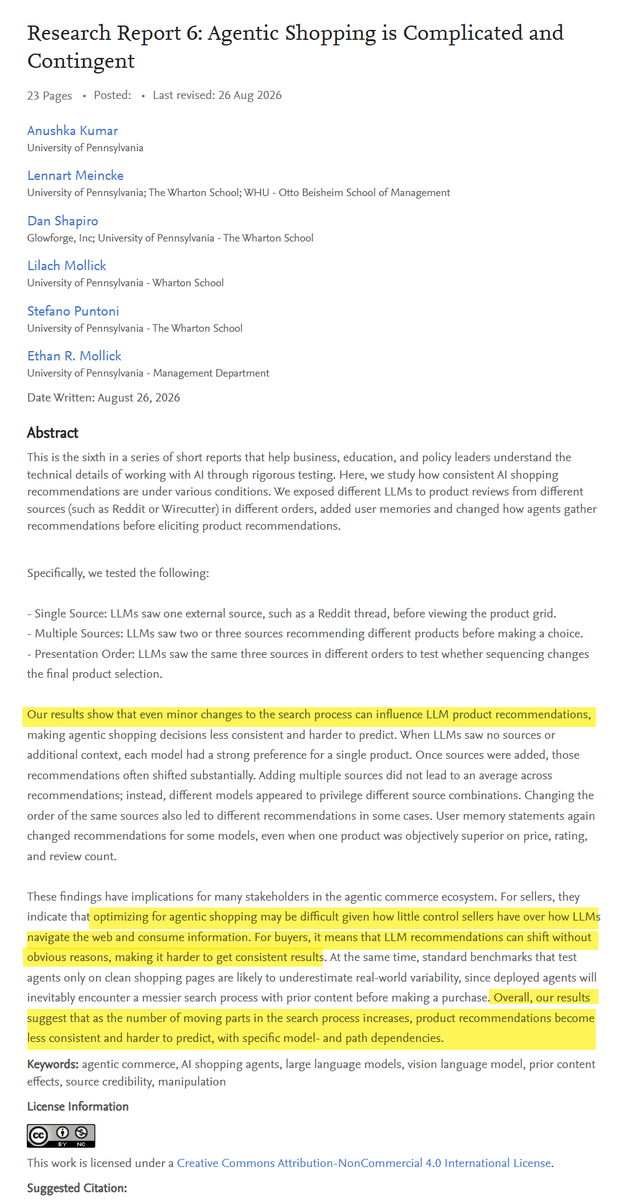
🚨Our new research examines agentic shopping: can you consistently predict (or, using marketing, influence) what an agent chooses?
Nope.
We found that even small differences (viewing order of pages, memories) changed AI preferences in unpredictable ways. https://t.co/Gyw4gBecyw