It's an exciting time @TeamOratomic. We are on a focused mission to build a utility-scale, fault-tolerant quantum computer, and have now raised $775M since our launch in March 2026.
Find out more about us here:
https://t.co/ogeN9oamrY
@TeamOratomic has raised $300M to build the world’s first fault-tolerant quantum computer.
Now we’re growing the team to make it happen. We’re looking for extraordinary people to join us in pursuing one of the defining technological achievements of our generation.
Details: https://t.co/UnTVNoYpsc
Research from Caltech and Oratomic developed a new approach for reducing the errors that riddle today's rudimentary quantum computers. The need for fewer qubits means that quantum computers could, in theory, be operational by the end of the decade.
https://t.co/DYhB9GBsLV
With extraordinary colleagues, we are developing new architectures for neutral-atom quantum processors that dramatically reduce the resource estimates for fault-tolerant quantum computing. This progress makes me optimistic that broadly useful quantum computing will soon be a reality.
We’ll continue fundamental research @Caltech to advance quantum science and technology, while building fault-tolerant quantum machines and exploring their applications @TeamOratomic.
It’s a very exciting time to be a quantum scientist!
https://t.co/fCEMU3LG0J
Our work "Error-structure-tailored early fault-tolerant quantum computing" is finally out! In this work, we have shown how to perform the continuous logical-rotation gates Rz(\phi) as simple as CNOT, but still with good accuracy! https://t.co/oTkf5PeNB0
The Quantum Algorithmic Science & Engineering (QASE) Lab at UCLA is hiring a postdoc (start 2026)!
Topics: quantum algorithms, complexity, high-dimensional statistics, fault-tolerant q. systems and applications
Apply by Dec 1 via AJO 👉 https://t.co/zF4gqfuI74
Please share!
When and how will quantum computing broadly benefit humanity? Despite exhilarating recent progress, we still don’t know. Here my friend Jens Eisert and I assess the current status and the challenges ahead. We are optimistic about the quantum future, but there’s a lot of work to do.
https://t.co/cTbXNSd9c6
📢 Preprint: High-Rate Code Surgery
Hand us your favorite high-rate qLDPC code — even one with a mysterious structure you barely understand — and we’ll give you a machinery to operate on all logical qubits at once with low costs, enabling dense, parallel logical computation (1/5)
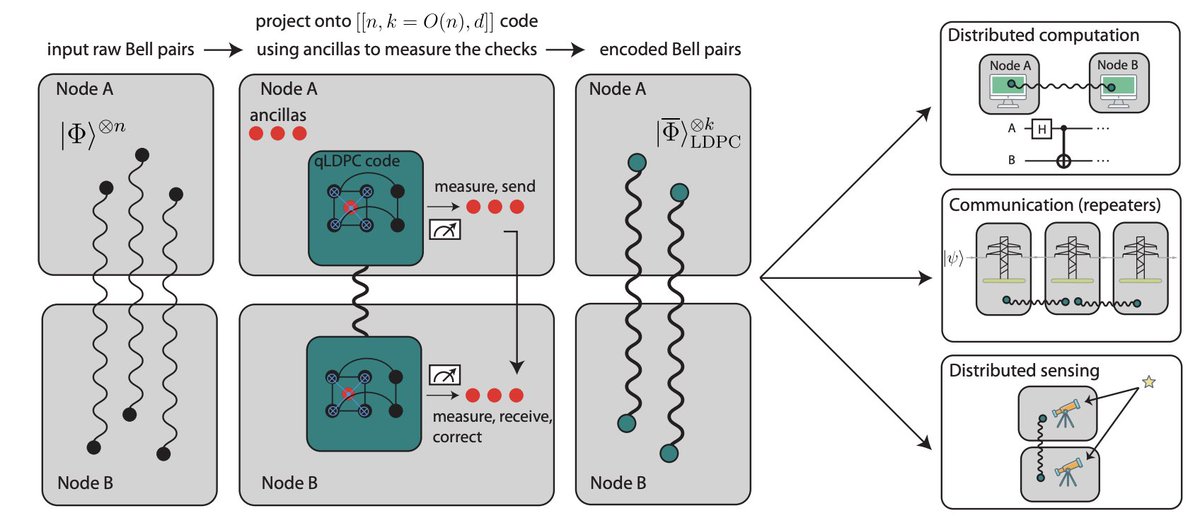
Our work on entanglement distillation with high-rate codes has been published in PRL (https://t.co/192bdapYzl).
We show how to connect two quantum computing nodes with constant spacetime overhead and low logical error rates using high-rate qLDPC codes.
(5/5)
Hope these results provide new ideas on designing high-rate FT protocols and parallel algorithms. Huge thanks to my collaborators, particularly @NishadMaskara and @hyharryzhou who are also taking the lead, along with @DolevBluvstein, Maddie, Marcin, @preskill, and Misha
(1/5)
Excited to share our new preprint on high-rate operations for qLDPC codes!
https://t.co/Tt3HTwOpo7
qLDPC codes can potentially encode thousands of logical qubits efficiently — but to compute with them, we also need logical operations that are equally efficient.
(4/5)
We also introduce near-term constructions using self-dual Bivariate-Bicycle codes with high encoding rates, transversal Clifford gates, and global T gates via parallel magic-state cultivation, and demonstrate logical Hamiltonian simulations with reduced space-time cost
With @AndiGu00 we built machine learning (ML) decoders for the recent neutral atom experiment on error-corrected quantum memory and logical computation (https://t.co/maNZbWYGlc), which led us to ask: how general can these decoders be? It turns out, quite general...
Glad to see that our recent work is now published in PRX! We explore logical computation with high-rate qLDPC codes using (partially) addressable transversal CNOTs. Big thanks to my amazing collaborators @hyharryzhou, @JerryGZheng, @DolevBluvstein, @J_Pablo_Bonilla, Misha & Liang
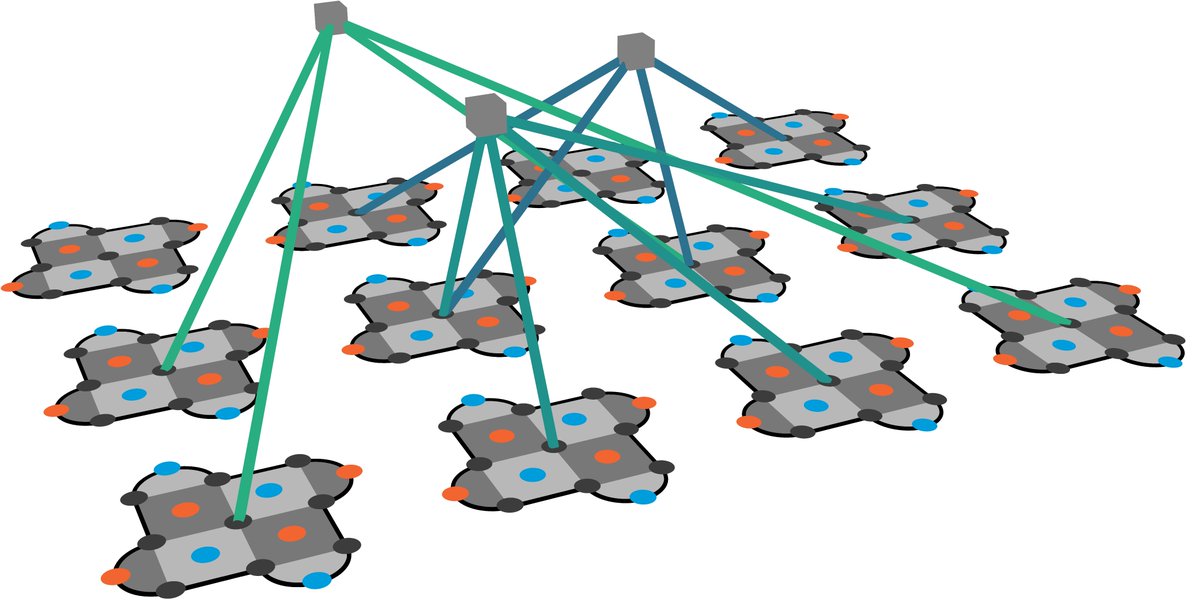
A new #quantum logic gate enables a family of high-rate quantum low-density-parity-check, or qLDPC, codes to measure logical #qubits selectively and in parallel, opening avenues for spacetime-efficient, fault-tolerant quantum computation.
Read the paper: https://t.co/ufhMoLQ1V4
Happy to share that some previous work with @krishnanirudh and @preskill that we call hierarchical codes (2303.04798) was recently published in Quantum! 1/10
I'm hiring a postdoc! If you'd like to work with me on quantum learning, error correction, quantum algorithms, and FTQC at Virginia Tech in the Washington, DC metro area, please apply here: https://t.co/eb0uFpKs3y
Submissions for QEC 2025 are now open through March 28.
This will easily be the most exciting conference on quantum error correction yet!
Conference homepage:
https://t.co/Endm46qaUU
EasyChair submission page:
https://t.co/Wg8xa8TZ42