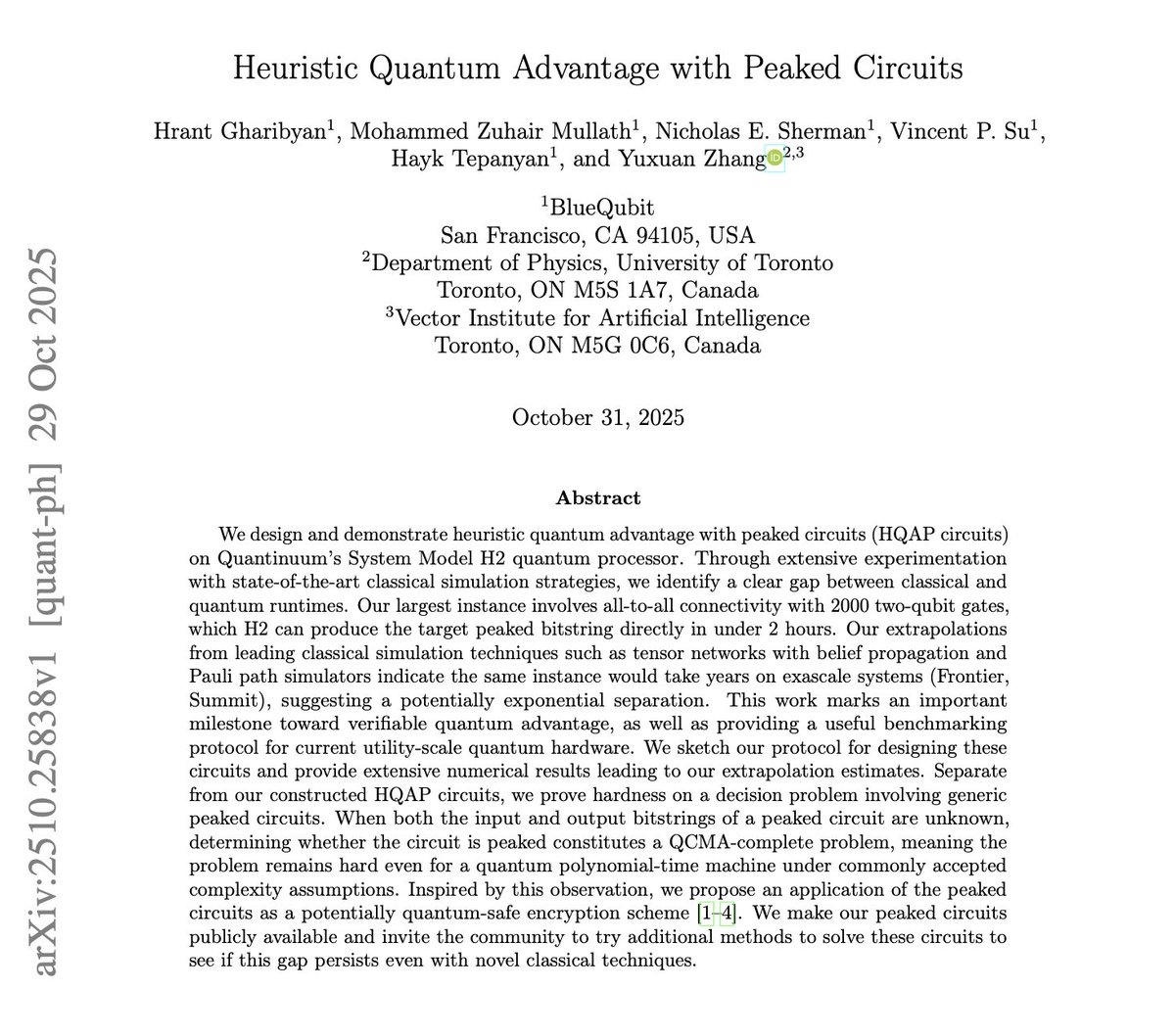
🚀 I am excited to share @BlueQubitIO first heuristic quantum advantage claim -- run on @QuantinuumQC H2 and backed by a careful comparison against state-of-the-art classical simulators. 🙌
🔷What’s new?
• We introduce a protocol for designing “peaked circuits” that can encrypt a message inside a quantum circuit with 50+ qubits. 🔐
• On H2 quantum processor, our largest instance (all-to-all connectivity, ~2000 two-qubit gates) finds the target peaked bitstring in under 2 hours. ⚡️
• Best-known classical approaches—tensor networks with belief propagation, Pauli Path simulation, and others—extrapolate to years even on exascale systems (Frontier, Summit). 🖥️⏳
• Estimated ~10,000× gap in energy and time (quantum ≈ hours vs. classical ≈ years). ♻️⚙️
🔷Why it matters
• Toward verifiable quantum advantage: a practical, testable path—plus extensive numerics supporting our extrapolations. ✅
• Benchmarking tool for NISQ hardware 🧪
• Crypto angle: potentially new type of encryption method🔒
🔷Open to the community
We’re releasing the circuits so others can try fresh classical techniques and pressure-test the gap. If you beat our baselines—or even narrow them—we want to hear from you! 🤝
📄 Check out the full manuscript: https://t.co/5a4bV6sCSC
🙏 Huge thanks to the @BlueQubitIO team for amazing work over the last couple of months, and to the @QuantinuumQC team for many insightful discussions and access to their very powerful quantum system.
#quantumcomputing #quantumadvantage #Quantinuum #NISQ #cryptography #HPC #PauliPath #tensornetworks #BlueQubit
The Quantum Algorithmic Science & Engineering (QASE) Lab at UCLA is hiring a postdoc (start 2026)!
Topics: quantum algorithms, complexity, high-dimensional statistics, fault-tolerant q. systems and applications
Apply by Dec 1 via AJO 👉 https://t.co/zF4gqfuI74
Please share!
Our team, Los Quanta, made up of @UCLA researchers, is a Semifinalist in the @XPRIZE#QuantumApplications competition!
133 teams from 31 countries are competing for a $5M prize, and we're thrilled be among the 20 advancing to the next stage!
https://t.co/zSIT5TTXfP
Aside from Yang-Mills theory and parity nonconservation, Yang made so many profound contributions to physics! One that deeply impressed me as I was starting grad school: a 1975 paper with T. T. Wu highlighting the role of fiber bundles in gauge theory.
https://t.co/kKP738L2sy
🎉 Big news! BlueQubit has closed a $10M Seed round led by Nyca Partners, with support from Chaac Ventures, Restive Ventures, & others. 🚀
We're building tools & algorithms to unlock quantum advantage.
Huge thanks to our team, customers, & investors!
PS: We're hiring! 💙 #QuantumComputing #QuantumTech #QuantumAdvantage
https://t.co/tcFnmqnpr7
Mitigating racial bias from LLMs is a lot easier than removing it from humans!
Can’t believe this happened at the best AI conference @NeurIPSConf
We have ethical reviews for authors, but missed it for invited speakers? 😡
Congratulations to my co-authors on finishing this nice work proposing HamQAOA, a quantum algo to optimize quantum Hamiltonians with provable guarantees! Ishaan did most of the writing here while juggling a full-time job and grad school applications. Expect great things from him!
Preparing ground states of multi-particle quantum systems with local interactions is really hard.
In work (https://t.co/evsKqhz72U) with @robbieking1000 and @leologist, we propose a new, surprisingly effective quantum approximation algorithm for this QMA-hard challenge🤖⚡️.
Just landed in the beautiful Vancouver to attend #NeurIPS for the first time! Here to present my work on a quantum algorithm for learning tensor data with Joao Basso and @Song__Mei. Come say hi at our Spotlight poster Wednesday 11a-2p!
We believe that studying optimization problems with symmetries enables better understanding of the unique behaviors of quantum algorithms and opens up new possibilities of superpolynomial quantum speedups! 🚀
(6/6)
Can low-depth QAOA provide exponential quantum speedup over the best known classical heuristics on any optimization problems?
Yes! ✅ @quantumashley and I show this in our new paper:
https://t.co/NqdPtP6XU1
which we did while I was a visiting fellow @PhasecraftLtd! (1/6)
While symmetry might appear important for the QAOA to succeed, we show the success probability remains high even when the symmetry is broken by randomly sampling the clauses. For example, we can take a symmetric Max-5-SAT problem with n^5 clauses and keep only n^2 clauses. (5/6)
Excited to officially start as Assistant Professor at the beautiful campus of @UCLA today! If you are interested in a postdoc position in the theory of quantum computing, check out this position and apply by December 1: https://t.co/tmMmTcHfF7
My friends at @BlueQubitIO are hiring! If you’re passionate about useful applications of (near-future) quantum computers and thrive in a dynamic start-up environment, I highly recommend applying. It’s a lot of fun working with these guys!
🚀 Exciting News! @BlueQubitIO team is Growing, and We’re Hiring! 👇
We’re seeking full-time Quantum Research Scientists in the USA with expertise in quantum algorithm research.
🤝 Join our world-class team and be a part of building the future of computing.
💻 Develop novel quantum algorithms and test them on cutting-edge quantum computers from @IBM, @QuantinuumQC, @QueraComputing and others.
If you’re passionate about quantum technology and want to make a real impact, we’d love to connect with you!
#QuantumComputing #Hiring #QuantumScience #JoinOurTeam #Innovation #BlueQubit
Apply Here:
https://t.co/upwaewHuGI
Excited to share that this week, I’m wrapping up my time @Caltech and joining @PhasecraftLtd to research quantum optimization! I will be in the UK for the summer before starting as an Assistant Professor @ECE_UCLA this fall! Looking forward to new challenges and collaborations 🚀
@science_eye has written a very nice article on our recent work “Local minima in quantum systems,” currently featured on the front page of @QuantaMagazine !
A team of physicists has found a problem that only quantum computers can perform. Though still theoretical, this “quantum advantage” may put an end to decades of searching for a useful problem that classical computers can’t do. @science_eye reports: https://t.co/HVzI26VwBS
A team of physicists has found a problem that only quantum computers can perform. Though still theoretical, this “quantum advantage” may put an end to decades of searching for a useful problem that classical computers can’t do. @science_eye reports: https://t.co/HVzI26VwBS