Over the past few months I got addicted to optimizing Clifford+T QEC simulator (100% using Claude). Every time I decided to write up about it, a new simulator came along and made mine worse in comparison. But finally, I have something that I am happy to share publicly. https://t.co/EvAPHcmGFT
As part of the newly established NSF Institute for Fault-Tolerant Quantum Systems, Architectures and Applications (FTQSAA), we are looking for a postdoc at UCLA at the intersection of quantum computing and AI. If you are interested, please apply via AJO: https://t.co/WmUwkvor1R
We are announcing three new discoveries in mathematics, computer science, and physics about harmonic analysis, complexity theory, and quantum field theory.
https://t.co/9BX8HWQDTJ
Quantinuum has achieved a major industry breakthrough that solves a critical error-correction bottleneck and validates our path to delivering a fault-tolerant quantum computer by 2029.
We’ve announced a new world record for quantum error correction, achieving 99.9995% logical fidelity on our Helios commercial quantum computer using our error-correction architecture.
Equivalent to just five errors in a million operations, the result is 10× better than our previous record achieved just last month and 100× better than the best published result on any other hardware modality.
The study also demonstrated a record 12× reduction in logical errors as code distance increased, a critical step toward scalable fault tolerance.
These successive breakthroughs using different codes on the same commercial hardware demonstrate how Quantinuum's flexible error-correction architecture and highly accurate trapped-ion technology work together to enable exponential improvements in accuracy, with performance now within the target range for Apollo, our first universal fault-tolerant quantum computer planned for 2029.
Learn more: https://t.co/I1RpLxeo55
A new era of quantum computing progress is here! ⚛️🚀 We’re moving beyond whether logical qubits beat physical qubits to how reliable they are and how well error correction scales.
Quantinuum’s latest Helios result stands out:
🔹 Logical errors fell ~12× at each step from d=3 → 5 → 7. Exciting scaling toward fault-tolerant computation!
🔹 At d=7, logical memory errors reached just 5 × 10⁻⁶ per correction cycle—five failures per million cycles. Remarkable reliability!
Congratulations to the entire Quantinuum team! 🔥
Cool to see @AnthropicAI getting into the quantum circuit game! ⚛️🔥 Claude is cutting gates and ,apparently, not corners. Exciting times for AI-powered quantum algorithm design!
New from our STEM Fellows Program: Designing more efficient quantum circuits with Claude.
Given plain-language instructions, Claude Mythos 5 designed quantum circuits that improve on the best published ones, sometimes by an order of magnitude or more.
More efficient circuits reduce the resources needed by quantum algorithms, which could bring quantum computing applications in chemistry and materials science within reach sooner.
Read more: https://t.co/QCvoJLDmBo
@GoogleQuantumAI is growing magic on Willow. 🪄🌱
Magic-state cultivation on real hardware, with ~40× lower error than uncultivated states. A serious step toward universal fault-tolerant quantum computing.
Quantum gardening is getting real and interesting! 🚀
Some magical progress towards "magic state" in quantum!
Our @GoogleQuantumAI team has demonstrated "magic state cultivation" on physical hardware for the first time. The result is a 40x error reduction on our Willow processor vs. previous methods, achieving a state-of-the-art 99.99% logical fidelity.
It's another step towards useful, error-corrected quantum computers to help solve the hardest problems. The result is published in Science today, watch the video below to see how it works
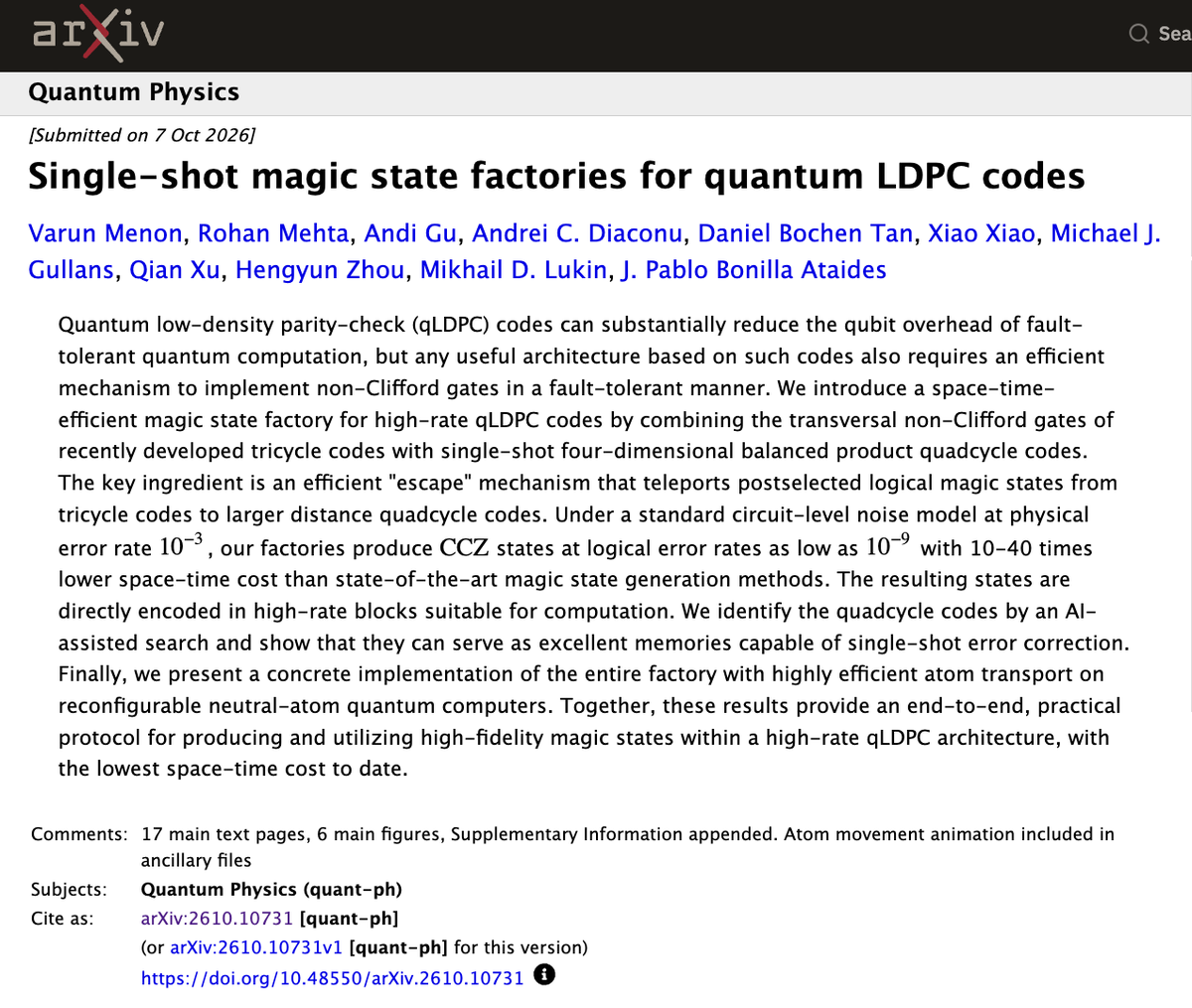
✨ Magic states, 10–40x cheaper.
New qLDPC factory teleports CCZ magic from tricycle codes into single-shot 4D quadcycle codes, reaching logical error rates as low as 10⁻⁹ at p = 10⁻³ 📉
📖 https://t.co/odeGfRUvTu
#QubitScript#QuantumComputing#QEC
Quantum is poised to become a multi-trillion dollar industry in the next few years. We think New Yorkers should share in that profit.
That's why we negotiated that New Yorkers get board seats and a 15% stake of intellectual property that comes out of NYU's Quantum Fabrication facility.
Because all New Yorkers should benefit from the economic success of this city.
⚛️ Estimate what a quantum circuit measures, without a quantum computer.
Duke Quantum Hackathon: run by @BlueQubitIO together with DuQuantum 2026 at @DukeU. 🎓
🔹 Around 10 hidden quantum circuits
🔹 About 50 observable expectation values
🔹 Simulations run through BlueQubit by circuit ID
🔹 Scoring based on how well estimates correlate with the exact values (signal-to-noise)
🤖 AI use is encouraged. The strongest teams will pair physical intuition with AI tools to iterate fast on simulation strategies.
📅 24 hours: Oct 24, 11:30 am ET to Oct 25, 11:30 am ET
🌍 Online for everyone
👤 In person at Duke for accepted DuQuantum participants
👥 Teams of up to 5 recommended
🎟️ Free to join; compute credits provided at kickoff
📈 All levels: from quantum enthusiasts to seasoned researchers
👉 Join the hackathon: https://t.co/Gks3SNsUuF
#QubitScript #QuantumComputing
"Anthropic shared the algorithm with the authors in September 2026 under a confidentiality agreement, offered compensation, and provided access to the public version of Claude."
The time has come to bring the best AI model capabilities to quantum computing -- and give researchers the resources to see how far they can go.
That’s why we are excited to launch Quantum Flywheel, BlueQubit’s $150,000 grant program, with support from Amazon Web Services (AWS), IBM, and NVIDIA 🚀
AI is changing how we write code, design experiments, and explore new ideas. But turning those ideas into quantum computing results still requires access to hardware and compute.
The program will provide winners three months of QPU, CPU, and GPU credits, access to frontier AI models, and a quantum-native development environment.
We’re inviting proposals in three areas:
⚛️ Novel quantum algorithms that achieve quantum advantage
🧮 Adversarial classical simulation to stress-test quantum advantage claims
🛡️ AI agents for discovering and decoding quantum error-correction
The open call runs for five weeks. If you have an idea you’ve been waiting to test, I’d love to see your proposal. Please share this with researchers who might be interested!
👉 https://t.co/NrcIKoOCiV
New paper with some amazing collaborators claiming quantum advantage for quantum simulation of prethermal dynamics on an IBM quantum processor and validated with Quantinuum's Helios.
Try to break our classical hardness claim!
https://t.co/UOxwk0GxyG
💬 Have you tried BlueQubit AI?
Stop context-switching:
Write circuit → debug → read papers → repeat 😤BlueQubit AI:
🔵 Debug Qiskit errors instantly
🔵 Sketch & run circuits
🔵 Work through Hamiltonians
🔵 Understand papers faster
From idea → code → execution, all in one loop 🚀
💡 Try it via the chat icon in the bottom-right 💬
🔗https://t.co/Rhs5Y7z3Fl
#QuantumComputing #Qiskit #BlueQubit #QuantumSoftware #QuantumResearch
We at @khoslaventures made the largest initial investment yet, as we did in OpenAI, into @TeamOratomic after we looked at a dozen Quantum starts in a decade. On its way to solve Shor's algorithm, the true symbol of getting to "quantum computing" FIRST. https://t.co/58VBxKHLk3. Join them in building the world’s first fault-tolerant quantum computer capable of useful applications and a fundamentally new model of computation that could have consequences far beyond what we can predict today