Tenure-track AP at Shanghai Jiao Tong Univ. @sjtu1896, former postdoc @UChicago. Interested in all the elegant ideas of robust and practical quantum design.
Our work "Error-structure-tailored early fault-tolerant quantum computing" is finally out! In this work, we have shown how to perform the continuous logical-rotation gates Rz(\phi) as simple as CNOT, but still with good accuracy! https://t.co/oTkf5PeNB0
To sum up, our early-fault-tolerant rotation gate Rz(\phi) construction is:
1. Economic: can be done with a comparable cost like CNOT lattice surgery.
2. Simple: no distillation circuit required.
3. Small footprint: ancillary requirement is small.
4. Nearest-neighbor interaction.
If it looks Haar-random, walks Haar-randomly, quacks Haar-randomly.... it still may not be Haar-random -- provided you're only a polynomial-time observer. @aporemba_ explains our pseudorandom unitary construction.
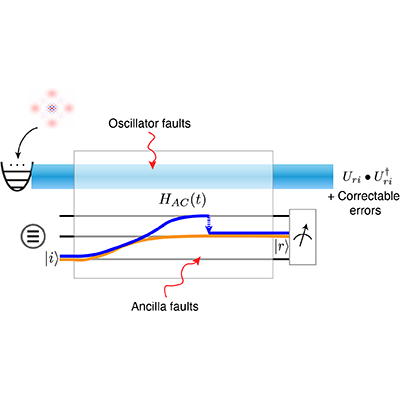
Qian Xu @ChicagoQuantum discusses a different set of FT operations on bosonic qubits based on path independence. The idea is to make sure that the effective overall channel performs a unitary conditional on information that you can extract using ancillas. #qec23
Check out our new preprint on universal error corrected operations of bosonic qubits with noisy ancillae https://t.co/kMHVYRVL5o. Made it just in time before my talk at #qec23! Please come to my talk today if you are interested!
Duke ECE is seeking applicants for multiple Assistant Professor positions. More abour the positions can be found here: https://t.co/OcZANcZ9rt @DukeEngineering
The Department of Physics at Harvard University seeks to appoint a TENURE-TRACK PROFESSOR IN THEORETICAL PHYSICS. The areas of interest include: theory of soft and living matter or physical aspects of quantum information theory. https://t.co/qKAjX0XDg5
This work is collaborated with Anran Jin and Prof. Richard Penty from Cambridge, Xingjian Zhang from Tsinghua University, and Liang Jiang from UChicago.
Continuous-variable quantum key distribution has low implementation cost, flexibility of multiplexing, and compatibility with standard coherent communication technologies. We propose a CV QKD with simple parameter estimation and no reference pulse (https://t.co/n6NXBYp3gs).
Also, phase randomization is introduced to decouple different photon-number components. We can then tag the photon number, effectively estimate the associated privacy using a carefully designed coherent-detection method, and independently extract keys from each component.