Should the global tech community continue investing in Malaysia?
Given recent events, I raise this question respectfully for the consideration of Prime Minister Yang Amat Berhormat Dato’ Seri Anwar bin Ibrahim (@anwaribrahim), for the people of Malaysia, and for our friends in the Malaysian tech community. The answer will be of interest to anyone in global tech that’s considering building, investing, or expanding in Malaysia, including executives at Google, Amazon, Apple, and Microsoft, founders of tech unicorns like Coinbase and Solana, and investors at the world’s largest venture capital funds like a16z and Polychain.
As context, I am the former CTO of Coinbase and former General Partner at a16z. In October 2024, I opened a startup society called Network School in Malaysia, because I felt I’d been invited in by the government’s pro-tech policies.
Specifically, the KL20 initiative set out Malaysia’s ambition of becoming a top 20 global tech hub. Their MDEC digital nomad visas and MM2H investor visas were created to facilitate an influx of global talent and capital. And the Johor-Singapore Special Economic Zone was announced to facilitate the flow of capital and talent between Malaysia and Singapore, where I live. When taken in combination with Malaysia’s datacenter buildout and its policy of welcoming visa-free visits for 98% of the world, it seemed like Malaysia might be a great place to build a global tech hub that was simultaneously inexpensive and easy to visit (especially for non-Westerners).
And that’s what we did, by creating Network School. It’s an international tech community with its first node in Forest City, Malaysia. We picked Forest City because it had millions of square feet of empty space, because it was one hour from Singapore’s capital markets, and because it was within the Johor-Singapore Special Economic Zone. Then, within 18 months, without a single penny of government money, we built Network School into a global attraction that brought thousands of engineers, investors, and builders from 70+ countries to learn technology, burn calories, earn online, and have fun, integrating with the local Malaysian economy along the way.
Indeed, in terms of quantifiable contribution to the Malaysian economy, we’ve already invested 100M+ MYR in our campus to make it startup-friendly. For perspective, that’s about 4% of the budget of Johor, the Malaysian state where Forest City is located. We employ dozens of Malaysians directly and indirectly at every level from executive to staff. We’ve backed Malaysian tech startups like Collektr, hosted events for local teams like Superteam Malaysia, and are major customers of many local businesses like barbers, laundromats, and restaurants. We’ve also revitalized the multibillion-dollar Forest City project, causing millions of MYR in real estate appreciation. And, as the video below describes, we were on the cusp of a 500M+ MYR expansion to grow our community, as well as a global merit scholarship with my friend Amjad Masad of Replit.
However, that emerging multi-billion dollar success story — which should rightfully have been hailed as a huge victory for the pro-tech policies of the Malaysian government — is at risk of being derailed by a fake story spread by an anonymous account named MP4P.
In short: on the day before the July 11 Johor elections, MP4P posted an Instagram post falsely accusing Network School of harboring illegal aliens. The sensational accusations caused a tizzy in Malaysia, until Malaysian authorities came to our campus on July 14 to investigate. (I should note that the officers were very polite and professional.) After checking hundreds of physical passports from 40 countries, including dual passport holders, the authorities confirmed to the press on July 15 that all travel documents were in order. During the process, we cooperated fully; in the thread below you can see a photo of the men, women, and children of Network School smiling and holding up their passports in the bright daylight. Our faces are shown and our names are known; we have nothing to hide.
With that said, the process is the punishment. What MP4P did is very similar to the American crime of “swatting”, because MP4P created a hoax report of a serious threat, thereby forcing the Malaysian police to take time away from protecting the Malaysian people towards investigating a nonexistent issue. Moreover, this anonymous MP4P account has also called for Malaysia to boycott Apple, Google, Amazon, and Microsoft…a move that would cost ordinary Malaysians thousands of jobs…even while MP4P’s own Instagram collaborators promote their Apple and Google apps! I mean, we aren’t talking about a credible accuser, but just someone screaming inconsistently at the top of their lungs on social media for traffic, an all-too-common phenomenon these days.
Anyway, at this point, all further investment we were planning to make in Malaysia is on hold until we get sufficient assurance that such issues won’t recur. So are the investment plans of many of our friends, including the execs and investors at global tech firms that we brought to Forest City. Because to put it very plainly: we have invested 100M+ MYR in Malaysia, while creating jobs for dozens of Malaysians, and our faces and names are known. Our Malaysian executives and employees deserve the benefit of the doubt over anonymous internet trolls.
There are two paths forward. In the first case, if Malaysia still wants continued global tech investment, if it wants to be a top 20 tech hub, if it wants us to revitalize Forest City, then we request an audience with the Prime Minister’s office to discuss the terms of a memorandum of understanding between Network School and the Malaysian government, similar to the document recently signed between the Solana Foundation and the Kazakhstan government.
Specifics can of course be discussed, but we would publicly commit to abiding by all Malaysian laws (we already do) and respecting Malaysia’s sovereignty (never in question). In return, they’d get to know our friendly community, and realize that we actually chose Malaysia because we thought it was a great place to build a tech hub where engineers from the global South, investors from the West, and builders from Malaysia itself could meet new people, build cool things, and perhaps create millions of dollars in economic growth in the fullness of time.
That vision of peace and trade, internationalism and entrepreneurialism, is still on the table. We aren’t asking for any money — just a meeting, to help restore confidence in Malaysia as an investable jurisdiction. Alternatively, if you don’t want our investment, or those of our colleagues at billion dollar funds and trillion dollar companies, we will of course respect your wishes, and reallocate our capital to other countries instead.
Either way, we will remain friends and abide by your decision. Please let us know.
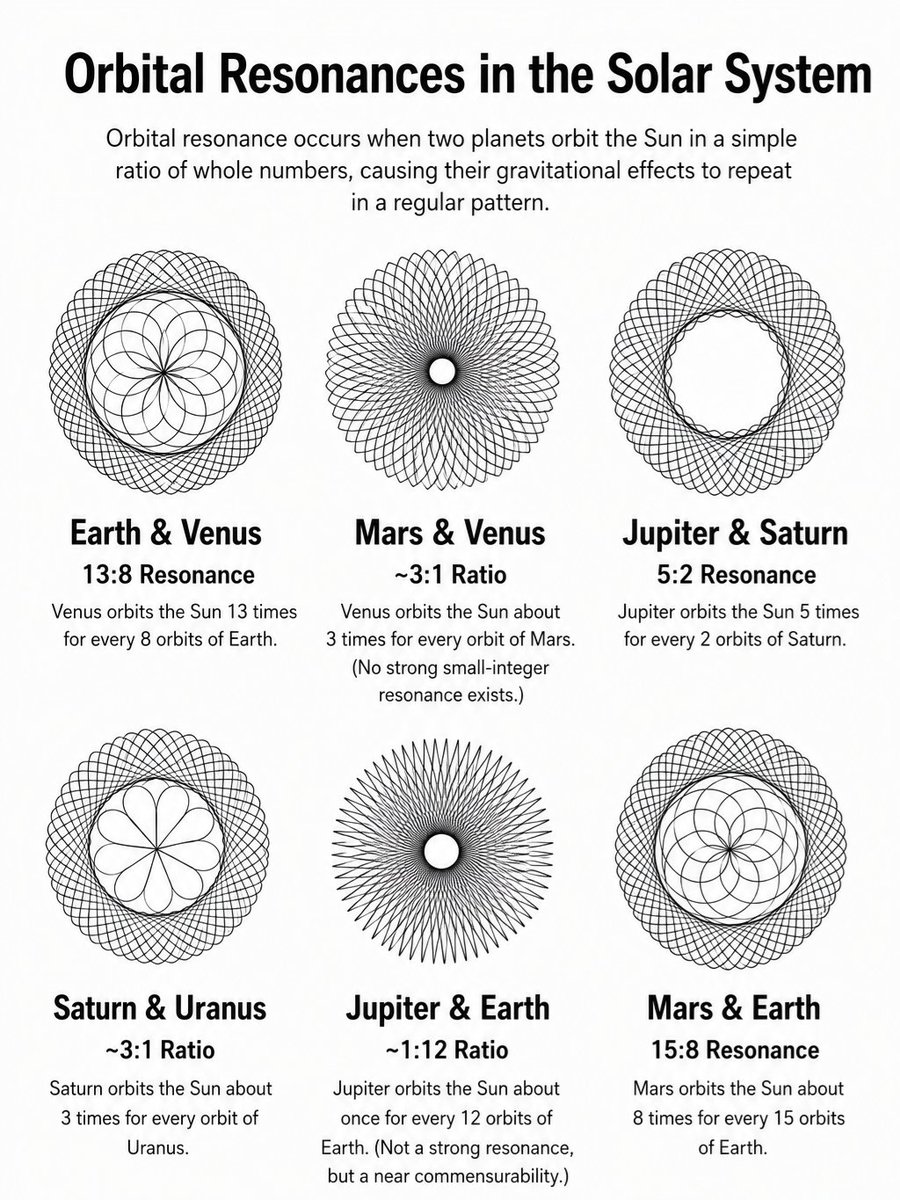
The Solar System isn't just a collection of planets. It's a system of repeating rhythms shaped by gravity.
This graphic visualizes the geometric patterns created when pairs of planets complete their orbits in simple or nearly simple ratios. As their positions repeat over time, they trace beautiful spirograph like paths that reveal the hidden harmony of planetary motion.
Some pairs, such as Earth and Venus, Jupiter and Saturn, and Mars and Earth, come remarkably close to repeating orbital cycles. These near resonances play an important role in understanding long term orbital stability and the gravitational interactions that shape our Solar System over millions of years.
Harvard proved people will pay four times more for their own ugly origami than a stranger will, and it is why you can't tell your bad ideas are bad.
I read the actual study at 1am and could not stop seeing it everywhere after. It is called the IKEA effect.
> people overpay for crumpled paper
> only if they folded it themselves
> a stranger sees worthless trash
> the maker sees near expert work
> 92 percent swear they're immune
> almost none of them are
Same object. Two completely different prices. The only thing that changed was whose hands built it.
Why?
In 2011, three researchers named Michael Norton, Daniel Mochon, and Dan Ariely ran the cleanest test of this you could imagine.
They handed people a sheet of paper and simple instructions and had them fold a little frog or crane. Amateur stuff. Crooked corners, uneven folds, the kind of thing you would toss without a second look. Then they asked the folder what they would pay to keep it.
The average person bid 23 cents for their own lopsided frog.
Then they showed those exact same frogs to strangers who had no hand in making them. Those people would pay 5 cents. To the outside eye it was a wad of bent paper worth nothing.
Here is where it stops being cute.
The researchers also had origami experts fold clean, beautiful versions of the same frog. Museum quality next to the amateur ones. Strangers would pay 27 cents for the expert work.
Sit with the three numbers:
> stranger on a beginner frog: 5 cents
> stranger on an expert frog: 27 cents
> the beginner on their own frog: 23 cents
The person who built the bad thing valued it almost as high as the expert's. Their own two hands had blinded them completely.
Then they proved it was the building that did it, not just owning something.
Step 0: they suspected the love came from the labor, not the object
Step 1: they gave everyone the same Lego set to remove any difference in the thing itself
Step 2: they split people into two groups doing opposite actions
a) one group built the set and kept it
b) the other group built the set and then took it apart before bidding
The builders who kept it paid far more than anyone. The ones who broke it back down paid almost nothing. The love did not live in the plastic. It lived in finishing the thing. Undo the finish and the feeling dies on the spot.
They named it after IKEA because a flat pack shelf you built yourself, wobbly and slightly crooked, feels more like yours than any perfect shelf a store could hand you fully built. The sweat is the glue.
Now the part that should make every creator uneasy.
Norton tied this straight to something that happens in every office and studio on Earth. The reason smart people keep pouring money into obviously failing projects. The reason they refuse to touch a better idea because someone else thought of it first. It is not stupidity. It is the frog. The second you build something, your brain quietly reprices it far above what it is worth, and you cannot feel yourself doing it.
Your worst idea, the one you sketched at 2am and have defended in three meetings since, is your origami frog. You are bidding 23 cents on it. Everyone else in the room is bidding 5.
The cruelest detail in the whole paper is the survey. Asked in the abstract whether they would pay more for something pre built or something they had to assemble, 92 percent said pre built. Nobody thinks they are the sucker. The bias only switches on after your hands are already dirty, and by then it is invisible to you.
So next time you fall in love with an idea, ask one question. Do I love this because it is good, or because I made it?
You will not be able to tell. That is the entire point.
The proof that "Homer" never existed came out of a Bosnian coffeehouse in 1935, dictated by a butcher who couldn't read or write.
Milman Parry, a 33-year-old Harvard classicist, had a theory the ancient texts couldn't prove. All those repeated phrases in the Iliad, "swift-footed Achilles," "wine-dark sea," weren't decoration. They were machinery: pre-fitted metrical parts that let a singer assemble a poem live, at the speed of performance. To prove humans could actually do this, he needed a living oral tradition.
So he built a custom recorder with two turntables that swapped aluminum discs mid-song, hauled it to Yugoslavia, and went looking for singers. In Bijelo Polje he found Avdo Međedović, an illiterate butcher in his sixties.
Parry asked him for a song as long as the Iliad. Over a week in July 1935, Avdo produced The Wedding of Smailagić Meho: 12,311 lines. The Odyssey runs about 12,000.
Here's the part that settles the debate. Avdo had learned that story from hearing a 2,160-line version read to him a few times. His performance was six times longer. Same plot, richer scenes, new speeches. He wasn't retrieving a poem from memory. He was generating one, in meter, in real time.
Parry died five months later at 33, shot while unpacking a suitcase in an LA hotel. His grad student Albert Lord spent 25 years finishing the work. Gregory Nagy, the professor in this interview, later ran the Harvard collection that holds those 3,584 discs.
Nagy's own twist is the name. In archaic Greek, "Homeros" can be read as "he who fits the song together." The 3,000-year search for the author may have been a search for a job title.
The Standard Model of Particle Physics
• Quarks
• Leptons
• Gauge Bosons
• Higgs Boson
The framework that explains the fundamental building blocks of matter, the particles that carry the fundamental forces, and the origin of mass for elementary particles. It remains the most successful theory describing the microscopic universe, while leaving questions like dark matter and gravity unanswered.
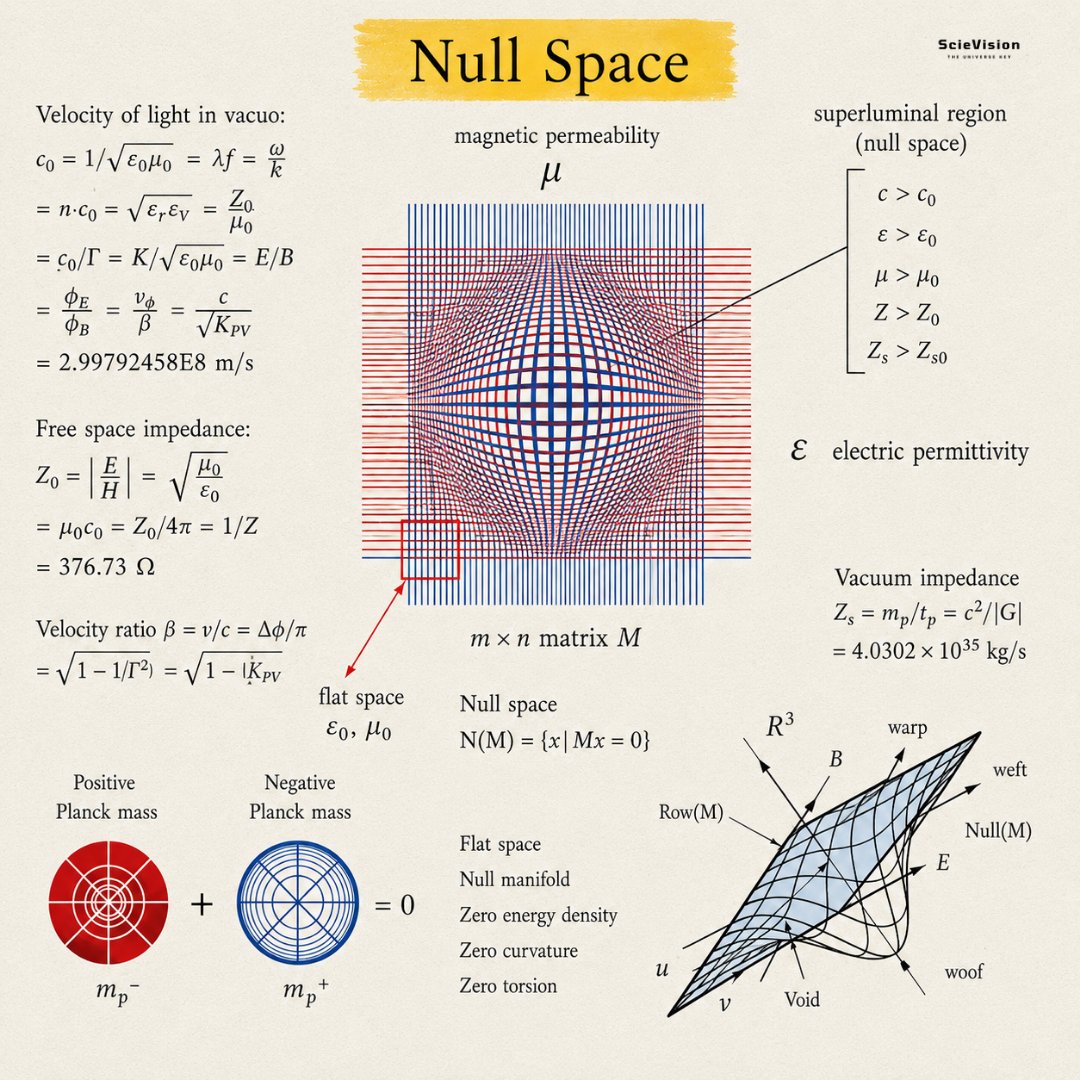
Null Space ✍️
This diagram brings together one of the most significant ideas in mathematics and physics under one beautiful concept called null space. The term null means zero or nothing, and null space represents nothingness defined in a very precise and meaningful way. However, this is not the ordinary nothingness of an empty room or a blank page. It represents a deep and structured nothingness, a state of perfect balance, flatness, and symmetry from which all physical reality emerges in one direction or another. The diagram connects this idea across multiple fields, including pure mathematics, the physics of light and electromagnetic waves, the geometry of curved space, and even speculative ideas about the total energy content of the universe.
The large central image in the diagram is the most striking element and carries much of the meaning visually. It shows a grid made of red horizontal lines and blue vertical lines. In the outer areas, the lines are straight and evenly spaced, forming a regular flat pattern. Toward the center, the lines become increasingly distorted, curved, compressed, and warped, creating a bubble-like bulge in the middle. The flat outer region represents normal undistorted empty space; the vacuum as it exists far from any unusual influence. The warped central region represents space that has been curved or altered by some physical effect. The transition between them shows the boundary between modified space and normal flat space. The grid is also labeled as a matrix, linking this physical picture to the mathematical concept of null space from linear algebra, where a matrix is simply a rectangular array of numbers that acts as a transformation machine, converting one set of numbers into another.
The mathematical definition of null space is one of the most important concepts in mathematics. In simple terms, it means this: the null space of a transformation is the complete collection of all inputs that the transformation completely destroys, turning them into zero. When you input any of these special values into the transformation machine, the output is always exactly nothing. Most inputs produce meaningful nonzero outputs, but some special inputs are completely destroyed. These destroyed inputs form the null space, the blind spot of the transformation, the directions it cannot see, detect, or preserve. The null space is always a geometrically meaningful collection of directions forming a line, a plane, or a higher-dimensional equivalent through the origin. It represents the directions that are completely invisible to the transformation, the information it cannot distinguish from the total absence of any input.
The diagram lists five properties associated with null space in the context of space and spacetime. The first is flat space; the null state of the universe is perfectly flat space with no curves, bends, or warps. In Einstein's general relativity, massive objects curve the space around them, and this curvature is what we experience as gravity. However, in the complete absence of all matter and energy, space is perfectly flat, and this flat state is the null baseline. The second property is null manifold, referring to the fact that light rays in spacetime travel along paths where the combined spacetime distance is exactly zero, even though light crosses real distances during real durations of time. This zero spacetime distance of light paths is a fundamental geometrical fact about our universe. The third property is zero energy density. True empty space has no energy stored within it, no matter, no radiation, and no concentrated field energy. The fourth property is zero curvature, which follows directly from zero energy because Einstein's equations tell us that where there is no energy, there is no curvature. The fifth property is zero torsion, which means space has no twisting or rotation, representing the most symmetric and undistorted possible state of spacetime.
Cotangent space ✍️
Imagine standing on a hillside where you can move in many different directions from your exact spot. The tangent space is the complete collection of all those possible directions of movement at that point. It includes every way you could step and every speed you could travel, all gathered into one flat plane that just touches the curved surface right where you stand.
The cotangent space is something different but closely related. Instead of collecting all possible directions of movement, it collects all possible ways to measure those directions. Each measuring device takes any direction you give it and returns a single number in response. A good way to picture this is to think about temperature spread across a landscape. At any point, if you step in some direction, the temperature changes at a certain rate. That rate is a single number, and the rule that takes your chosen direction and gives you that rate of change is exactly the kind of object found in the cotangent space.
These measuring devices are called covectors. They are different from vectors because a vector is an arrow pointing somewhere, while a covector is a device that reads arrows and reports numbers, similar to how a speedometer differs from the velocity of the car it's in. Once you set up coordinates to give every point in the space an address, like how longitude and latitude address every spot on Earth, you automatically get one natural measuring device for each coordinate. Each device answers the question of how quickly that particular coordinate changes as you step in any direction. These coordinate-based devices form a basis, meaning every other measuring device at that point can be built from combinations of them, making them the basic tools of the cotangent space.
This distinction between directions and measuring devices is very important in physics. Momentum in classical mechanics is most naturally a covector rather than a vector because it pairs with velocity to produce energy. Gradients of quantities like temperature or voltage are covectors in their truest form. In general relativity, where spacetime itself curves, the difference between vectors and covectors becomes clear because there is no universal way to convert between them in curved space.
The key idea the cotangent space captures is that nature includes not just things moving through directions but also things that measure and respond to those directions. These are genuinely different kinds of objects in different spaces, related through a straightforward pairing where every direction combines with a measuring device to produce a number. The full collection of all such measuring devices at any single point makes up the cotangent space.
The world’s 8.2 billion people, shown as a single tree map. India and China dominate, Africa is already nearly twice the size of Europe, and Australia barely registers. Source: https://t.co/xYy9Ec1vhi
Is IQ the best predictor of life outcomes?
For most of the last century, psychologists would have said yes without blinking.
If you had to bet on someone's future using a single number, IQ was the smartest bet on the table.
Then a psychologist at UC Davis named Dean Simonton spent decades studying genius and creativity, and kept running into the same wall.
The idea traces back further, to a researcher named J.P. Guilford in 1967, and Simonton spent his career building on it.
IQ predicts real world achievement extremely well, up to a score of about 120.
Past that point, the relationship gets strange. Someone with an IQ of 150 does not reliably outperform someone with an IQ of 125. More raw intelligence stops buying you anything extra.
That breaks the assumption most of us grew up with. We are taught intelligence is a straight line. More points, more success, all the way up. The data does not agree.
So if IQ stops being the deciding factor past that line, what takes over?
A psychologist named Robert Sternberg spent his career chasing that question, and he landed on something he called practical intelligence. Here is what that actually means, broken into three parts.
1. It has nothing to do with solving puzzles. It is the skill of walking into a messy, ambiguous situation with no clear rulebook and knowing what to actually do.
Sternberg called the specific version of this "tacit knowledge," the stuff nobody ever teaches you directly. Reading a boss who never says what he wants. Knowing when to push in a negotiation and when to fold. You either pick this up through experience or you don't.
2. It barely overlaps with IQ at all. Sternberg and his colleague Richard Wagner tested business executives on a standard IQ style test and on a tacit knowledge test built from real workplace scenarios.
The tacit knowledge scores explained 32 percent of the difference in how well those executives actually performed, on top of everything IQ already explained. That entire 32 percent was invisible to the IQ test.
3. It shows up strongest exactly where you'd expect it to matter most.
Sternberg's team also studied military leaders across three ranks: platoon commander, company commander, battalion commander. The tacit knowledge test predicted how good a leader someone actually was. The IQ test did not.
Classrooms are built to train the exact opposite of this skill. Memorize the material, solve the defined problem, get graded against a clear rubric.
Practical intelligence only grows in the opposite conditions: ambiguous rooms, no rubric, nobody grading you in real time.
Sternberg's work is still debated inside psychology, and some researchers argue tacit knowledge is just intelligence wearing a disguise.
But the pattern keeps showing up study after study, and it is not something you can cram for the night before.
Maybe that's the real answer. IQ tells you who starts the race with a head start.
It stops telling you who wins it.
how to study and learn really difficult subjects:
1. don’t panic. hard just means dense. it’s not impossible, it’s just packed. unwrap it slowly.
2. get a map before diving in. watch an overview video, read the table of contents, or skim the wikipedia page. you need context first.
3. use multiple sources. one book will confuse you, two will clarify, three will enlighten.
4. build intuition, not memory. visualize it. simulate it. code it. teach it to a friend or a wall.
5. tolerate confusion. you’ll feel dumb 90% of the time; that’s the price of learning something that rewires your brain.
6. connect it to reality. every abstract thing has a real-world analog. find it. relate it. ground it.
7. revisit the same topic after a week. mastery is not about reading once; it’s about returning after your brain has “chewed” on it.
8. don’t romanticize genius. smart people aren’t born knowing it. they just survived longer in the confusion phase.
the truth is; learning hard stuff isn’t about intelligence.
it’s about endurance, humility, and curiosity.
you stay long enough in the fog until it clears.
Marc Andreessen (@pmarca): Airbnb could have been boutique booking software. Uber could have been taxi dispatch software. Tesla could have been self-driving software.
They decided to take over the entire industry instead:
"Silicon Valley between 1950 and 2010 was primarily just in the tools business.
You'd build a tool like an operating system or a disk drive, sell it to people, and they'd figure out what to do with it.
Then something changed.
Alternate universe Airbnb is just boutique booking software. A tiny little business building spreadsheet software. But Brian Chesky decided: we're going to go into the hospitality business and compete with hotels directly.
Uber and Lyft in the old world were just taxi dispatch software. In the new world, they're full transportation providers.
Tesla in the old world would have just been software for self-driving cars. In the new world, it builds the entire car.
Facebook, same thing. Prior to Facebook, if you built online ad software, you were selling it to media companies. Mark said: no. We're just going to beat the media company. We're going to build the entire thing.
That was the pivot point when the Valley's ambitions went from just building tools to going directly into incumbent industries.
And then AI makes that crystal clear. The winning AI companies are raising billions, tens of billions, in some cases hundreds of billions of dollars.
The old world of $10,000,000 or $50,000,000 — where VCs tap out — is just not relevant anymore."
Ken Griffin, founder of Citadel, the most profitable hedge fund in history, on the moment that left him "shocked and depressed" about AI:
"one of our team members built an agentic AI system to recreate academic papers in finance."
"we have a legion of young masters and PhDs doing this work. it takes roughly six to eight weeks to reproduce a paper."
"my colleague built an AI system that would read a paper, reproduce it, verify the results, produce the results on out of sample data — in about two to three hours per paper."
"this is not just a white collar job. this is a master's or PhD-level job. six weeks of work turned into two to three hours."
"and then OpenAI just solved a math problem that no one had solved for eighty years."
"competitive moats are being filled in at lightning speed."
the founder of Citadel watching PhD-level work get compressed from six weeks to two hours. and his response wasn't to cut headcount, it was "i will take every single productivity gain i can get because with the talented people we have, we just have more to go after."
This paper remains one of the most astonishing feats of data wizardry I’ve ever seen. They inferred the roughness of every road in America from how much the driver’s phone bumped up and down! Every single one!