Today, we're kicking off the first phase of the research preview for Model Hardware Standard (MHS): a new standard for AI agents to safely operate physical equipment in scientific research and advanced manufacturing.
Read more: https://t.co/XQ2y9EW7Af
Introducing GlucoFM, a lightweight, self-supervised continuous glucose monitoring foundation model that separates metabolic baselines from transient spikes, producing transferable representations and setting new performance standards across diverse metabolic prediction tasks, such as diabetes risk assessment, insulin resistance, and post-prandial glycemic response.
Learn more →https://t.co/PA7wpFz2xo
Now we know: The popular Ox Alpha LLM was GLM-5.3-Flash...
Compared to GLM-5.2, this new GLM-5.3-Flash model uses:
- a Kimi Linear-style 3:1 (super*) hybrid attention pattern with 34 Kimi Delta Attention layers (KDA) and 11 Multi-heat Latent Attention (MLA) / DeepSeek Sparse Attention (DSA) layers;
- a scaled-down GLM-5.2-style sparse MoE backbone, going from 744B-A40B to 320B-A18B;
- a DeepSeek V4-style mHC residual path with four parallel streams;
- plus a native vision encoder (not shown).
* "Super hybrid" because both KDA and MLA/DSA are "efficient" components. E.g., Kimi only uses KDA + full attention GQA, DeepSeek V3.2 uses DSA + full attention MLA.
PS: Sry for the excessive tech jargon. Explainers on all these components (MLA, DSA, KDA, mhC, etc.) in my LLM Architecture Gallery
PPS: Haha, maybe justification for getting that pricey Mac Studio M5 Ultra 256 GB / 512 GB to run this locally...
Introducing GLM-5.3-Flash
- Leading capabilities at a highly competitive price
- Natively multimodal with a 1M-token context window
- A 320B-A18B model released under the MIT License
- Previously previewed as Ox Alpha, running entirely on Chinese AI chips
Blog: https://t.co/tzOmB7gdZP
Available now across all official platforms:
Weights: https://t.co/9LRMahY9Wa
API: https://t.co/VcaQnzYmS9
Coding Plan: https://t.co/Nk8Y98HNhU
ZCode: https://t.co/Peepqv4XSx
Chat: https://t.co/WCqWT0qCQb
AutoClaw: https://t.co/aGEG5HqTTb
⚡Meet Qwen3.8-Flash, a multimodal MoE and an early preview of the Qwen4 architecture, now open-weight!
The production version Qwen3.8-Flash will be available soon via QwenCloud API at just $ 0.16/1M input tokens and $ 0.47/1M output tokens.
125B parameters + 51B N-gram embeddings, with just 6B activated per token. Unmatched cost-efficiency.
What's new: 🥳
- Next architecture: GDN + QSA hybrid attention, Gated Residual, N-gram Embedding & Muon optimizer, serving as a precursor to the architecture used in Qwen4.
- Dramatically lower training and inference costs: trained at just 1/9 the cost of Qwen3.7-Plus, while outperforming it across the board with especially strong gains in coding and office tasks.
- Strong performance: scoring 58.7 on DeepSWE 1.1, 62.5 on SWE-bench Pro, 73.9 on CoWorkBench, 84.5 on AndroidWorld, and 95.7 on MathVision (with CI).
- 262K native context, extensible to 1M with YaRN.
We’re also releasing the weights for Qwen3.8-Flash-Next, giving the community an early look at the new architecture we’re exploring for Qwen4.🚀
We can't wait to see what you build with Qwen3.8-Flash!👀👇
- Blog: https://t.co/M5hYypFLgJ
- Technical Report: https://t.co/IF0gObIkQO
- Hugging Face: https://t.co/6ow8QVAABt
- ModelScope: https://t.co/tDOn2jNuFG
Ever meet someone and instantly click? 🤝
You’re talking, laughing, finishing each other’s sentences — and it feels effortless, like your minds already know how to dance together. Turns out, there’s real science behind that feeling.
Neuroscientists call it “homophily” — the idea that people who think alike, quite literally look alike in the brain. Research shows that close friends often share similar structures in brain regions linked to social behaviour. That’s why some conversations flow so naturally — your brains are wired in ways that complement each other.
But it gets even cooler. Scientists have discovered something called “interbrain synchrony.” 🧠
When two people deeply connect — through storytelling, teamwork, or even a heart-to-heart chat — their brains can show matching activity patterns. It’s not mind-reading or magic… It’s just how our brains mirror connection.
So next time you walk away from a great conversation thinking, “Wow, they really get me,” — you might be right. Your brains were literally in sync.
📖 Source: Thomson, J. (2024). The sci-fi hypothesis that explains why you click with certain people.
ok, THIS is local AI at its finest. not just the model. the orchestrator, subagents, tools, and the entire agent harness are running on the DGX Spark.
Qwen3.8-27B is already supported. 🔥
i think open-source AI just won!
For so long, we have confused purpose with productivity because work was NECESSARY for survival. When survival is guaranteed, we will discover what meaning actually is.
who’s using DeepSeek-V4-Flash-Vision-Exp with the DeepSeek harness? i am out of Codex quota so i switched to this combo and i can’t believe what i am seeing!
Why this is a big deal:
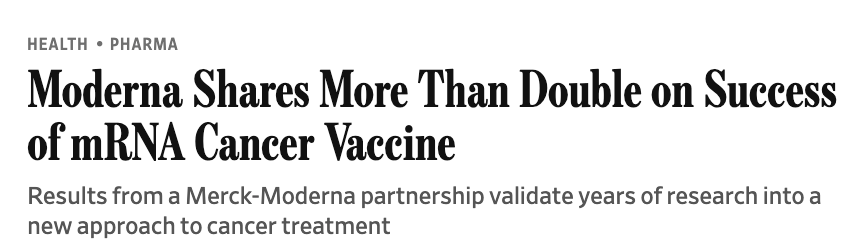
this mRNA therapy instructs the body to produce the specific fingerprints of the person's tumor and trains the immune system to hunt and kill it.
First time in a Phase 3 trial.
One way cancer grows is by hiding from the immune system and turning off attacking T-cells. This mRNA therapy provides the tumor's genetic fingerprint so that the immune system can train T-cells to identify the cancer. Keytruda then removes the brakes that cancer had put on the T-cells enabling them to eliminate the cancer.
Most people are not ready for what’s coming..
And honestly, the quantum-powered world feels much closer than we think.👀
Quantum computers just performed a computation in ~15 minutes that leading classical simulation methods can’t practically reproduce.
Just recently:
“IBM and University of Chicago researchers ran a 70-logical-qubit quantum circuit containing 468 non-Clifford T gates and 2,415 logical two-qubit operations, using 97 physical qubits and spacetime error-correction techniques.”
“The computation took roughly 15 minutes and was designed to be beyond the practical reach of leading classical simulation methods.”
“Using spacetime quantum error-correcting codes and syndrome post-selection, they suppressed gate-error rates by about 10×.”
“Crucially, syndrome measurements allowed the researchers to statistically certify a fidelity lower bound of 0.284 with 95% confidence.”
In other words, this experiment tackles one of quantum computing’s biggest challenges: making quantum computations both powerful and trustworthy.👀