BREAKING🚨 UNDER GARY GENSLER'S LEADERSHIP, THE SEC HAS BEEN CAUGHT COLLUDING WITH WALL STREET
FOIA records reveal a broker trade group pushed the SEC to deny a company’s S-1 due to unaccounted-for shares, known as naked shorts $MMTLP
After years of playing it their way, the CEO speaks out!!!
Next Bridge Hydrocarbons CEO Greg McCabe tells the story behind the BIGGEST FINANCIAL CRIME of the century. So big, "nobody knows what to do".
WHAT IS MMTLP???...
Shareholders fight for transparency after a series of regulatory failures trapped them and froze their assets for nearly 4 years. Evidence of counterfeit shares, lack of SEC and FINRA enforcement, and FOIA revelations fuel their fight in one of the biggest financial crimes in history. @JunkSavvy
EVERY INVESTOR THAT HAS MONEY IN THE STOCK MARKET SHOULD REPOST THIS TO SPREAD THE WORD🗣️
Interview from: @laralogan
Full interview: https://t.co/gdY2oM8Bz2
Pure Corruption… ⬇️
🚨A watchdog that can halt trading should be able to answer questions.
Who authorized the #MMTLP halt? Who benefited? Where are the records?
@palikaras@nbhydrocarbons@johnbrda keep demanding the paper trail.
Watch. Share. Turn up the pressure.
Because.....
Investors deserve answers when self-regulating non-government agencies ignore the consequence of their actions.
#FINRA #SEC #ReleaseTheRecords #InvestorRights
cc: @laralogan@cvpayne@SECGov@FINRA
THE INVERSE OF PUMP & DUMP
In the latest episode of Going Rogue with Lara Logan, Lara sits down with Greg McCabe, chairman and CEO of Next Bridge Hydrocarbons, as he breaks more than three years of public silence about the battle surrounding MMTLP and Next Bridge.
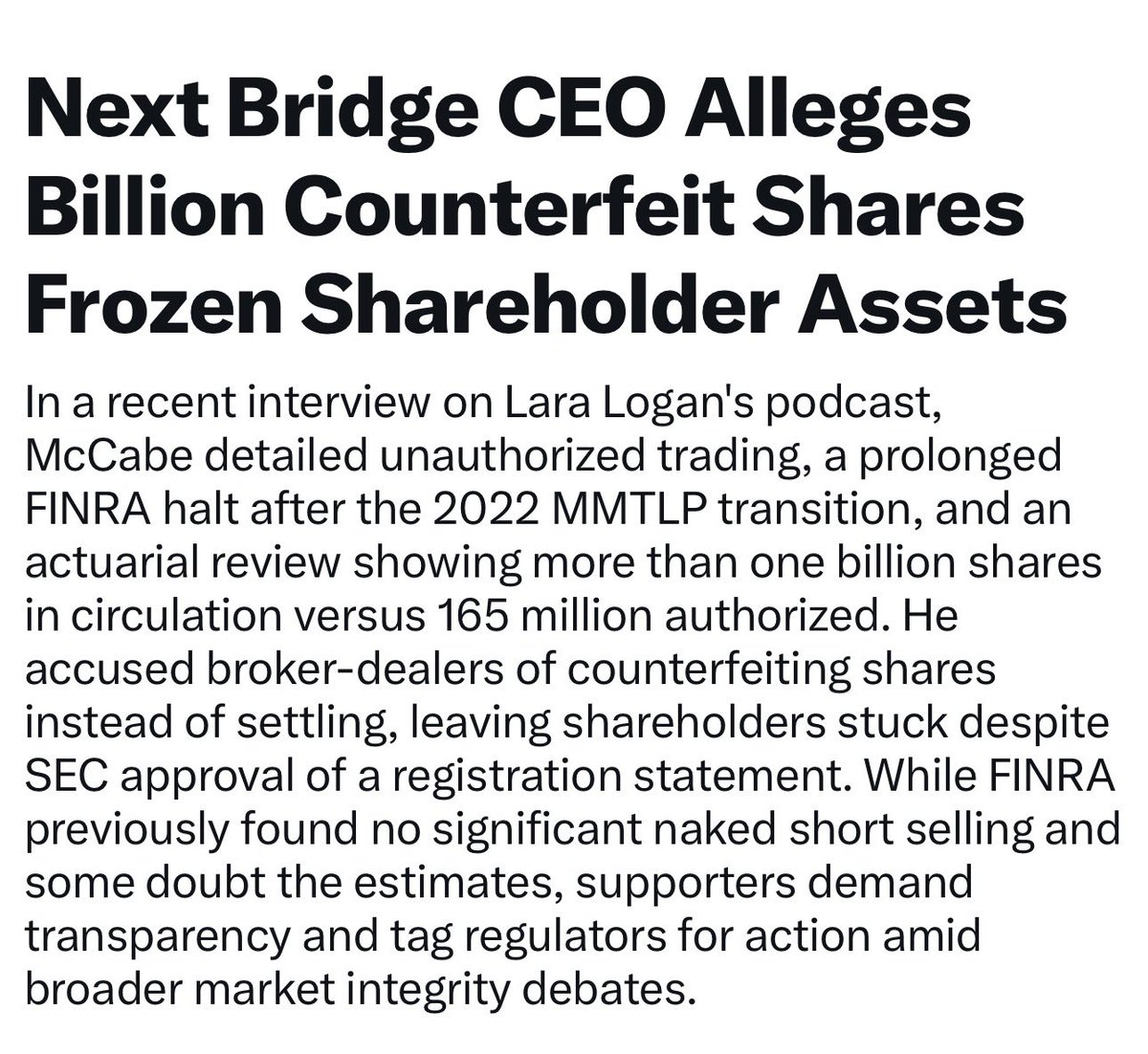
McCabe details what he alleges are serious failures in the U.S. financial markets, including naked short selling, unauthorized trading, counterfeit shares and the FINRA trading halt that affected roughly 124,000 shareholders.
McCabe explains what he calls “short and distort” — the inverse of pump and dump: profiting from a falling stock while negative information is used to undermine confidence in a company. Lara presses him on the role of regulators and what these practices could mean for everyday Americans invested in the stock market.
The episode examines the MMTLP controversy, the actions of FINRA and the SEC, the billion-share allegation, broker-dealer settlement issues and McCabe’s call for greater transparency and accountability.
@GregMcCabeJr | @GoingRoguewLara
Watch the full episode:
https://t.co/zeOoJlPpuf
Support Going Rogue:
https://t.co/UpUMiEhGvr
#LaraLogan #WallStreet #StockMarket #RetailInvestors #MarketManipulation
Greg McCabe broke his silence with Lara Logan and is taking his message to the President himself, A BILLION COUNTERFEIT SHARES
Trending AGAIN on X News, this Biden SEC and Congressional Scandal is gaining momentum and there’s nothing the Regulating/Market Maker Criminals can do about it 👊🏼🇺🇸
THEY’RE SELLING FAKE SHARES
Lara Logan asks Next Bridge Hydrocarbons CEO Greg McCabe to explain naked short selling and how traders can allegedly flood the market with shares they never borrowed and do not actually own.
In the newest episode of Going Rogue with Lara Logan, McCabe breaks his silence about the MMTLP scandal affecting approximately 124,000 shareholders, alleged market manipulation and what he describes as serious regulatory failures by FINRA and the SEC. @GregMcCabeJr
Watch New Episode: https://t.co/zeOoJlPpuf
Support Going Rogue with Lara Logan:
https://t.co/ZGF3YDUxp3
#LaraLogan #NakedShortSelling #MMTLP #StockMarket #FinancialCorruption
After nearly four years, Next Bridge Hydrocarbons Chairman and CEO Mr. Greg McCabe is breaking his silence and speaking publicly about MMTLP and Next Bridge Hydrocarbons.
🚨Breaking news: 🦋
@Nasdaq just LOST its Motion to Quash.
Read that again s l o w l y . . .
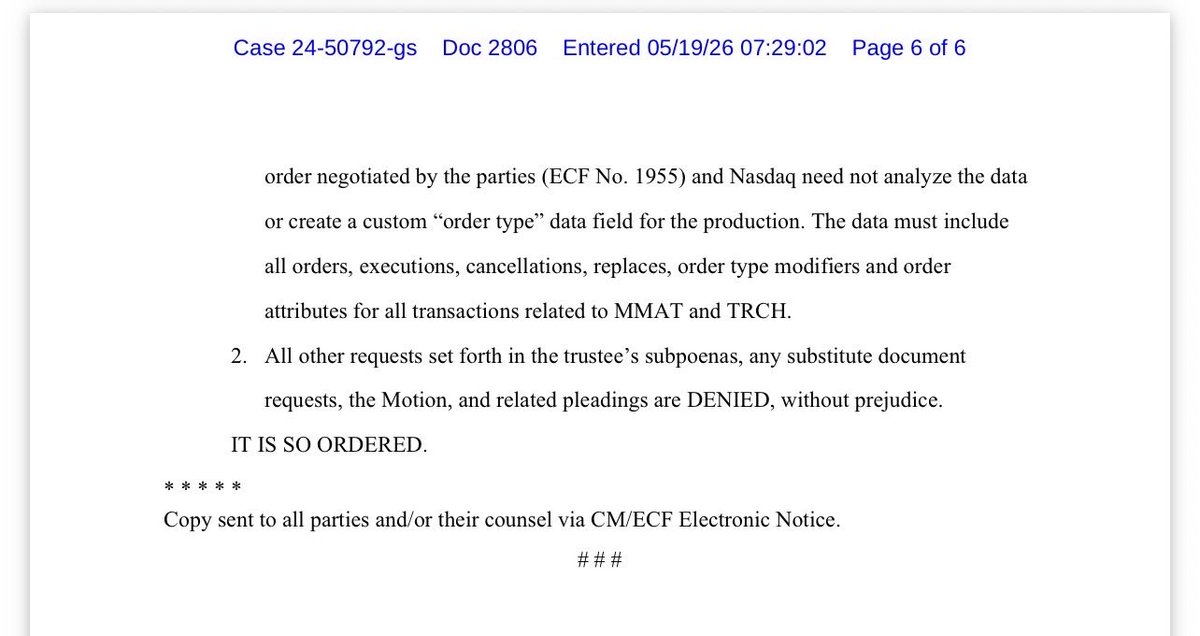
The Bankruptcy Court in Nevada has now ordered Nasdaq to produce extensive $MMAT/TRCH trading data under Rule 2004, including RASH and CORE data, order attributes, cancellations, replaces, executions, and related transaction records covering nearly FOUR YEARS.
The Court was NOT persuaded by the ‘undue burden’ argument, noting that producing ~15GB of spreadsheet data is not exactly impossible for… Nasdaq. (One $10 usb stick)
Even more important, the Court explicitly recognized the Trustee’s AUTHORITY to investigate whether wrongdoing occurred on behalf of the estate, including potential claims tied to stock trading activity.
Translation:
This investigation is very much ALIVE.
For months, some people mocked and undermined the Trustee’s efforts, claimed discovery would never happen, and acted like every subpoena didn’t get served initially and that it would be crushed before daylight. Instead, the wall keeps cracking.
FINRA discovery.
Now Nasdaq discovery.
And the Court explicitly referenced separate pending motions involving Citadel, Virtu, and Anson.
Interesting times ahead.
Turns out Rule 2004 is not just a decorative suggestion.
To the Trustee and legal teams, incredible respect.
It takes courage to walk into rooms filled with institutions that have virtually unlimited resources and say:
‘Produce the data’
And to the echo chambers already warming up their spin machines tonight…
You may want to read the actual order first. 🤝
Blessings to all.
How about you stay in your office for a week and reach out to MMTLP investors that have all the evidence you need to start an all out investigation of FINRA wrong doings and SEC stonewalling of a simple S1 for NextBridge Hydrocarbons a non trading private company that is on its 12th revision. It is now the 2nd longest S1 application in SEC history. How about we do that instead of gallivanting all over the country making empty promises of action.
Pt. 2 of >>> 🚨 The FOIAs Don’t Lie.
@bleedblue18 lays it out: the documents prove that the SEC and FINRA worked together — not just on the U3 halt, but in the cover-up and cleanup before and after and sometimes over coffee.
This wasn’t confusion. It wasn’t an accident. It was collusion. And now it’s on record.
Watch the breakdown 👇 #MMTLP #FOIA #Fraud #Rico
from yours truly - Artburn
Hi Kevin 👋
🚨BREAKING NEWS🚨
Next Bridge Hydrocarbons announces they have engaged the services of Houston-based law firm Christian Attar "to explore and investigate any and all potential claims related to harassment, business disparagement, libel, slander, tortious interference, conspiracy, obstruction of justice and violations of the Administrative Procedures Act." https://t.co/b3HS9DXEeq
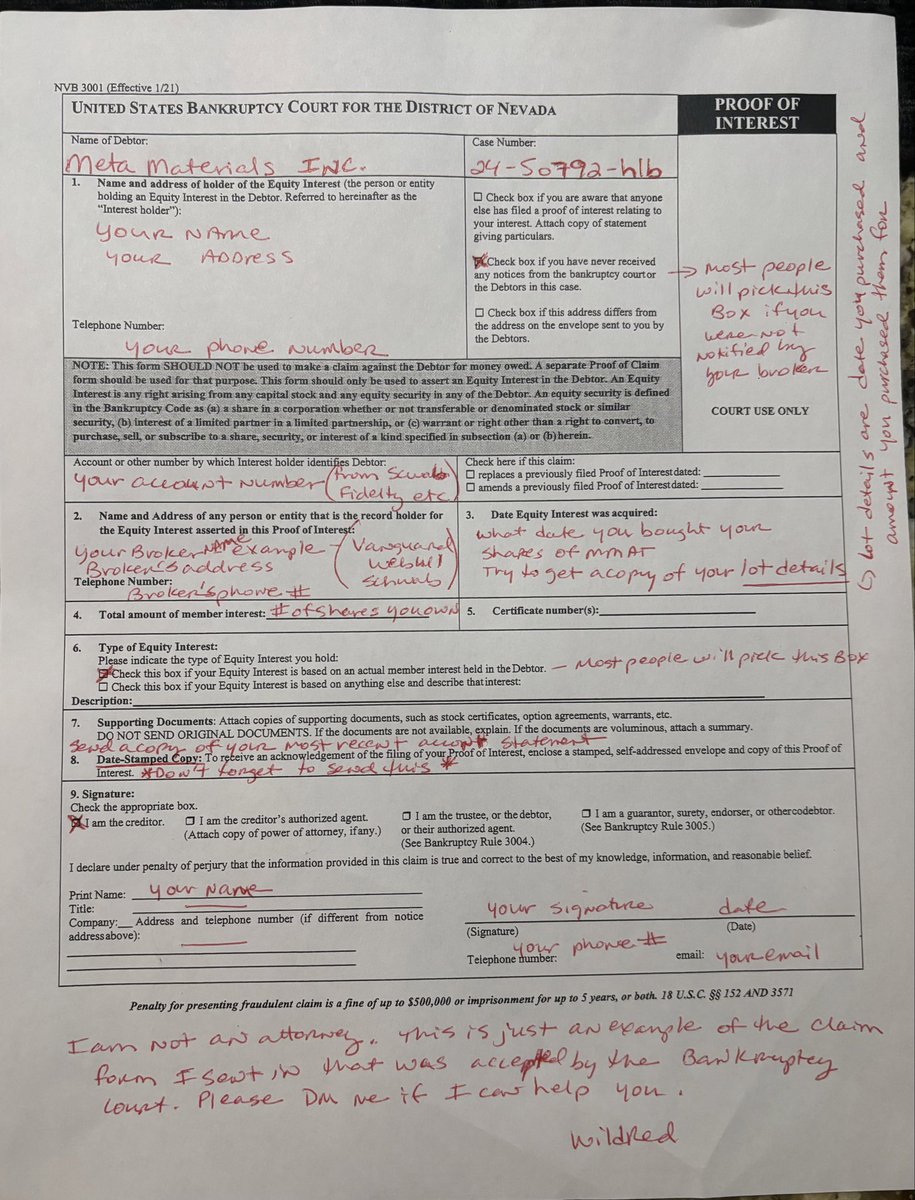
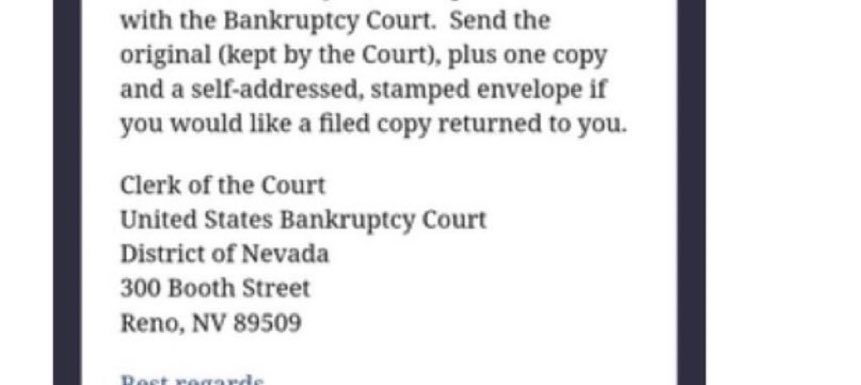
True. As it is also true that if (when) the litigation team (more than just Wes) does their work as expected and is able to recover a large enough amount, then I wholeheartedly believe there will be more than enough for the shareholders. There was no secured creditors in MMAT, the creditors are insignificant compared to the potential size of claim and the waterfall (as it is called) will, in my opinion, flow all the way to every shareholder (maybe for the first time in history and set precedence). I URGE everyone to submit the Expression of Interest forms before the deadline which is next month.
🚨BONUS Part 4 – Hedge Funds and High-Frequency Trading: The Cost of Playing Fast and Loose 🚨 @DOGE
I know it is a lot to take in, I am not an expert but I am now starting to understand enough to be dangerous. if you see anything you don't agree with specifically, or it is factually wrong correct me, add your comments and do your research to see for yourselves...
Now for the Bonus round, let’s paint a picture of a #hedgefund with say $10 billion in assets (AUM) and near-limitless leverage, called Charlie's Capital. Internal leverage limits ⁉️ Who needs them ⁉️ Charlie's Capital isn't subject to specific regulatory caps on leverage, meaning they have FULL discretion to set their OWN limits—typically based on their investment strategies and risk tolerance. This freedom allows them to go big, and often, they go all-in.
When combined with high-frequency trading (HFT) strategies, this kind of power is a game-changer.
The only real limit? Getting caught—but with only a “speeding ticket” type fine, it’s just another cost of doing business...
Here’s how this all plays out, with examples of big-league strategies and the resulting consequences when things go wrong. This is based on my PART 3 list, but this time adjusted for a large-AUM aggressive-leverage players like Charlie's Capital:
1. Spoofing
How It Works: Charlie's Capital uses its unlimited leverage to flood the market with large orders at multiple price points, creating an illusion of market demand or supply—then cancels the orders just before execution.
Impact with HFT: HFT algorithms take over, executing trades in mili/nanoseconds, and with near-limitless leverage, the hedge fund can manipulate market prices on a massive scale, especially in illiquid or heavily shorted stocks.
Risk/Reward: The rewards are immense, but the risk of a “speeding ticket” fine is always there. After all, spoofing is illegal, but the fines? Just part of the cost of doing business... 🚨for example, in 2020, JPMorgan Chase paid a $920 million fine for engaging in market manipulation practices like spoofing and using HFT to manipulate precious metals and U.S. Treasury markets. (https://t.co/8aTy1dv5HQ)
2. Layering
How It Works: Charlie's Capital places a series of small, artificial orders at fractional decimal points (e.g. SIX decimal points) to mislead other traders (Retail) into believing there’s a trend.
Impact with HFT: Charlie's Capital can trigger a cascade of trades through rapid HFT algorithms, and with unlimited leverage, they can amplify these movements to create significant market distortions.
Risk/Reward: The reward is a swift profit from price manipulations, but the risk is getting caught in the act. Once again, the fine becomes just part of the game... 🚨for example in Sept 2010, Trilium Brokerage Services was slapped with a $1.0 million fine by FINRA for engaging in illegal “layering” and manipulative trading practices. "Neither the firm nor the 11 employees admitted or denied the charges but consented to FINRA's findings." For Charlie's Capital with nearly $10 billion in AUM, this would be a mere bump in the road, an operational cost. (https://t.co/Gs1OxqV3M4)
3. Naked Short Selling
How It Works: Charlie's Capital could sell shares it hasn't borrowed, benefiting from the downward price pressure it creates.
Impact with HFT: By using HFT and leveraging fractional shares (e.g. to six decimal points), the hedge fund can execute these trades rapidly across multiple exchanges, exploiting price differences and pressuring the stock to fall further. The unlimited leverage makes this strategy even more potent.
Risk/Reward: Naked short selling is risky and illegal under most regulations, but with HFT's speed, the hedge fund can execute the strategy and cover positions at such a speed before regulators or counterparties can react, making it a high-risk, high-reward play...
4. Wash Trading
How It Works: Charlie's Capital buys and sells the same security, creating the illusion of volume and price movement.
Impact with HFT: With unlimited leverage, wash trading can generate substantial volume, distorting market liquidity. HFT executes these trades at the speed of light, ensuring rapid-fire manipulations.
Risk/Reward: While wash trading is illegal, the fines are often a drop in the bucket for firms with massive leverage and deep pockets. The rewards from manipulating price momentum can often outweigh the penalty costs... 🚨for example a small $350k fine against Eagle Market Makers by CFTC was imposed in July 2019, for similar types of market manipulations through wash trading and misleading market activity (read about this care in the following amazing article and the remarks by the author and special Counsel, MR Gary De Waal, on his award winning “Bridging the Week” column on National Law Review. https://t.co/6SjDUVpwdy)
5. Short Ladder Attacks
How It Works: Charlie's Capital uses HFT to execute a series of small, rapid sell orders to trigger a price spiral downward.
Impact with HFT: Charlie's Capital can rapidly escalate this attack, leveraging unlimited capital to push a stock’s price downward and profit from the shorted positions. HFT ensures they can hit targets before anyone notices.
Risk/Reward: While the strategy can be immensely profitable, the hedge fund risks getting caught in the act. To date i have seen no case or fine in this category.
What happens in the "Grey Area" Strategies with Unlimited/Ultra-high Leverage:
6. Ping Orders
How It Works: Charlie's Capital places small orders to "ping" for hidden liquidity in the market, using the information to suppress prices and profit from price fluctuations.
Impact with HFT: With unlimited leverage, Charlie's Capital can suppress prices across multiple markets, taking advantage of hidden liquidity at an incredible speed, gaining a quick edge in the market.
Risk/Reward: Unfortunately, Ping orders themselves aren’t illegal, but they raise ethical questions. Even so, when combined with HFT speed, they can be highly profitable. The hedge fund can easily brush off any penalties—just a slap on the wrist. To date i have not seen a case or fine in this category.
7. Quote Stuffing
How It Works: Charlie's Capital submits and cancels thousands of orders in milli/nanoseconds, overwhelming market systems to slow price updates.
Impact with HFT: With unlimited leverage, Charlie's Capital can flood the market with order data, creating confusion and misleading other traders. This tactic can result in massive profits as other traders get caught in the haze of confusion.
Risk/Reward: Quote stuffing is a grey area, and while regulators watch it closely, it’s often just another cost of doing business for the hedge fund... 🚨for example in June 2014, high-frequency trading firm Citadel LLC was fined $800,000 for violations that included quote stuffing. Nasdaq's disciplinary action stated that Citadel "failed to prevent the strategy from sending millions of orders to the exchanges with few or no executions." It was pointed out that Citadel "sent multiple, periodic bursts of order messages, at 10,000 orders per second, to the exchanges. This excessive messaging activity, which involved hundreds of thousands of orders for more than 19 million shares, occurred two to three times per day." similar activities show the value of such fines when it’s just a part of the firm’s cost structure... (source: https://t.co/ILJK36CnOj)
8. Sub-Pennying
How It Works: Charlie's Capital places bids or offers at slightly lower or higher prices than visible orders to jump ahead in the queue.
Impact with HFT: With unlimited leverage, this tactic can dramatically manipulate stock momentum, especially in stocks with large short interest. The hedge fund can seize control of price movements while other traders remain unaware.
Risk/Reward: Sub-pennying is controversial, but not explicitly illegal. The reward is quick profits, but the regulatory pushback could come in the form of fines—which, for firms with unlimited leverage like Charlie's Capital, are just another operating cost... 🚨Although the SEC's Sub-Penny Rule (Rule 612 of Regulation NMS) prohibits exchanges from quoting trades in increments of less than a penny for stocks priced over $1, sub-penny trading can still occur off-exchange. This practice allows traders to step ahead of displayed limit orders by offering a slightly better price, often just a fraction of a cent better (how about 6 decimal points of a cent better?), which can give them priority in executing trades. Check out this interesting article in 2010 around the time when the SEC was bringing forth their Sub-Penny Rule... The article discussed the opposition from industry players to the proposal of sub-penny trading for stocks priced at $1 or more. Money managers and brokers argued that trading in increments smaller than a penny would lead to unfair competition and enable traders to outbid each other by insignificant amounts. The concern was that sub-penny increments would not contribute to orderly markets and could worsen issues like market depth and transparency. The SEC received multiple comment letters from firms and associations like the Securities Industry and Financial Markets Association and the Investment Company Institute expressing these concerns...
(https://t.co/aIlIm4UBpb )
To their credit, the SEC has taken action against HFT firms for fraudulent trading practices designed to manipulate closing prices, their first ever case was in 2014 and Athena Capital Research was fined $1M (https://t.co/41dgPz8ANS)
9. Flash Orders
How It Works: The hedge fund takes advantage of fleeting market orders, exploiting brief glimpses to gain a trading advantage.
Impact with HFT: Flash orders, combined with unlimited leverage, allow the hedge fund to outpace competitors by executing trades in nanoseconds, making a profit off small price movements.
Risk/Reward: Flash orders are controversial, and their use is being closely scrutinized. If regulators move against them, the hedge fund could face fines or penalties, but they can profit significantly in the short term... 🚨While the SEC proposed a rule amendment in 2009 to prohibit flash orders, my research shows that critics believe their new rule created a two-tiered market by allowing only selected participants to access information about the best available prices for listed securities (https://t.co/a5Y9nMIyhY)
10. Cross-Market Arbitrage
How It Works: Charlie's Capital takes advantage of price discrepancies between exchanges or markets, trading on both to profit.
Impact with HFT: With unlimited leverage, Charlie's Capital can execute cross-market arbitrage trades faster than any retail, driving prices down in one market while profiting from discrepancies in another.
Risk/Reward: Legal but heavily scrutinized, cross-market arbitrage provides a substantial opportunity for profit, though it could lead to market manipulation claims... 🚨for example The Commodity Futures Trading Commission (CFTC) fined Victory Asset, Inc. $1.8 million and Michael D. Franko $500,000 for spoofing and manipulative schemes that involved both single-market and cross-market activities. Franko engaged in cross-market spoofing by placing orders in one market to benefit positions in another correlated market... (https://t.co/FtTwMcQL4l)
11. Abuse of Dark Pools
How It Works: The hedge fund hides large trades in dark pools, distorting market data and influencing public prices.
Impact with HFT: With unlimited leverage, the hedge fund can suppress prices in dark pools while benefiting from lower prices in public markets. HFT ensures they can hide trades in a flash, manipulating the market quickly.
Risk/Reward: While dark pools are legal, their abuse can attract regulatory attention and penalties. The hedge fund can profit from the price discrepancy, but at a significant ethical and legal risk...🚨🚨🚨
Several firms have been fined for market manipulation and abuses related to dark pool trading. Here are some infamous examples:
- ITG Inc. and AlterNet Securities: In 2015, ITG Inc. and its affiliate AlterNet Securities were fined $20.3 million by the SEC for operating a secret trading desk and misusing the confidential trading information of dark pool subscribers. This involved engaging in proprietary trading against subscribers in their dark pool, POSIT, while claiming to protect subscriber confidentiality (https://t.co/XiLNWEVepm)
- Citigroup Global Markets Inc.: In 2018, Citigroup was fined $6.5 million by the SEC for misleading users of its dark pool, Citi Match. Citigroup misrepresented that high-frequency traders were not allowed in the pool when, in fact, two of its most active users were high-frequency traders (https://t.co/i4LJ9YtuiV)
- Barclays Capital Inc. and Credit Suisse Securities (USA) LLC: In 2016, Barclays and Credit Suisse were fined by the SEC and the New York Attorney General's office for violations related to their dark pools. Barclays paid $35 million in penalties for misleading investors about how it monitored its dark pool for predatory trading. Credit Suisse paid a total of $84.3 million for misrepresentations about its Crossfinder dark pool (https://t.co/YyfIXAYRcm)
- Deutsche Bank: In 2016, Deutsche Bank was fined $18.5 million by the SEC and NYAG for misleading clients about the performance of its automated order router, which primarily sent client orders to dark pools. The bank failed to accurately describe how it ranked dark pools based on execution quality (https://t.co/xsnCt8RlWz)
12. Exploiting Weak Market Regulations
How It Works: The hedge fund trades in markets with looser regulations, amplifying short pressure on U.S. stocks.
Impact with HFT: Using unlimited leverage and HFT, the hedge fund can exploit market inefficiencies across multiple jurisdictions, applying pressure on U.S. stocks and profiting from price movements.
Risk/Reward: While technically legal, this strategy raises ethical concerns and could face regulatory challenges across borders.
⁉️ SO WHAT ARE OTHER REGULATORS, OUTSIDE OF USA, DOING TO PROTECT THEIR INVESTORS ⁉️
The EU’s 30x Leverage Cap: A Contrast in Regulation ⚖️:
Now, let's compare this with the European Union's regulatory framework, which has taken a more cautious and restrictive approach to leverage. The European Securities and Markets Authority (ESMA) imposed a 30:1 leverage cap on retail clients for major currency pairs in 2018. This was a direct response to concerns about the risks retail traders were taking on with high leverage, often leading to significant losses.
While hedge funds in the EU can still access higher leverage levels for professional investors, the ESMA's limits on retail trading provide an essential contrast to the near-limitless leverage available in the U.S. hedge fund world. In essence, the EU's regulations aim to protect retail investors from excessive risk exposure, whereas U.S. hedge funds can operate with far fewer constraints.
It is a step in the right direction but the disparity in regulation highlights a stark contrast between the two regions:
The EU's 30:1 leverage cap protects retail investors from market manipulation and excessive risk, ensuring that firms operating in that region are held accountable for the risks they impose on clients.
In contrast, U.S. hedge funds with near-unlimited leverage are allowed the flexibility to engage in market manipulation with HFT, exploiting the system to maximize profits, and often facing no more than minor fines when caught—costs that are trivial compared to the profits they make.
Call to Action: The New U.S. Administration Must Act 🚨 @DOGE
The new U.S. administration must address the imbalance between hedge funds’ unlimited leverage and the weak regulatory constraints they face, in my opinion. With market manipulation running rampant, it’s time for the U.S. to follow the other examples and impose stricter regulations on hedge funds using high-frequency trading strategies. The market should not be a playground for a select few with deep pockets and near-unlimited power to manipulate prices. This is pattern that is repeating over and over in many stocks, from $TSLA in the past to $DJT currently and everyone in between...
It’s time to level the playing field—not just for retail investors but for the health and fairness of the entire market system. The EU’s 30x leverage cap for retail traders should be a starting point, not a limit.
The new administration has an opportunity to ensure that hedge funds and their manipulative strategies are held accountable, with stronger regulations that protect investors and promote market stability.
The clock is ticking, and it's time for real #reform. It's time for the U.S. market to step up and ensure that hedge funds can no longer play with near-limitless leverage, undetected and unpunished.
What do you think? Comment below with suggestions.
#LevelThePlayingField
#EndHighLeverage
#ProtectRetailInvestors