مع كل صفحة أقراها في هالكتاب يجي في بالي تساؤل واحد :
كيف مثل هالكتاب ماله ترجمة عربية ؟! شيء يغبن بأن الكثير من العلوم للحين ما توصلنا و السبب ما فيه ترجمة !
[1/n] Good to see follow up pieces to our Economist piece on the yuan and global imbalances. This is also helpful to clarify what we say and do no say (seems like an endless thread!) We do not claim that the exchange rate is unaffected by policy choices or that the exchange rate is irrelevant for imbalances (we did not pick the headline for our piece). We fully recognize that the exchange rate is an *endogenous variable* that depends on fundamentals and policy choices, including currency interventions and capital controls. Here is what we say: "Indeed, the yuan does not float freely, and it is possible to engineer both a persistent current account surplus and a weak real exchange rate through a combination of capital controls, consumption suppression and foreign-exchange interventions." @pogourinchas@helene_rey
Coding isn't yet another application domain -- it's the meta-skill required for AI to automatically develop its own training material, via symbolic world models. That's how the RSI loop actually kicks off.
I like figures a lot to understand quickly/grasp concepts.
IMHO, this book is a masterpiece at conveying notions and intuitions with many nice figures:
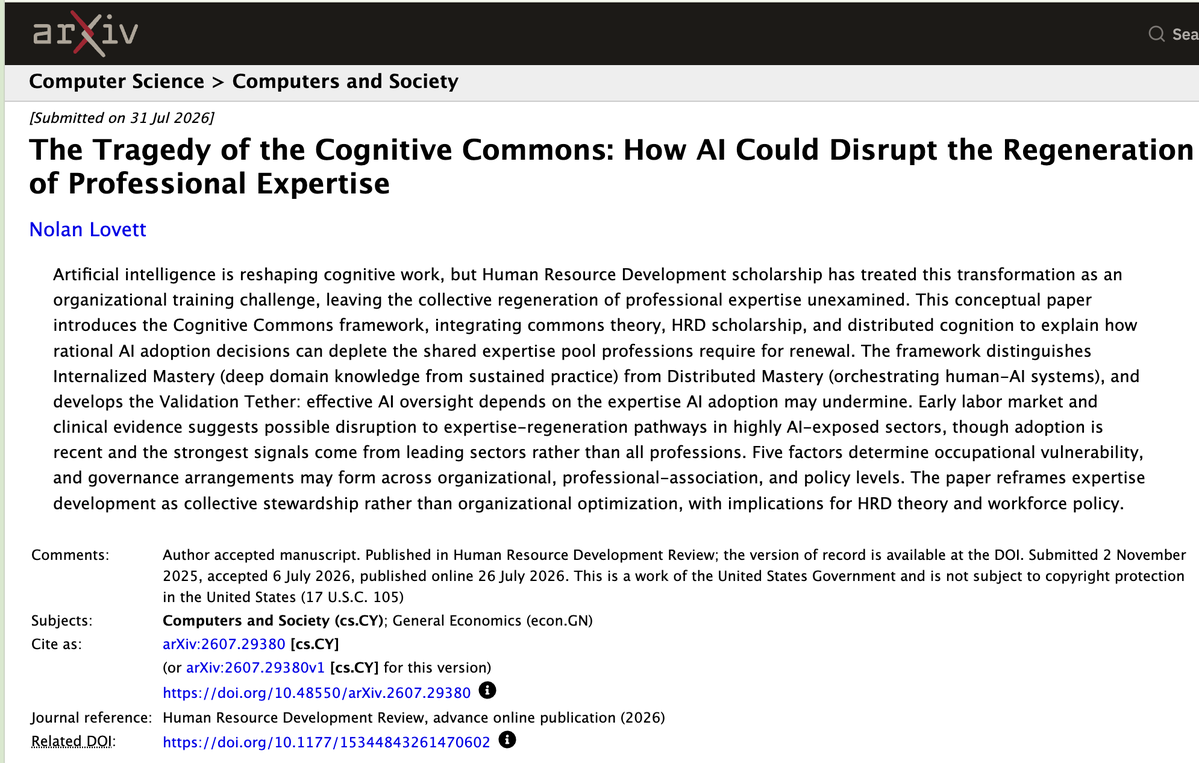
This paper gives a fancy name to a problem you can already feel in your bones
"The Tragedy of the Cognitive Commons." Checking AI output requires deep expertise. Deep expertise comes from doing grunt work for years. And grunt work is the first thing AI eats
So we're building systems that need expert supervision while dismantling the only known process for making experts
The paper calls the shared pool of human expertise the "cognitive commons." Every profession drinks from it. Nobody's refilling it.
By eliminating junior roles, each company is acting totally rationally, and the collective result: a profession that can't catch AI's mistakes anymore because it never learned to do the work in the first place
Who checks AI's homework in 15 years?
This is a very interesting idea from Nick Boles:
"Under the proposal, Britain would push for the creation of a “European Confederation”, linking the EU’s free-trade zone with Nato’s defence commitments.
Countries such as Ukraine, Switzerland, Norway and the Western Balkan states would also be invited to join...
Ukraine would join the confederation with a promise to maintain a large army to serve as a main bulwark against any future Russian invasion as well as share its drone technologies with the rest of Europe."
always loved this kurt vonnegut guide to writing with style, particularly that the very first step is 'find a subject you care about and which you in your heart feel others should care about. it is this genuine caring, and not your games with language, which will be the most compelling and seductive element in your style'
Very true. These are some useful books that help illustrate how the expansion and self-definition of Latin Christendom in the Middle Ages helped lay the foundations for colonialism, particularly the racism that underpinned it:
A major lesson from the Arday situation: document everything and always be ready to defend your CV. Across LSE, Duisburg-Essen, Warwick, UC Berkeley, Oxford, SOAS, and now Liverpool, I’ve kept every certificate, transcript, photo, contract, student evaluation, and referee contact. When you're a minority in elite spaces, you have to keep receipts so people can't wake up tomorrow and call you a DEI diversity hire 😅
Two weeks ago, I resigned from OpenAI to join Conduit as a founding researcher, where we're training models to non-invasively read the human mind.
I've written some thoughts about what telepathy could look like by 2035 and how to get there:
So about these recent shifts at Google...
Caveat: While Shane Legg worked for me 2.5 decades ago and I knew Demis a bit as well in the pre-DeepMind days, and I know a heck of a lot of Googlers to various degrees, I am far from an insider. I am not privy to any deep dark or shiny bright secrets regarding their palace intrigues or strategy shifts.
However I have enough knowledge to form a decent view of what is likely going on... bearing in mind that all this is educated guessing and this is just a tweet not a fully grounded scientific analysis!
1) Clearly this is the nail in the coffin for DeepMind as a semi-autonomous unit within Google... DeepMind will now be a regular Google division.
2) As a consequence of 1, one would expect all the non-Gemini/LLM AGI R&D projects within DM -- with the very important exception of Shane Legg's team (which by. my perhaps wrong understanding has 50-100 great people in it, not trivial) -- to get torched or allowed to wither... Basically Google will now have two AGI bets: Gemini/LLM and whatever Shane's team is doing...
3) Some folks have suggested to me that Shane will now depart and do his own thing. This I have no knowledge or opinion of -- but the question one would ask is: if it did happen he wanted to do this, could he somehow negotiate to leave and bring his team, which is great and built over a period of time with great effort and thought etc. ...?
4) One possible interpretation is that Demis has concluded that, while LLMs are inelegant and intellectually not that interesting, they may be good enough to get to the first HLAGI... which will then take care of building the next more-elegant and more-interesting AGI=>ASI architecture. If this is his perspective it would make sense for him to leave the AGI engineering to the Gemini folks for now, and focus on the broader social and economic and ethical issues.
Joscha Bach presented, tongue only partly in cheek, a similar perspective in his keynote at AGI-26. He wondered if, even though LLMs are not the best way to make a human level AGI, they just have so much momentum behind them that they can get there first anyway, and will then hopefully self-improve and self-modify and get to a more elegant architecture in the interim period btw AGI and ASI...
5) About Jeff Dean & co. leaving Google... one interpretation is that they genuinely don't think LLMs are the golden path to AGI and want to pursue a different path, which Google is not currently oriented to support. Another interpretation would be that they assume LLMs are going to lead to AGI and a lot of companies will get there roughly the same time with similar LLMs, and they feel they are not needed for this, so they may as well work on more interesting aspects of the Ai project which will then be able to synergize with all these LLM based barely-AGIs, helping them to better automate factories and solve hard science problems and etc. etc.
6) None of this is bad for Google's standing in the LLM race. It may actually improve Googles standing in the LLM race, by allowing Google to streamline and focus more on Gemini and getting out-of-the-way power players who were never so passionate about LLMs in the first place. What it is bad for is Google's potential to come up with the next big thing after LLMs -- unless Shane's team has it !! .... I have often said Google is the only big tech that is maintaining a serious pursuit of other AGi bets besides scaled-up LLMs, and it would seem this will now be much less true...
7) None of this seems bad for Google as a business in the near term ... it may make them stronger contenders in the LLM race and they still have a unique superpower to make $$ from retail users on LLMs due to integration with all their other products
8) As I do not believe LLMs are the golden path to AGI, this feels to me like it removes a major competitor to my own Hyperon+PC path to AGI... the competitor now is not Google or DM, it's Shane's team only and specifically.... OTOH we may get a lot more competitors in well-funded post-LLM startups spun off from ex-DeepMinders...
9) As others have said, we can expect a lot more churn, craziness and chaos in these last say 1-5 years before the breakthrough to HLAGI... and even more in the period btw HLAGI and ASI ...
I’ve been working towards AGI my whole life, and as we enter this pivotal moment, I’m stepping into a new role as Chair of Google DeepMind & Chief Scientist of Alphabet. This will allow me to focus on long-term strategy, and accelerating scientific breakthroughs, including leaning into my work at Isomorphic to help cure disease.
I’m excited that @koraykv will be stepping up to lead GDM as SVP, alongside @joshwoodward and our exec team. I could not be more excited and confident about our amazing next chapter! 🚀
https://t.co/2WtlIIlTUa






![GitaGopinath's tweet photo. [1/n] Good to see follow up pieces to our Economist piece on the yuan and global imbalances. This is also helpful to clarify what we say and do no say (seems like an endless thread!) We do not claim that the exchange rate is unaffected by policy choices or that the exchange rate is irrelevant for imbalances (we did not pick the headline for our piece). We fully recognize that the exchange rate is an *endogenous variable* that depends on fundamentals and policy choices, including currency interventions and capital controls. Here is what we say: "Indeed, the yuan does not float freely, and it is possible to engineer both a persistent current account surplus and a weak real exchange rate through a combination of capital controls, consumption suppression and foreign-exchange interventions." @pogourinchas @helene_rey](https://pbs.twimg.com/media/HPYNcJWWgAAZPGF.png)