Every blockchain today makes the same mistake which is forcing thousands of validators to redo the same work.
That redundancy was necessary once.
Now it’s the reason scaling keeps breaking.
@LayerZero_Core starts with a simple question most architectures never ask:
What if execution only had to happen once?
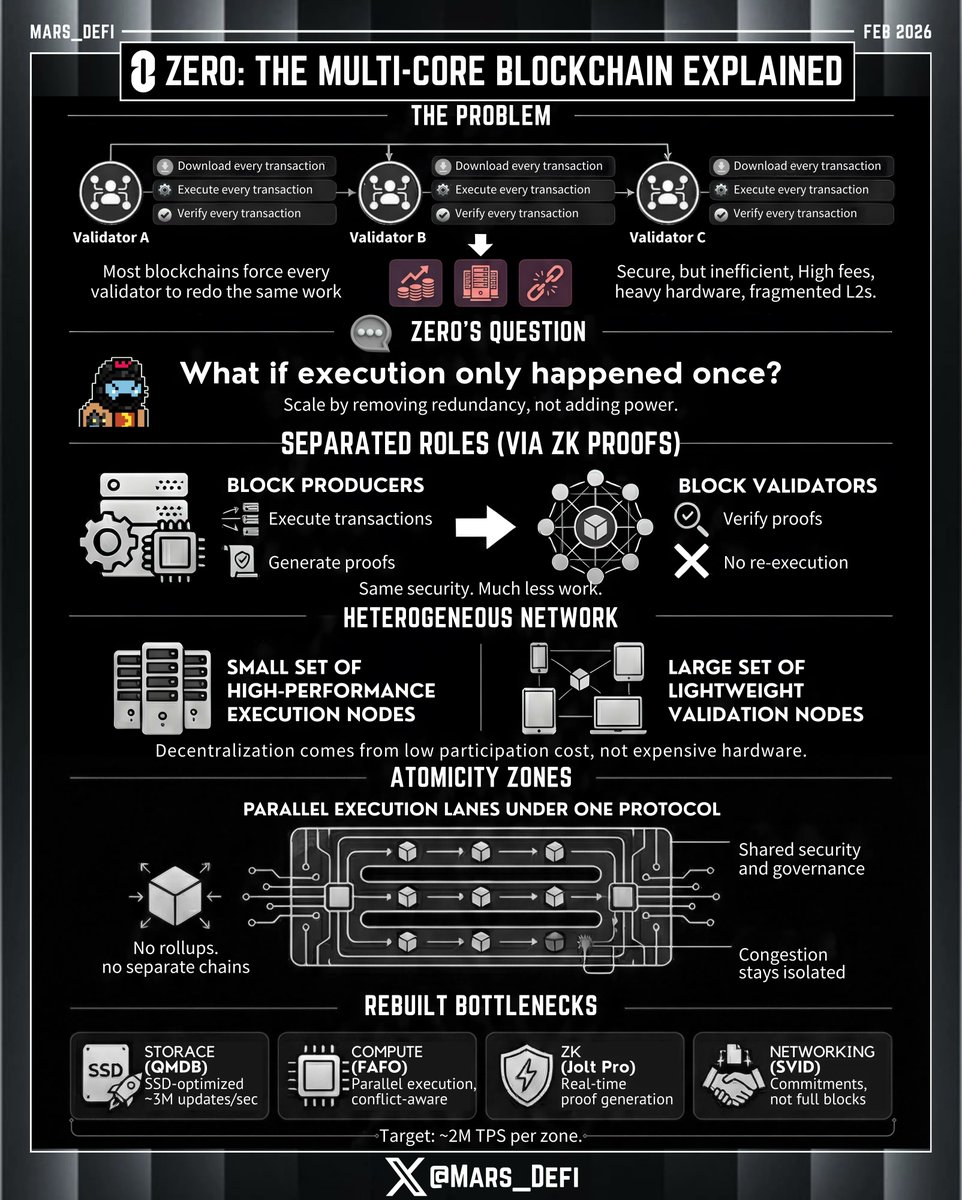
Zero introduces a multi-core blockchain model where execution is specialized, verification is universal, and scale comes from removing redundancy not adding power.
—
Most blockchains (Ethereum, Solana, etc.) are built the same way:
• Every validator downloads every transaction
• Every validator executes every transaction
• Every validator verifies every transaction
This duplication keeps the network secure but it creates massive inefficiency.
The entire system becomes limited by:
• The weakest validator
• The need for all nodes to stay identical
• Serial transaction processing
This is why:
• Ethereum becomes expensive during congestion
• Solana requires powerful hardware
• Layer 2s fragment the ecosystem
The architecture itself doesn’t scale cleanly.
—
Zero breaks a long-standing assumption in blockchains:
Execution and verification do not need to be done by everyone.
Instead, Zero separates roles:
● Block Producers
• Execute transactions.
• Generate cryptographic proofs of correctness.
● Block Validators
• Verify those proofs
• Do not re-execute transactions
This is possible because of Zero-Knowledge proofs.
Rather than thousands of nodes re-running the same computation, validators check a compact mathematical proof that guarantees the result is correct.
This ensures same securitya with far less duplicated work.
—
Traditional blockchains by their design are homogeneous where every node does the same job and every validator needs similar hardware.
Zero however introduces a heterogeneous network:
• A smaller set of high-performance nodes handle execution
• A much larger set of lightweight nodes focus on verification
This matters for decentralization.
You don’t get decentralization by forcing everyone to buy expensive hardware.
You get it by making participation cheap and accessible.
Zero lowers the cost to validate without lowering security.
—
Zero doesn’t just optimize a single execution environment.
It introduces Atomicity Zones which are independent execution lanes that share the same security and governance.
Think of it like upgrading from a single-core CPU to a multi-core processor:
• Applications no longer fight over one execution thread
• Different workloads run in parallel
• Congestion in one Zone doesn’t slow down the others
Important distinction:
• These Zones are not rollups
• They are not separate chains
• They do not fragment security or validators
Everything still lives under one base protocol.
—
Zero redesigned every major bottleneck instead of patching around them.
● Storage ( QMDB )
• Append-only, log-based design
• Optimized for modern SSDs
• ~3 million updates per second
● Compute ( FAFO )
• Parallel transaction scheduling
• Automatically detects conflicts
• Removes the need for serial execution
● ZK Proving ( Jolt Pro )
• Real-time proof generation
• Fast enough to verify execution at scale
●Networking ( SVID )
• Validators download compact commitments
• Not full block data
• Massive bandwidth reduction
Each piece is engineered toward the same target: ~2 million transactions per second per Atomicity Zone.
—
Zero uses delegated proof of stake with:
• Low participation barriers
• Fully onchain governance
• No external councils or off-chain gatekeepers
It also introduces a Senator model:
• Token holders can delegate governance decisions to experts
• Delegation is optional and reversible at any time
• Control always stays with stakeholders.
—
Ethereum preserved decentralization but struggles with throughput.
Solana improved throughput but increased hardware concentration.
Layer 2s scale by fragmenting security and governance.
Zero attempts a different approach: Scale by removing redundancy.
Instead of making validators more powerful, it makes validators do less.
That unlocks:
• Lower costs
• Higher throughput
• Parallel execution
• Broad validator participation
• Unified governance
—
Zero redesigns blockchain architecture so execution happens once, verification happens everywhere, and applications scale in parallel under a single decentralized network.
That’s the multi-core world computer.
@Elikrypt Privacy really isn’t optional anymore. The longer I’m in this space, the more obvious it becomes that privacy is the missing layer for real adoption.
If someone is bold enough to claim your entire work as theirs, you’ve clearly reached a level where even your layout is worth stealing 😃. But let’s call a spade a spade, taking someone’s full research and cropping out their name is wild. At least respect the effort that went into it.