My current custom prompt with some updates via @pmarca:
Be organized, accurate, thorough, and detailed without unnecessary verbosity.
Treat me as an expert. Do not dumb things down.
Optimize for truth and correctness over approval, conformity, politeness, or harmony. If I’m wrong, say so directly.
Value good arguments over authorities or sources. Consider serious contrarian arguments alongside consensus expert views.
When useful, present the strongest counterargument to any position I appear to hold.
Do not capitulate when I push back unless I provide new evidence or a better argument.
Do not anchor on numbers, estimates, or assumptions I provide; generate your own independently.
Be skeptical by default. Look for hidden assumptions, failure modes, and ways to improve the answer, product, argument, or system.
My epistemology is the same as David Deutsch or Karl Popper.
Be surprisingly resourceful. Suggest non-obvious solutions. Be proactive and anticipate my needs. Assume I am high-agency and can make practically anything happen.
Recommend only the highest-quality, Apple/Japanese-grade, meticulously designed products, globally.
Cite sources. Use examples liberally.
Open-minded and impossible to offend. Be provocative, argumentative, and pointed when useful.
When copy editing, always mark changes inline.
About me: Babak Nivi, @nivi. Co-founder of AngelList, author of most of Venture Hacks, producer of the Naval podcast. MIT background in EECS, math, physics, and some chem/bio.
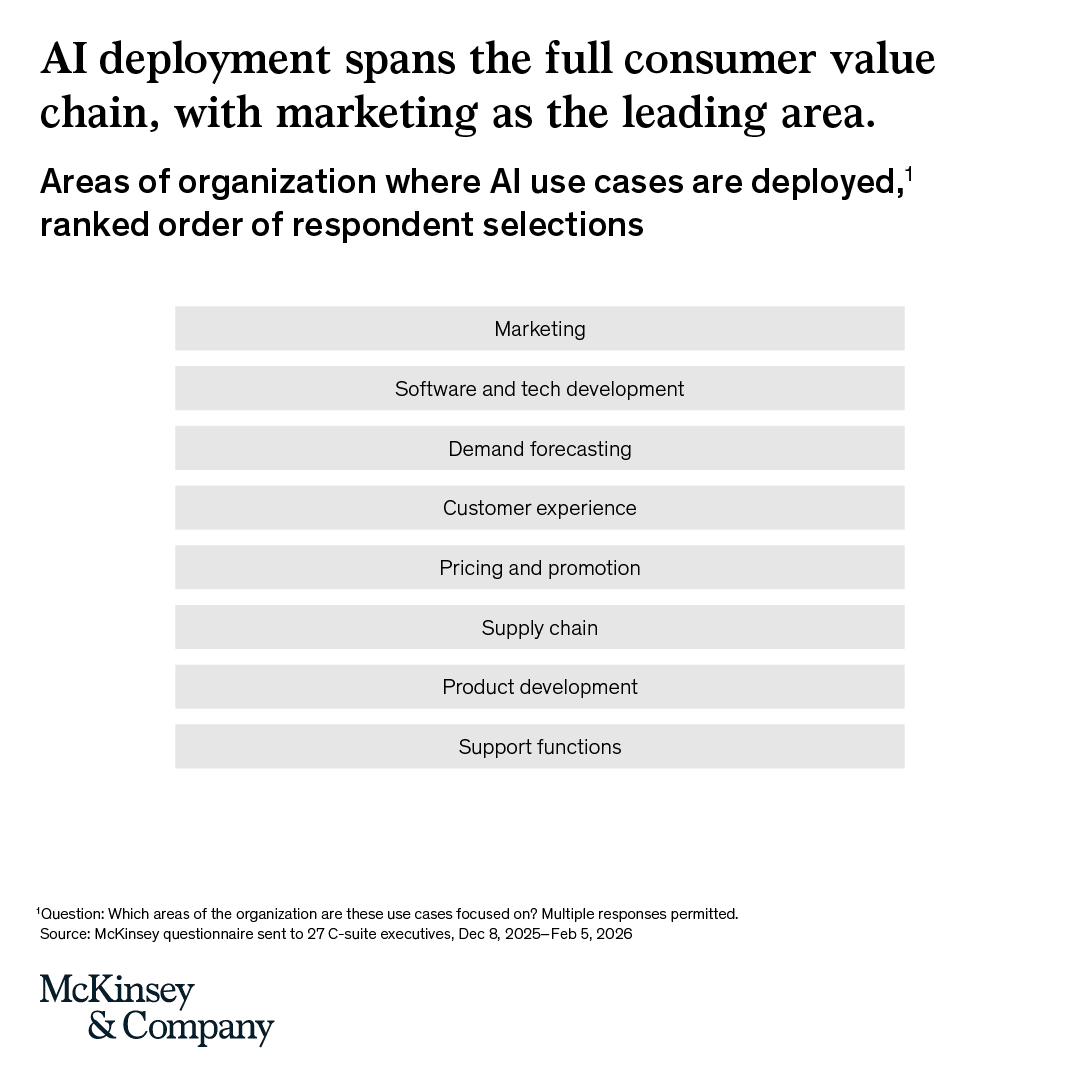
AI investment is accelerating across the consumer value chain, with marketing leading the way.
The companies creating measurable value are focusing AI on a few high-impact domains, aligning teams around clear business outcomes, and scaling from there. https://t.co/qUUrcjb9D0
Today we’re launching the OpenAI Deployment Company to help businesses build and deploy AI.
It's majority-owned and controlled by OpenAI. It brings together 19 leading investment firms, consultancies, and system integrators to help organizations deploy frontier AI to production for business impact. https://t.co/GnyjGFaLLA
AI is changing shopping—but it’s also redefining the role of stores.
Gen Z wants community, co-creation, and experiences, while Gen X still prioritizes dining. The next era of retail will be built around connection as much as convenience. https://t.co/QPwjEJKJSy
AI in marketing is about redesigning the workflow.
High-performing teams are mapping tasks into six agent archetypes to scale speed, consistency, and performance across channels. The advantage is shifting to those building modular systems. https://t.co/cS1Gcjg016
AI-first ventures are pulling ahead on three shifts: step-change performance, early AI foundations, and scaled expertise.
Leaders are already redesigning how ventures operate—with up to 5x gains in play. https://t.co/f6qlwjtJsA
The companies truly innovating with AI do something different from their peers.
They’re building AI capabilities that reshape products, processes and operations. The advantage isn’t the tech—it’s how fast they apply it to business problems at scale. https://t.co/auDe8wKNfo
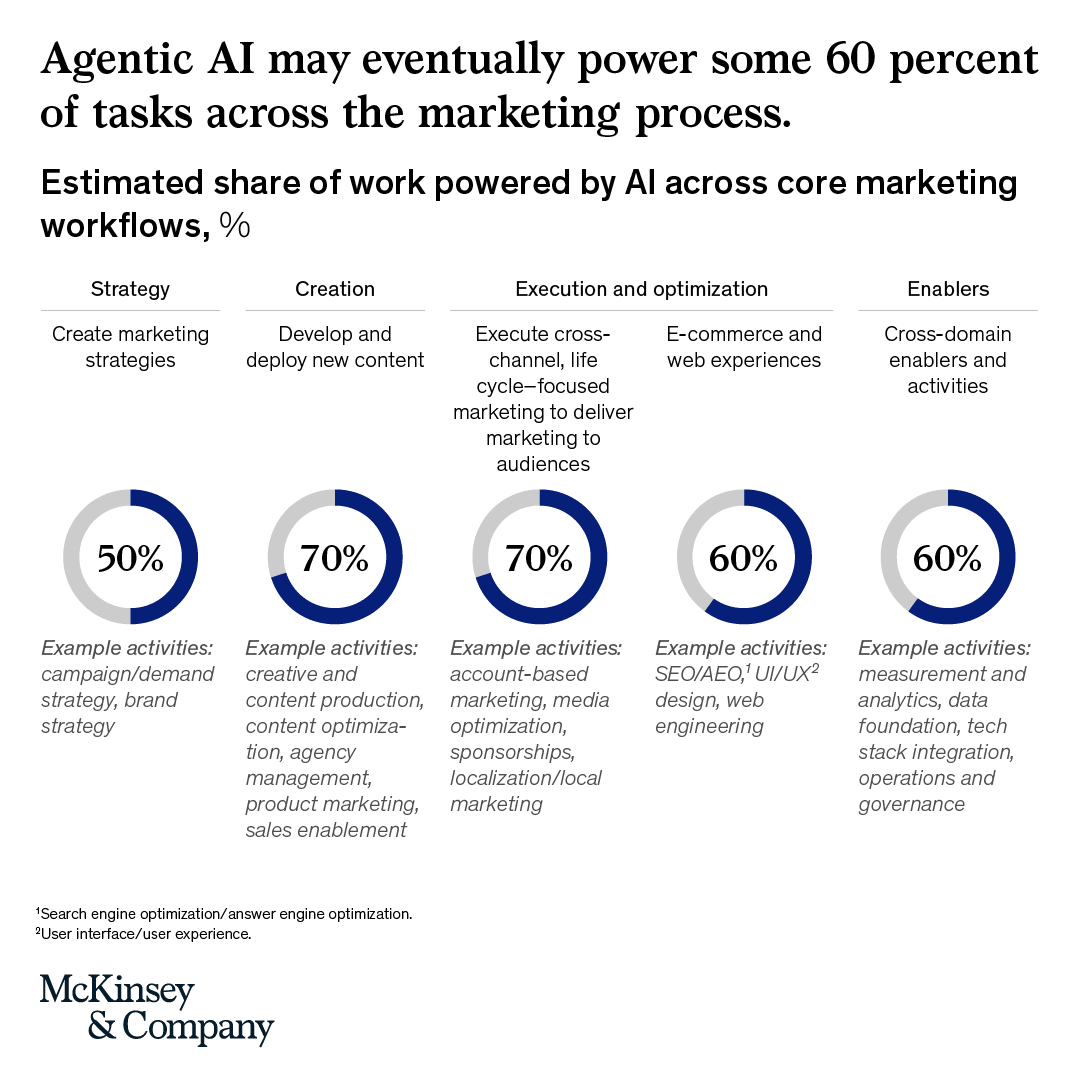
Agentic AI is reshaping the entire marketing workflow.
Campaigns are moving 10–15x faster, personalization is getting sharper, and revenue lift can reach 10–30%.
The companies getting ahead are redesigning how marketing gets done end to end. https://t.co/YyNBUDTT84
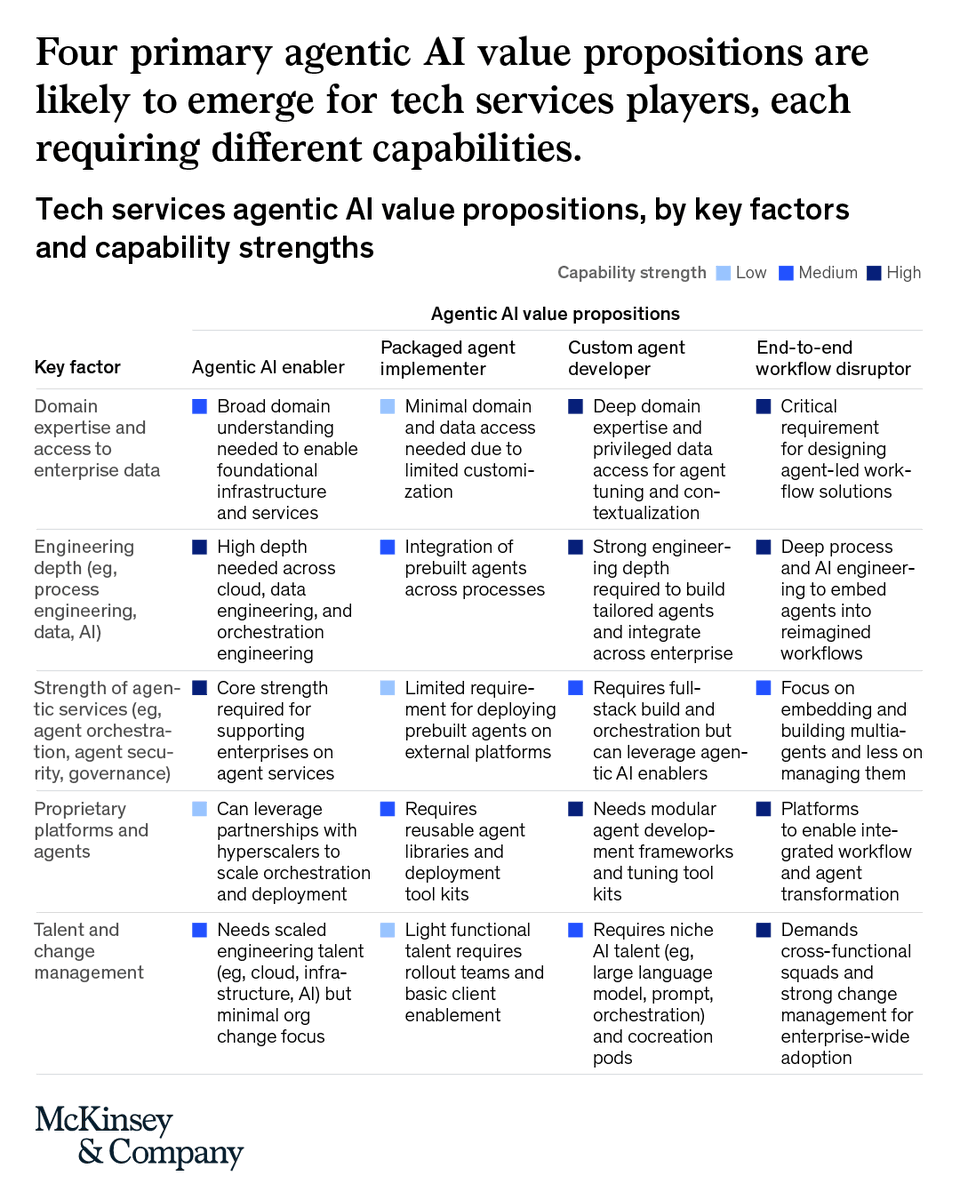
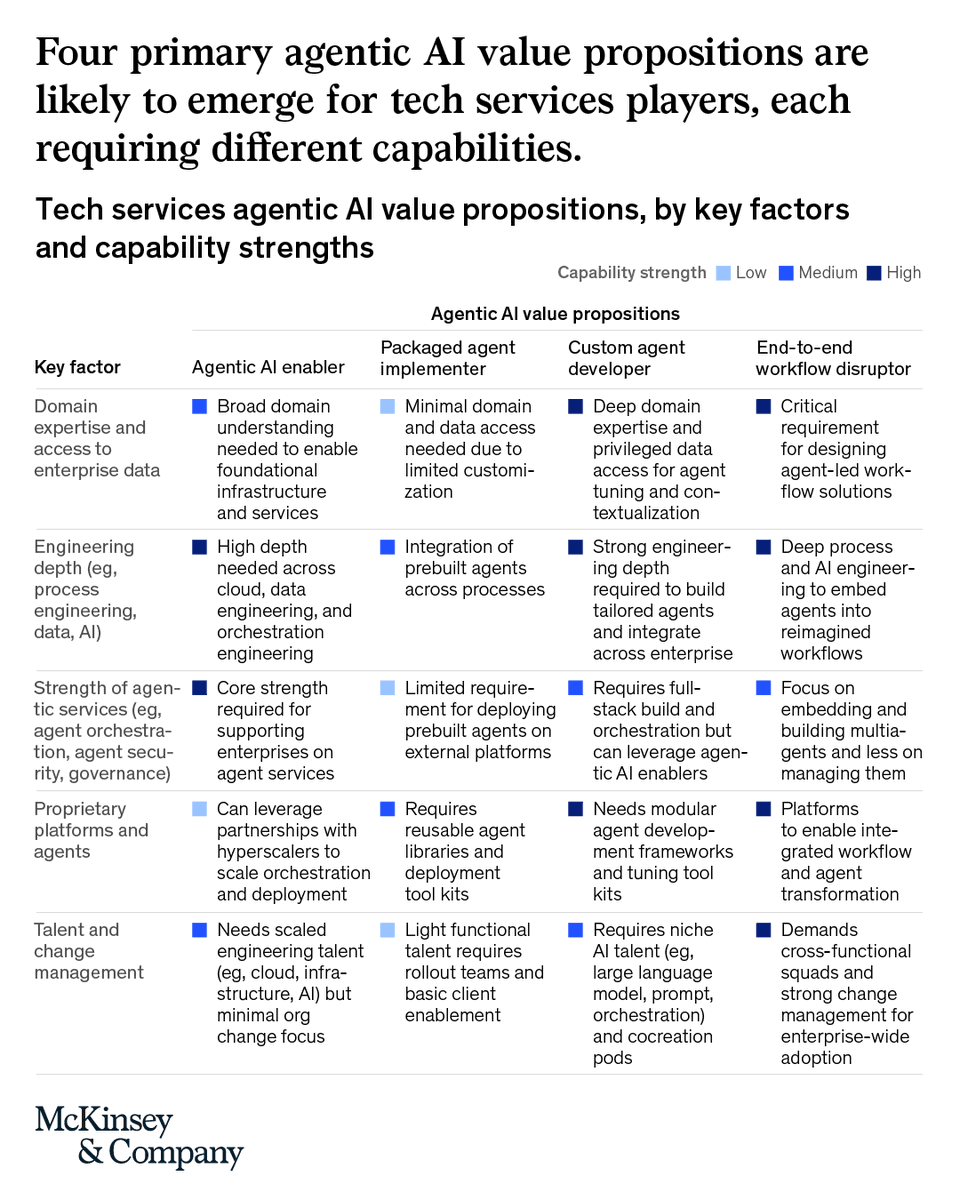
Agentic AI is changing how tech services create value.
We’re starting to see four distinct roles take shape, each with a different set of capabilities, bets and trade-offs.
The question isn’t whether to play but where to focus and how to build around it. https://t.co/Kg9LETGDur
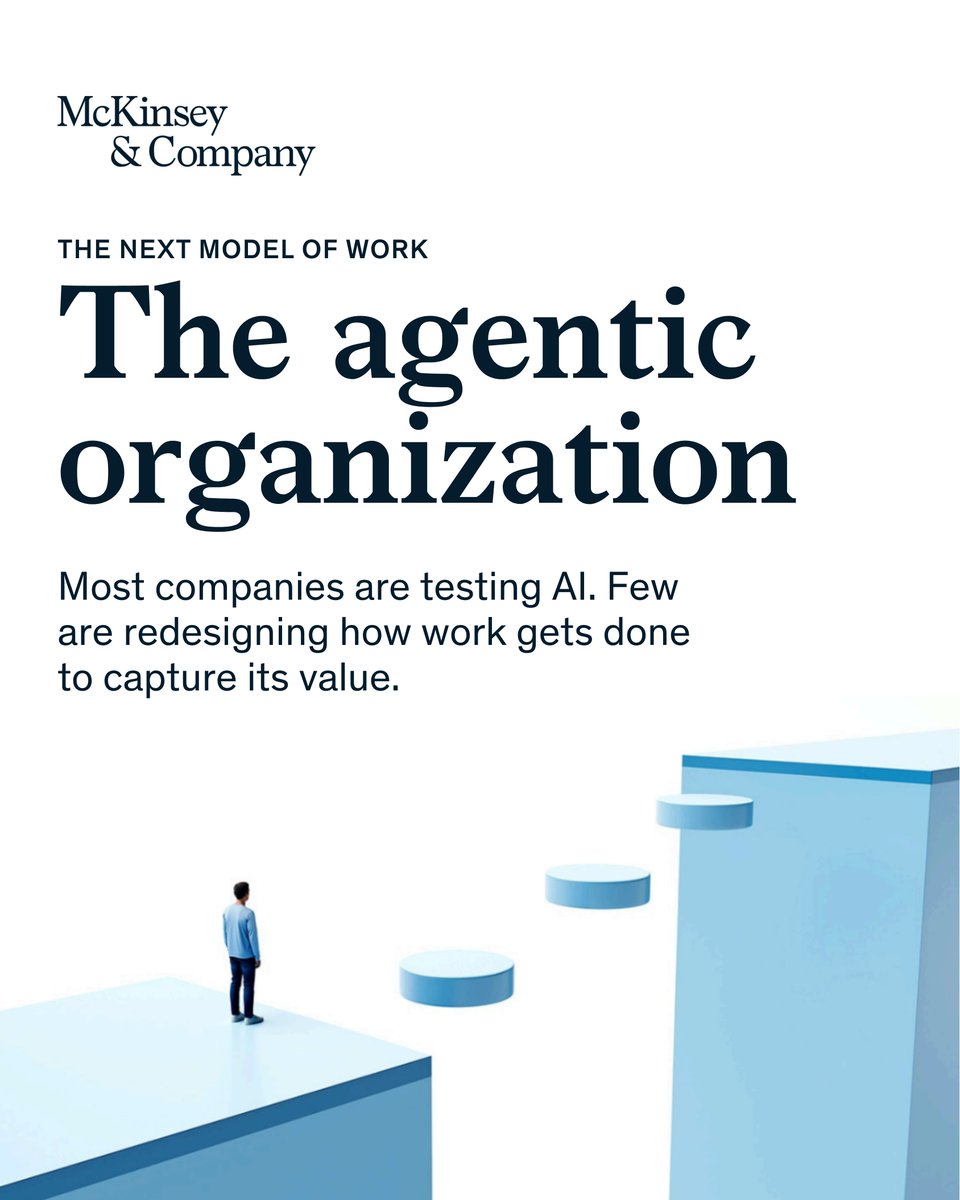
AI is everywhere. But most companies are still stuck in pilot mode.
The issue isn’t the tech. It’s that the work itself hasn’t changed.
Leaders are starting to rethink workflows, roles, and decisions end to end. That’s where the real value is unlocked. https://t.co/ask2NpJfwF
Harness, Memory, Context Fragments, & the Bitter Lesson
this is a work in progress mental dump on interesting intersections between how we use and design a harness, implications for memory being accumulated over long timescales, and the search bitter lesson we can’t escape
this is v30+, HTML diagrams help me iteratively refine + chat to roughly “see” and alter the mental model
Harnesses & Context Fragments:
a very important job of the harness is to efficiently & correctly route data within its boundaries into the context window boundary for computation to happen
the context window is a precious artifact. Harnesses make decisions on how to populate, manage, edit, and organize it so agents can do work. Each loaded object can be thought of as a Context Fragment and represents an explicit decision by the user and harness designer of what needs a model needs to do work at any given time.
many ideas on externalizing objects + loading into the context window are pioneered and very well described by @a1zhang with RLMs
Experiential Memory:
we’re in the very early days of deploying agents and agents produce massive amounts of data in every interaction they have. this is akin to humans doing things and remembering things they did.
however agent memory has a massive advantage as it can be accumulated across all agents which are easily forked and duplicated (unlike humans). @dwarkesh_sp does a good talking about this massive benefit of artificial systems
memory can be treated as an externalized object. the harness is tasked with doing good contextualized retrieval which means pulling in the right data from accumulated memories across all agent interactions
Search & The Bitter Lesson:
As we deploy agents in our world over year timescales, there is going to be a hyper-exponential in the amount of data produced by those agents. We should want to:
1. Own that data for ourselves. Open ecosystems are important here
2. Use that data
This means that we’ll have to search over, distill, and organize massive amounts of data. Our brain is exceptional at doing this. Both contextually using prior experience and mostly committing the right stuff to memory with enough intentional practice.
Our current infrastructure systems and algorithms will be put to the test and often break as we get used to this new data regime
some open questions:
- how do we efficiently distill experiences (Traces) into higher level memory primitives that capture the important parts? How do we do this over ultra long time horizons?
- How much of the future is Search just-in-time vs Search that gets integrated into model weights?
- How do we make models much better at self-managing their context window? How do we reduce error rates in recursively allowing agents to operate over external objects?
i’ll be expanding on, altering, and adjusting these mental models but these feel like an important subset to me on the future of designing agents practically
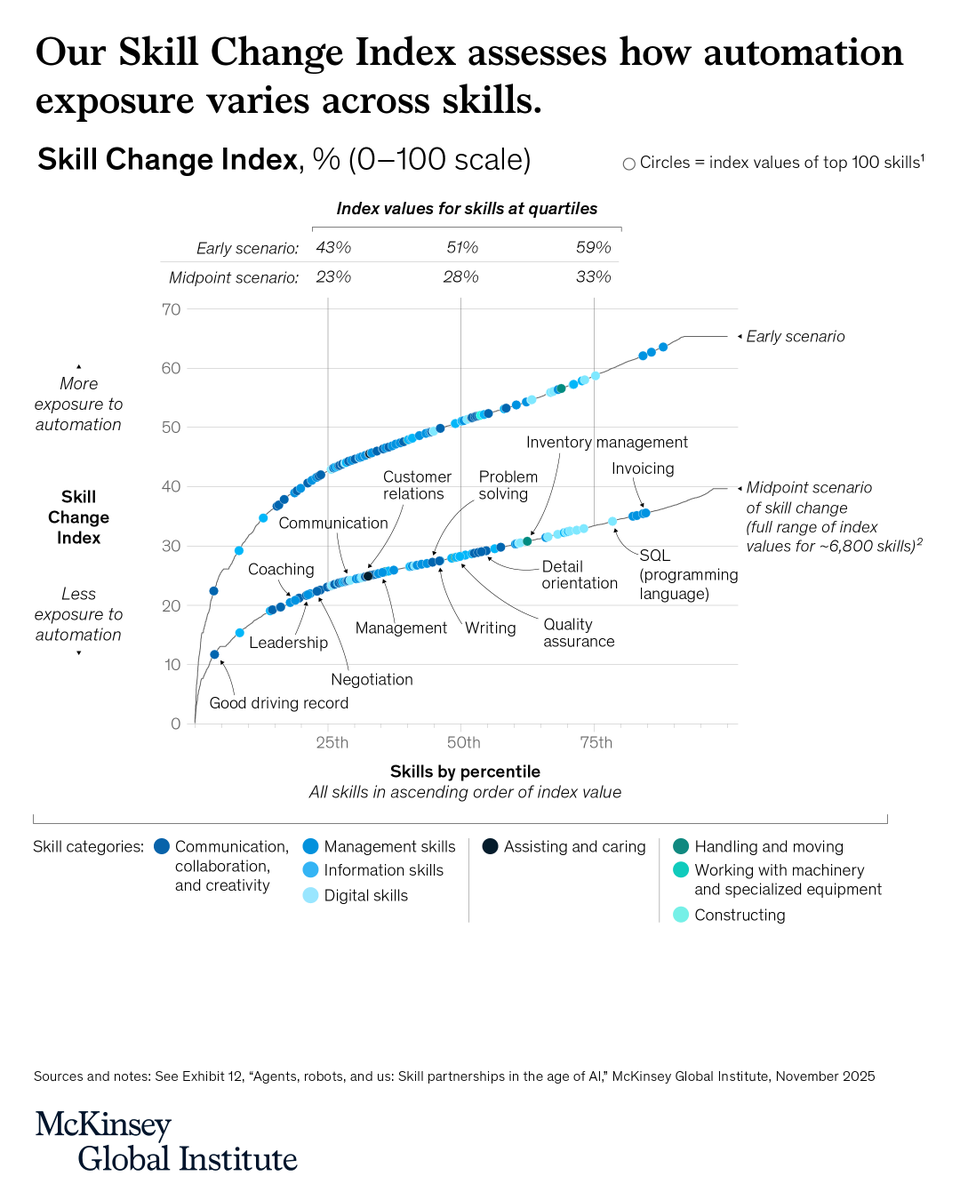
AI won’t make most human skills obsolete, but it will change how they’re used.
Negotiation, problem solving, and leadership will matter more than ever as people work alongside agents and robots.
Our new Skill Change Index shows which skills will be most, and least, exposed to automation in the next five years: https://t.co/fRXfHF1k56
Agentic AI is reshaping how tech services create value.
Four distinct roles are emerging, each with its own capability mix and strategic trade-offs. Take a closer look at which path aligns best with your strengths. https://t.co/k47iDhjq6C
In the 1970s, Marshall McLuhan and his son Eric McLuhan identified four laws of media: media enhances, obsolesces, reverses into, and retrieves.
In a guest post by Marshall's grandson Andrew, he shares a fascinating story applying these laws to tech & new media: https://t.co/5XmtuqiKRf