Quint Studio is now in open beta!
Here’s how it works in a minute. Studio breaks your codebase into components, agents write a Quint spec for each, real bugs get reproduced as tests, and your specs are kept in sync as the code changes.
Earlier this year, @tursodatabase posted a blog about how they found bugs in SQLite with @quint_lang . Now, they are @supabase and I was very happy to see today that the team is still leveraging Quint! 🔗👇
On episode 61 of Generationship, @rachelchalmers sits down with Gabriela Moreira (@bugarela) to explore why formal methods are having an AI moment. Gabriela traces her journey from programming contests to co-creating @quint_lang and explains how AI is lowering the cost of writing specifications. Tune in!
https://t.co/LXfWlbvbwV
Then a wizard showed up. (Okay, it was AI.)
Suddenly, conjuring code was easy, and understanding it became the hard part. The specs that were once too costly to wield? Now cheap to write and keep in sync.
So we went all in for the village. Quint became its own company, and we’re building Quint Studio (with the help of this wizard) to bring formal methods to every developer across the land.
Catch the full story (so far): https://t.co/4PQViL6Rb7
In 2022, @bugarela went on a quest: start Quint to make formal methods accessible for everyone.
It grew into an open-source language we leaned on across our own distributed systems work, and a village of Quint enthusiasts sprang up around it.
Then everything changed...
As the code changes, even when your agent writes it, you stay in command about how it behaves
See for yourself and join the open beta: https://t.co/hAdRiuXqOw
How does Quint Studio actually work?
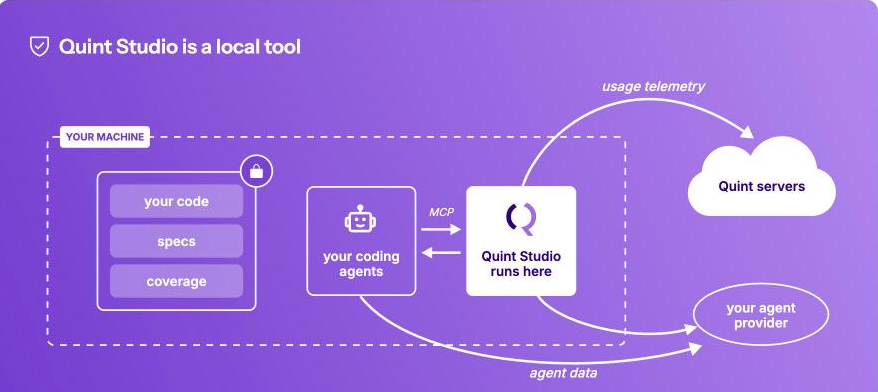
Short version: it runs on your machine, next to the coding agent you already use, and checks every change that touches the behavior you modeled.
The longer version ↓
Every modeled component gives you three views:
→ Misbehavior: what the code does that you didn’t intend, reproduced as a test and accompanied by a fix.
→ Correctness: the rules being checked with interactive details.
→ Coverage: how much of the formal model is enforced by existing tests.
On episode 61 of Generationship, @rachelchalmers speaks with Gabriela Moreira (@bugarela), co-founder and CEO of @quint_lang, about building trust in AI-generated code. Gabriela explains how executable specifications help engineers explore software behavior and why passing tests can offer false reassurance. They discuss making formal methods more accessible while preserving the judgment and curiosity that good engineering requires.
https://t.co/U1XIpb7zbr
In case you’ve been living under a rock or a dam, Quint Studio just entered open beta! Free, and open to everyone.
Capture how your software should behave, surface the bugs and gaps your tests miss, and stay in command as AI writes more of the code.
We did a short write up on why we built it: https://t.co/AuEb5OHrzf
Quint Studio is now in open beta!
Here’s how it works in a minute. Studio breaks your codebase into components, agents write a Quint spec for each, real bugs get reproduced as tests, and your specs are kept in sync as the code changes.
Formal methods are great tools for the design phase too!
In the skills built by @bkase_ (based on @poteto’s pstack), you can use Quint to make decisions about the edge cases you and your agent missed while grilling.
@superlinear_fm released a great episode showing how they use these skills, in a very visual way and with great examples!
We found an interesting place to apply @poteto's /statechart skill: formally verifying our intent before writing any production code.
It discovers edge cases that neither we nor our coding agent caught during grilling.
Think of it as another layer on top of @mattpocockuk's /grill-me skill. Instead of relying on the agent to reason through every possible scenario, we use a model checker to systematically find where the intended behavior breaks.
The result: a much more thoroughly specified feature before implementation.
And when we handed it off to the coding agent, it built the feature correctly on the first pass.
We recorded a walkthrough of the workflow, including a real example where a product decision was surfaced we didn't even realize we needed to make.
Full episode also on YouTube, Apple Podcasts, and Spotify. Links below 👇
00:00 Catch edge cases before coding
01:54 Skill walkthrough
09:18 Explained: Model (we used @Quint_lang), promises, and checker
14:44 Q: Why a LLM misses this
17:24 Real example
26:07 Q: How to improve the model?
29:09 Q: How to make code match the model?
30:29 Q: Why formal verification?
34:15 Q: When to use or skip it?
38:06 Wrap-up and Discord