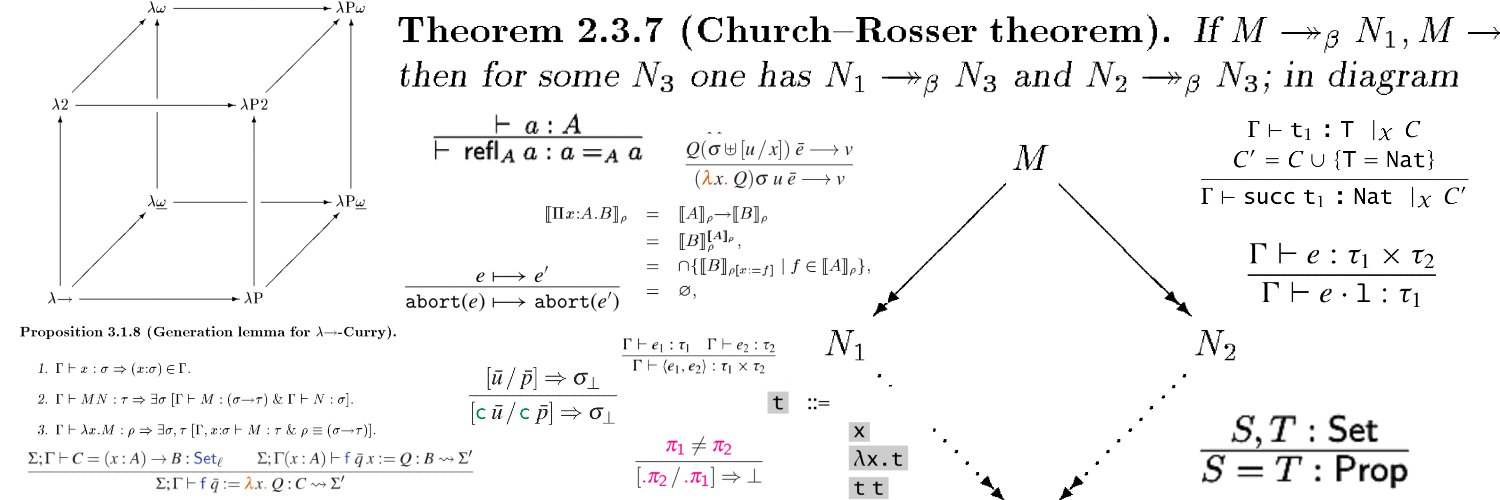
People often ask us: what is type theory and why is it useful?
Type Theory is the academic study of type systems: formal frameworks for classifying terms, structuring computation, and specifying the behavior of programs. It investigates how types enforce invariants, guarantee safety properties, and shape the design of programming languages.
Its impact is both theoretical and practical.
1) Programming language design and metatheory
Type theory provides the tools to state and prove properties such as type safety, normalization, and parametricity. These results are not testing heuristics. They are mathematical guarantees.
As Dijkstra wrote, “Program testing can be used to show the presence of bugs, but never to show their absence.” Tests explore a finite search space. Proofs quantify over infinite domains. Type theory is the foundation that makes such proofs possible in programming language research.
2) Industrial impact: Rust and RustBelt
Careful type theoretic design eliminates entire classes of bugs at compile time. The RustBelt project went further and formally verified core aspects of Rust’s type system using the Rocq proof assistant, with peer reviewed results in top PL venues. This is not marketing. It is mechanized metatheory.
3) Proof assistants and formal verification
Type theory is the theoretical backbone of systems such as Lean, Rocq, Agda, and also HOL based systems such as Isabelle/HOL. These are programmable logics where specifications and proofs coexist with code.
In an era of AI assisted development, proof assistants offer a different paradigm. Instead of generating plausible text, we iteratively construct machine checked proofs against a formal specification. The result is not just confidence. It is correctness by construction.
For students and engineers working on compilers, DSLs, or formal methods, type theory is not an abstract curiosity. It is the language in which we make precise claims about programs and then prove them.
If you are interested in learning more about type theory, programming languages, and proof assistants, follow us here and subscribe on Youtube: https://t.co/uqVg3rzOWB.
Elixir v1.20 released! Now officially a gradually typed language: Elixir type checks every single line of code, finding bugs and dead code, without developer overhead (no typing signatures) and extremely low false positives rate. Plus a faster compiler! Links and reports below.
Much fun talking with @natefoster about networks, BGP, programming languages, formal methods, and what it's like being a visiting researcher at Jane Street.
We have an opening in the Type Theory Forall schedule this month for a sponsored episode.
If you'd like to promote your company, research project, open-source tool, conference, or community to an audience interested in programming languages, formal methods, theorem proving, and functional programming, you can commission an episode here:
https://t.co/btAgi126rE
Past sponsors have included companies, research groups, conferences, and open-source projects.
Feel free to reach out if you have any questions.
And if you know someone who might be interested, a retweet would be greatly appreciated for reach.
why do maths if computers are going to automate it?
why eat steak if incinerator coverts it to energy more efficiently?
why play chess if computers are better at it?
why paint if printers create pictures faster?
get a life.
Startled to find out that there are young people who haven't read James Iry's magnificent "A Brief, Incomplete, and Mostly Wrong History of Programming Languages". Please drop what you're doing and head over.
https://t.co/bnzifwQ2p9
The reason "grade inflation" and all these other concepts don't really make sense to me is because I have a pretty simple, and I think appropriate, definition of what a grade is (consistent with Alex's).
90% of the types vs tests debate is typing advocates thinking all dynamic languages are like JavaScript and dynamic devs thinking all type systems are OO-based.
It’s still early, but I’m excited to share some interim results.
As the head of DEI (Discrimination, Exclusion, Inbreeding) at @typememetics, a central part of my role is ensuring that no unworthy person gets to write Haskell.
And we’ve now eliminated all Haskell freelance positions.
They’re all gone.
No “freelancer” will be paid to litter in the ivory tower.
You write Haskell professionally and can barely solve my challenges? That won’t last either.
Many thanks to @typememetics for funding this vital initiative.
Attention @arxiv authors: Our Code of Conduct states that by signing your name as an author of a paper, each author takes full responsibility for all its contents, irrespective of how the contents were generated. 1/
On behalf of ACM SIGPLAN Executive Committee, I'm thrilled to announce three exceptional papers on programming languages from 2024 that have been awarded SIGPLAN Research Highlight distinction!
⇒
FP folks -- please encourage recently completed PhD students to publish their dissertation abstracts in the Journal of Functional Programming: simple process, no refereeing, open access, 200+ published to date, deadline 31st May 2026. Please share! https://t.co/EdpoahnZmW