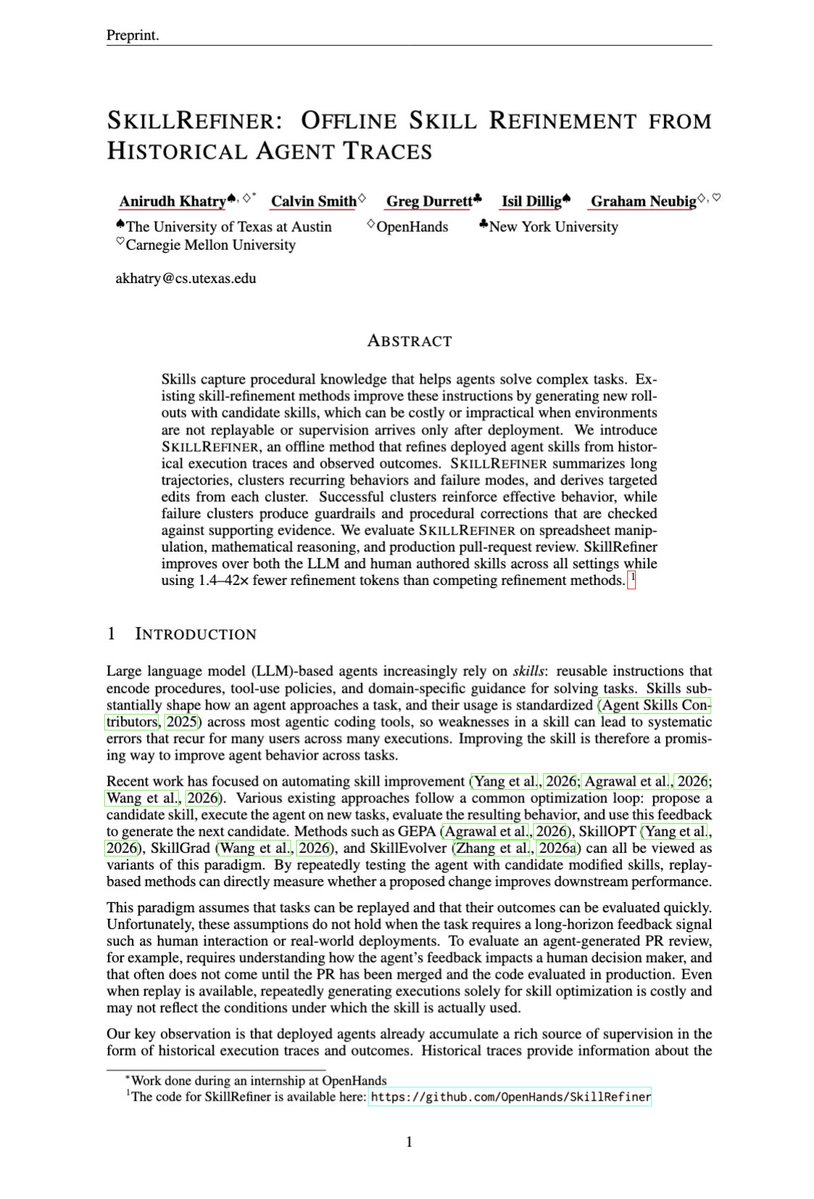
Can agents improve their own skills without generating any new rollouts?
This paper introduces SkillRefiner, which learns entirely from historical agent traces. It turns past mistake patterns into targeted edits to the agent’s existing skill, by basically treat deployment history like a bug report database.
Additionally, repeated successful behaviors get reinforced, while repeated failures become new guardrails, with an extra evidence check to avoid learning the wrong lesson.
Across all eight settings, it improved the original skill while using 1.4-13x fewer refinement tokens than the "extracting lessons from each past run individually" (Trace2Skill) method, and 2.4-42x fewer than the "generating new runs just to test whether each skill rewrite works" (GEPA) method.
https://t.co/YhWHRRSe3E
reading feynman lecturess as feynman intended: with accompanying ai-made demo sections for each chapter
rapid acquisition of knowledge is possible thanks to superintelligence
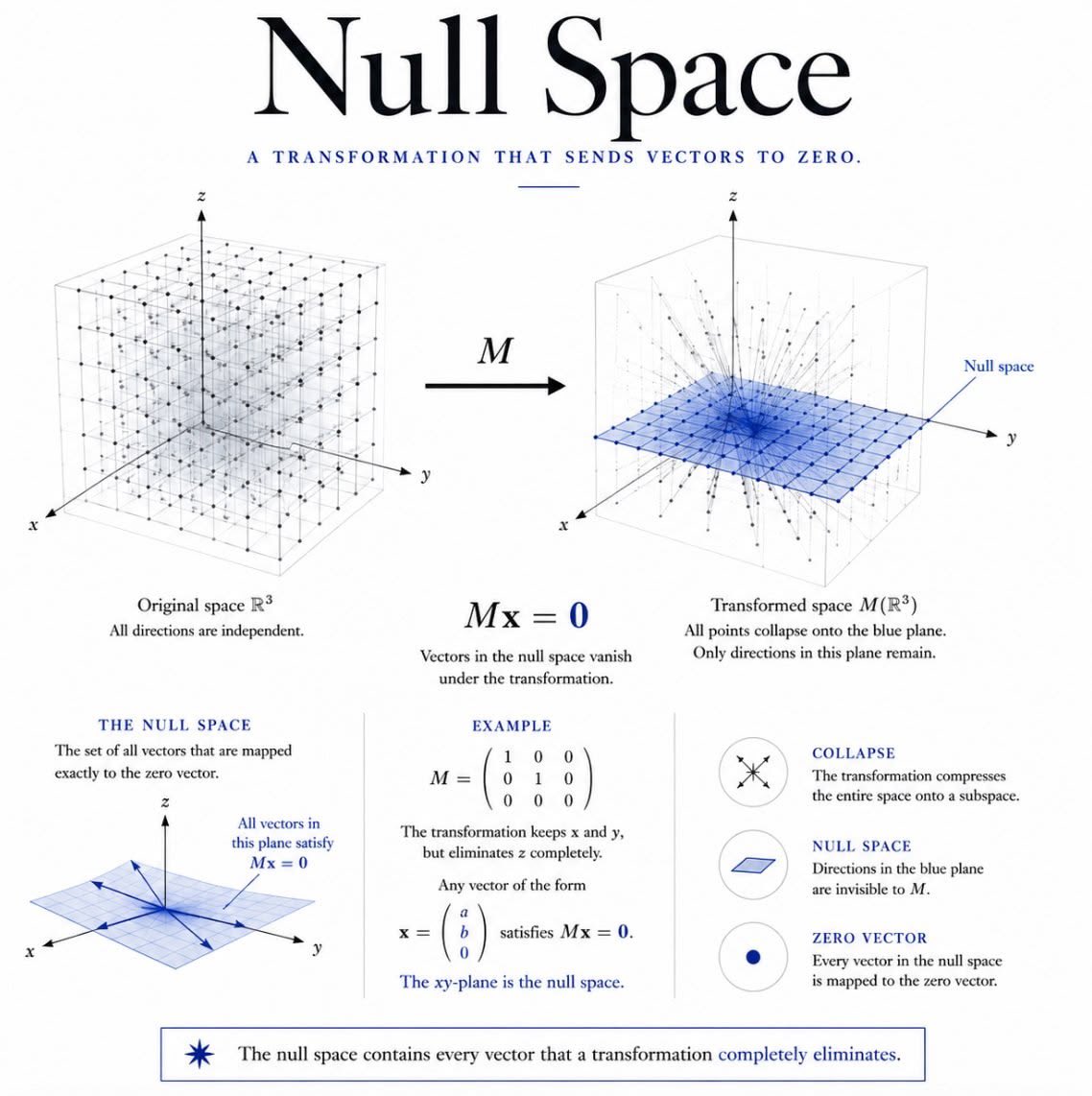
the null space is one of the most intuitive ways to understand what a matrix actually does. think of a matrix not as a grid of numbers, but as a machine that transforms space. it can rotate directions, stretch them, compress them, or completely erase them. the null space is the collection of all input directions that this transformation cannot see: feed any vector from the null space into the matrix and the output collapses to zero.
this tells you something deeper about information. if two different inputs differ only along a direction in the null space, the transformation produces the same output for both. that information has been destroyed. this is why the null space connects directly to rank, invertibility and solving linear systems. a matrix with only the zero vector in its null space loses no input directions and is one to one. a nontrivial null space means some degrees of freedom disappear under the transformation, making perfect reconstruction impossible without additional information.
this idea appears everywhere once you recognize it. in robotics, the null space of a jacobian contains joint motions that do not change the end effector motion, letting a robot reposition itself while preserving its primary task. in optimization, null spaces describe directions that preserve linear constraints. in estimation and sensing, they reveal states that measurements cannot distinguish. null space is therefore not merely “the vectors that map to zero.” it is a map of what a system is fundamentally blind to.
"Contrastive World Models"
If world model has to reconstruct every pixel, it'll pretty much waste most of its capacity modeling irrelevant background noise.
So this paper removes Google DeepMind's Dreamer pixel decoder and instead trains the latent state to identify features of the correct future observation.
It matches Dreamer on clean environments, but performs much better with moving distractors and natural-video backgrounds.
https://t.co/S5b0QWmwuH
A twist is a rotation whose angle grows along its own axis: Tₓ(s) turns the point (x, y, z) about the x axis through the angle sx.
The face x = 0 stays put, each slice x = c turns rigidly through sc, and edges along the axis bend into helices. With s = cos θ and side 2, the far face swings through ±2 radians, about ±115°.
The map is not linear, yet its Jacobian has determinant 1 everywhere, so the twist keeps volume.
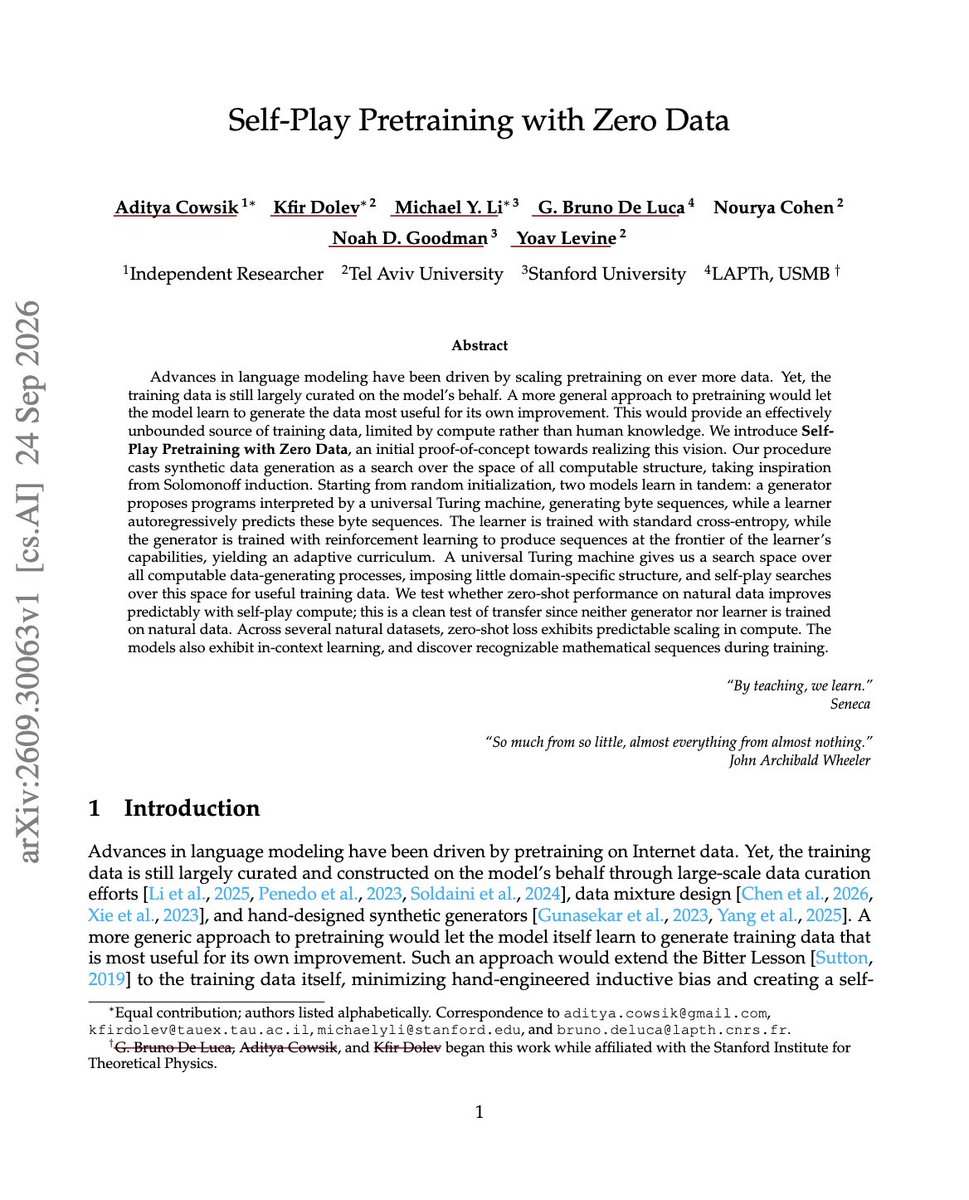
"Self-Play Pretraining with Zero Data"
Most pretraining still depends on humans deciding what data a model should learn from, so can a model learn entirely through self-play and no real data?
To test that, they trains two models from scratch. One writes small programs that generate byte sequences, while the other learns to predict those sequences with standard next-token training.
The generator is then updated with RL to pick the sequences that line up with the learner’s recent progress. So it keeps searching for data that is neither already solved nor just random, but sits near the learner’s current capability frontier.
And despite never training on natural data, the learner still improves on unseen text, images, audio, and code, and even develops in-context learning.
Which means some general predictive structure may be discoverable from self-generated computation alone, rather than having to come directly from real-world datasets.
https://t.co/3ZFGq95W8t
Jev founder Diogo Amogo just put out a PDF on building a Jev harness for coding agents
the claim: 200x faster, 400x cheaper
the model stopped being the bottleneck a while ago. the harness around it is where the cost and the speed actually live
hand this PDF and the article below to your Claude Code or Codex instance and let it rebuild its own setup
your agent gets a better harness tonight, and monday looks different than it would have 👇
Deploying DiffusionGemma-Jev (djev) just got a lot easier. You can now spin up a Jev API-compatible endpoint on Google Cloud Run using a single command.
Performance is solid: ~35-60 ms for single step latency and batch@32 is ~100-123 requests/sec.
It's a straightforward way to experiment without needing your own GPU. Runs at roughly $3/hr and drops to $0 when idle.
Get the code and instructions here: https://t.co/E3agzrW2hZ