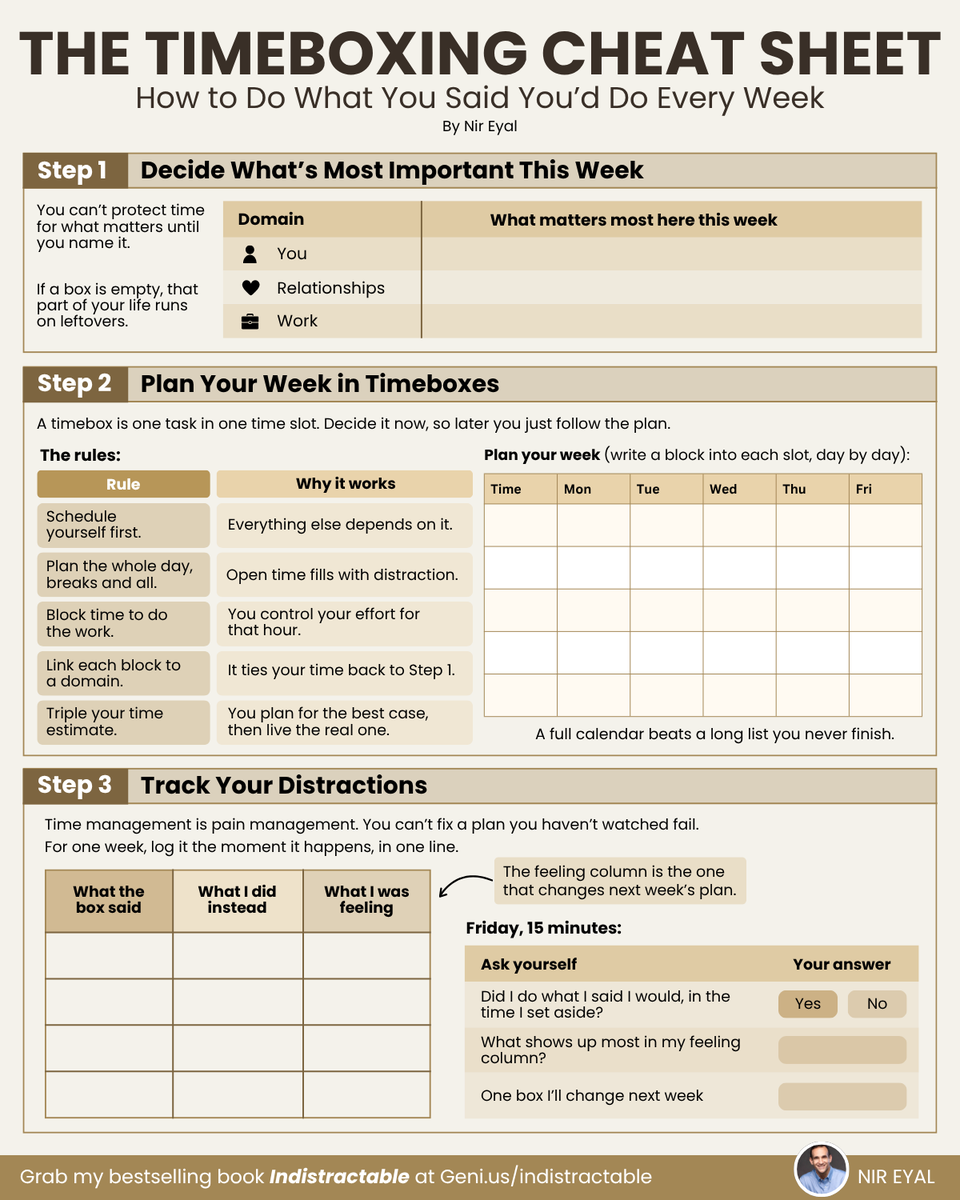
Most to-do lists fail for the same reason: they tell you what to do, but not when to do it.
That's why I stopped making to-do lists years ago. I became a schedule builder instead.
The tool is timeboxing — and the research behind it is unusually strong. A 2018 review in the Harvard Business Review called it the single most useful productivity practice. Cal Newport has called it the highest-leverage habit for knowledge workers.
Here's the cheat sheet:
1. Start with your values, not your tasks. Three domains: you, relationships, work. If your calendar doesn't reflect what you say matters, your calendar is lying for you.
2. Box the time, not the task. You don't schedule "write chapter 3." You schedule "9-11am: writing." The box protects the time. What you do inside it is a separate question.
3. Plan the week on Sunday. Fifteen minutes. Review what's coming, block the time, make it visible to the people who need to see it.
4. Expect to fail the first week. And the second. Timeboxing is a skill, not a switch. You adjust the schedule to match reality — not abandon it when reality pushes back.
The point of a timeboxed calendar isn't to control every minute. It's to give you something to come back to when you get pulled away.
You can't call something a distraction unless you know what you got distracted from.
Let me be blunt. Those who are afraid of AI feel deep down that they are impostors & have no edge. If you have a 1) clear mind, 2) a deep, not just cosmetic, undertanding of your specialty, 3) and/or are original enough to reinvent yourself when needed, AI will be your friend.
It is becoming more and more clear to me that AI will one day replace all knowledge work.
I sent out my first reports this week that use "Marie's Brain" - an OKF system filled with my knowledge + my algo update MCP + Gemini 4 Argon. I sent six reports this week. Normally it takes me 2+ weeks to do one of these.
The system is about as good as an employee with about 8-12 months of training. In many cases it is finding things that I wouldn't even have thought to look for.
It generates a report for me and I give it feedback on things to improve. Then we use the /learn command and Antigravity adds skills and rules so that it can do better next time.
Each report gets a little better and needs less feedback from me.
I expect that within a few weeks I'll be at the point where almost everything is automated.
-User purchases via Stripe
-Stripe redirects to a form for more info
-The form entry triggers an Antigravity instance which runs the report
-The report is sent to me for review
-I approve it and Antigravity sends it off to the client
How long before that 4th step is not necessary? I can easily believe that as the models get better eventually and the system continues to learn I won't need to make corrections. And I think we'll likely get to the place where I'm not needed to provide ongoing knowledge updates.
In the short term, I'm excited. I think there's so much opportunity for anyone who has knowledge that people pay for as well as knowledge in how to use AI.
In the long term, I don't know what happens to the world when AI can do the majority if not all of the knowledge work.
Brilliant essay by James Galbraith.
One of those essays that took me a while to finish because I wasn’t just trying to read it, I was trying to memorise it.
https://t.co/dA1rRyxnp6
Google announced new YouTube playlists for learning Search fundamentals and Technical SEO. This is such a good idea with resources you can have new SEO staff go through. Or really for anyone who wants to learn SEO.
You'll learn how Google crawls, indexes and serves content, how to optimize for Search and how to use GSC and Google Trends.
These videos are not new - it's just the playlist curation that is.
The playlist for Search fundamentals:
https://t.co/XtrCAS084e
The playlist for Technical Fundamentals:
https://t.co/FRrVzGhuWv
The blog post about these new playlists:
https://t.co/vMkTrALH4g
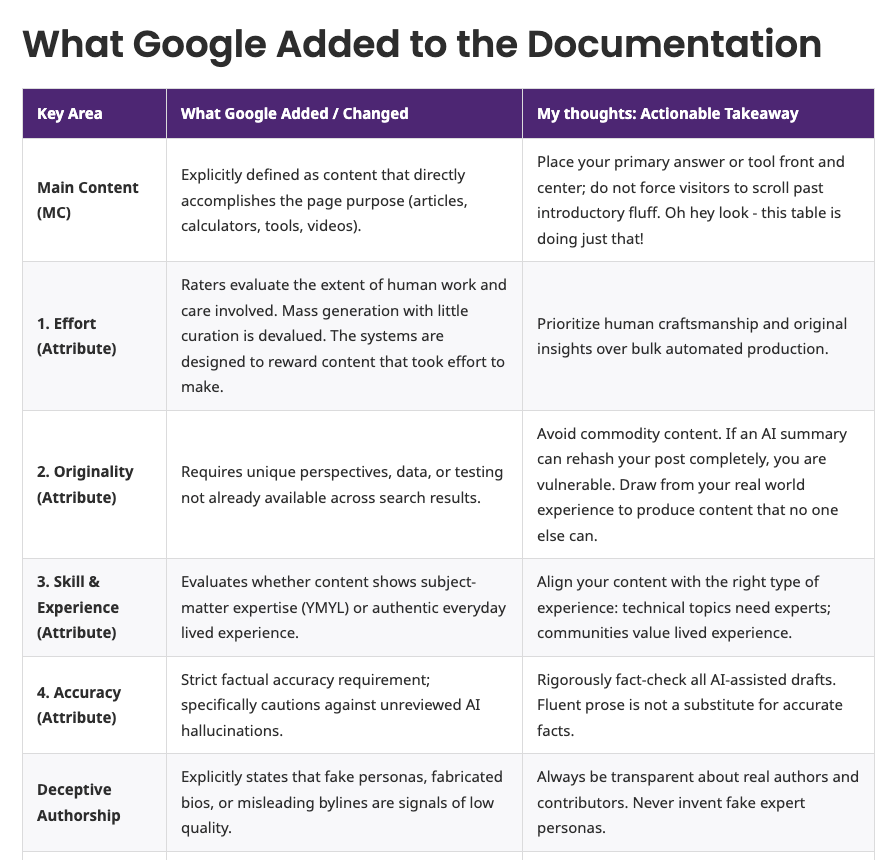
A few folks who shared my recent article on "main content" posted it and used a screenshot of this table.
Here's something cool. After I finished writing my article, I asked Antigravity what we could do to follow my own advice and make the main content - the reason why people were reading this piece - easier for people to ingest.
Antigravity suggested and create a table. I made a few modifications on it and then put it at the top of my article.
Here's a good prompt you can use in your LLM:
What is the primary purpose of this page? What is it helping people understand or achieve? Give me three ideas on how we could improve or add something to the page that would make it even more effective at achieving its purpose and helping people.
Dopamine from information gathering is a dangerous drug.
It’s the dopamine you get from reading. From planning. From learning. But never doing.
Information gathering as sport. Jammed into neat little dopamine feedback loops that convince you that you're doing something productive and valuable.
You're just one piece of information away from the big breakthrough. You'll start when your business plan is perfected. You'll meet your partner when you've scrolled through another round of profiles. You'll get that dream job when you have one more degree in hand.
Your entire life will change when you realize the world isn't run by a bunch of geniuses. The world is being run by a bunch of normal people with abnormal bias for action.
The answer you seek is hidden in the action you avoid.
Dopamine from information gathering is a dangerous drug.
Get your dopamine from action.
“You must stay drunk on writing so reality cannot destroy you.”
— Ray Bradbury
via the 5-Bullet Friday newsletter (https://t.co/3tZaxYBx2s) from @tferriss
A journalist in 1987 rewrote the 2,500-year-old Tao Te Ching as a series of short parables about programmers, and the book became required reading inside Silicon Valley because every line of the joke turned out to be deadly serious.
His name was Geoffrey James.
He was not a famous engineer. He was a technology journalist who had spent years inside the offices of early software companies watching the same disasters play out over and over again.
Managers piling more programmers onto failing projects. Codebases collapsing under their own weight. Corporate hierarchies producing endless documents that nobody read. Geniuses being interrupted by meetings until they quit and went home.
He could have written a serious management book. Plenty of serious management books already existed and almost nobody in software was reading them. He decided to do something stranger.
He picked up a copy of the Tao Te Ching, the foundational text of Taoist philosophy written in China around 500 BC, and he rewrote it line by line as if Lao Tzu had been a master programmer.
The result was published in 1987 as The Tao of Programming. 151 pages. Nine books. Roughly 50 short parables. A comedy book on the surface and a philosophy book underneath, written in deliberately ornate language that made you smile while you were absorbing arguments that have aged better than almost anything else published about software in the last 40 years.
The opening line of the book is the giveaway. Thus spake the master programmer. When you have learned to snatch the error code from the trap frame, it will be time for you to leave. The joke is that he is parodying the kung fu master from the old Kung Fu TV show. The argument underneath the joke is that real mastery in software is not measured by what you can build. It is measured by how cleanly you can recover when the system fails.
The book has been passed around hacker communities continuously since the late 1980s. It sits alongside Fred Brooks's Mythical Man-Month on the required reading list of serious software teams. People who have never heard of Geoffrey James still quote his lines without knowing where they came from. The reason it has refused to die for 40 years is that every line of the parody was always disguising a piece of real wisdom that nobody else was willing to say plainly.
Here are some of the lines, and what each one is actually saying.
"Even a perfect program still has bugs."
The line is funny because it sounds like a contradiction. The truth underneath is that there is no such thing as a finished program. Every system you ship is alive. It is going to encounter inputs you did not anticipate, hardware you did not test on, and edge cases your imagination could not produce.
Treating any piece of software as finished is the single most common reason production systems fail. The masters in the book are calm about bugs because they have stopped pretending bugs are exceptions. Bugs are the default state. The programmer's job is to keep them from compounding.
"Let the programmers be many and the managers few. Then all will be productive."
The line is funny because every software company in the world does the opposite. The truth underneath is that programming is a kind of work that runs almost entirely on uninterrupted thought, and the more layers of management you stack on top of it, the more interruptions you create, the more meetings the programmers have to attend, the fewer actual hours of deep work get done.
Every manager you add to a software team subtracts more productive hours from the engineers than the manager could possibly add through coordination. Brooks proved this formally in 1975. James said it in nine words in 1987.
"After three days without programming, life becomes meaningless."
The line is funny because it sounds like an addict talking. The truth underneath is that genuine craft work produces a kind of meaning that almost nothing else in modern life provides. The programmer who has not touched real code in three days is not just bored.
They are emotionally underfed. The masters in the book understand that the work itself is not a means to a paycheck. The work is the reward. The paycheck is a side effect. Everything that interferes with the actual work, no matter how prestigious or well-paid it looks, is making the programmer's life worse, not better.
"A manager went to the master programmer and showed him the requirements document for a new application. The manager asked the master, how long will it take to design this system if I assign five programmers to it? The master replied, it will take one year. The manager said, but we need this system immediately or even sooner. How long will it take if I assign ten programmers to it? The master programmer frowned. In that case it will take two years."
The line is the punchline of Brooks's Law disguised as a koan. Adding programmers to a late project makes it later, because every new person has to be brought up to speed by the existing team, which slows the existing team down, which extends the timeline. The book teaches this in 60 words. The same lesson takes most managers 20 years of failed projects to learn, if they ever learn it at all.
The deeper pattern is the one most readers miss the first time through.
James was not really writing about programming. He was using programming as a setting for a much older argument that Taoist philosophy has been making for 2,500 years.
The argument is that the world is governed by simple principles that get harder to see the more cleverness you stack on top of them. Force does not work. Pressure does not work. More resources do not work. The only thing that works is restraint, simplicity, and the patience to let the right shape emerge.
Lao Tzu was talking about how to govern a kingdom. James was talking about how to ship software. The wisdom is the same. The kingdom is the codebase. The emperor is the project manager. The advisors are the developers. And the entire collapse of every doomed software project in the last 40 years has had the same root cause that the collapse of every doomed dynasty has had for the previous 4,000.
People mistook complexity for competence.
The book has been sitting on the internet for free for almost 30 years. You can read all 151 pages in an afternoon. Most people who run it as a joke walk away quoting it for the rest of their careers.
What James understood in 1987 is even more true in 2026. AI can now generate millions of lines of code in seconds. The bottleneck has shifted entirely. The bottleneck is no longer typing speed. The bottleneck is judgment. The bottleneck is taste. The bottleneck is the ability to look at a generated codebase and feel, without quite knowing why, that something is wrong with it. That kind of feel is exactly what the book was teaching all along.
The Tao of Programming flows far away and returns on the wind of morning.
The masters in the book were never joking. The world just took 40 years to figure out they were not.