30 yrs in Cdn Oil & Gas marketing, planning and business development. Canada must develop its natural resources if it is to prosper. Climate is a distraction.
The oil sands mining and extraction is actually the world’s biggest cleanup of a natural oil spill. When the Rockies were thrust up by the Pacific Plate, the deep oil came up and oozed out into the plains. They are cleaning the sand and making fuel for transportation. OK by me.
@Handre Exactly. It is simply not possible for any bureaucracy, no matter how sophisticated, to duplicate the billions of decisions individuals make every day when they decide to buy something in a freely operating market environment. It can’t be done.
This is the Liberal legacy. On October 19th Albertans will decide if they want to continue down this path of self destruction or strike out on their own. I hope Albertans choose wisely and vote for independence. Canada is broken.
This is the economic record of nearly 11 years of Liberal rule.
When Stephen Harper left office, Canada had posted a $1.9 billion federal surplus. Federal debt stood at roughly 31% of GDP, and Canada had the lowest total-government net debt ratio in the G7. Statistics Canada now reports that Canadian GDP per person kept pace with the United States between 1997 and 2015.
Since the Liberals took power, Canada has fallen behind in productivity, business investment and output per person. Rapid population growth kept the headline GDP number looking respectable, but dividing that growth among millions more people exposed the truth. A larger economy doesn’t automatically mean Canadians are becoming more prosperous.
Harper governed through the worst global financial crisis since the Depression and returned the budget to balance. The Liberals inherited that position, doubled the federal debt and made large deficits routine. Carney’s first budget projected another $78.3 billion deficit.
We once measured ourselves against the strongest economies. After a decade of Liberal rule, we’re being told to accept stagnation and call it progress. Elections have consequences.
Here is a chart showing economic growth since Mark Carney became Prime Minister in Q1 of 2025.
It is the worst.
Worse than Australia, the U.K., the G7, the EU, the U.S.
Worse than Mexico, which also shares a border and a trade dispute with the U.S.
Mark Carney promised to be first. He delivered the worst.
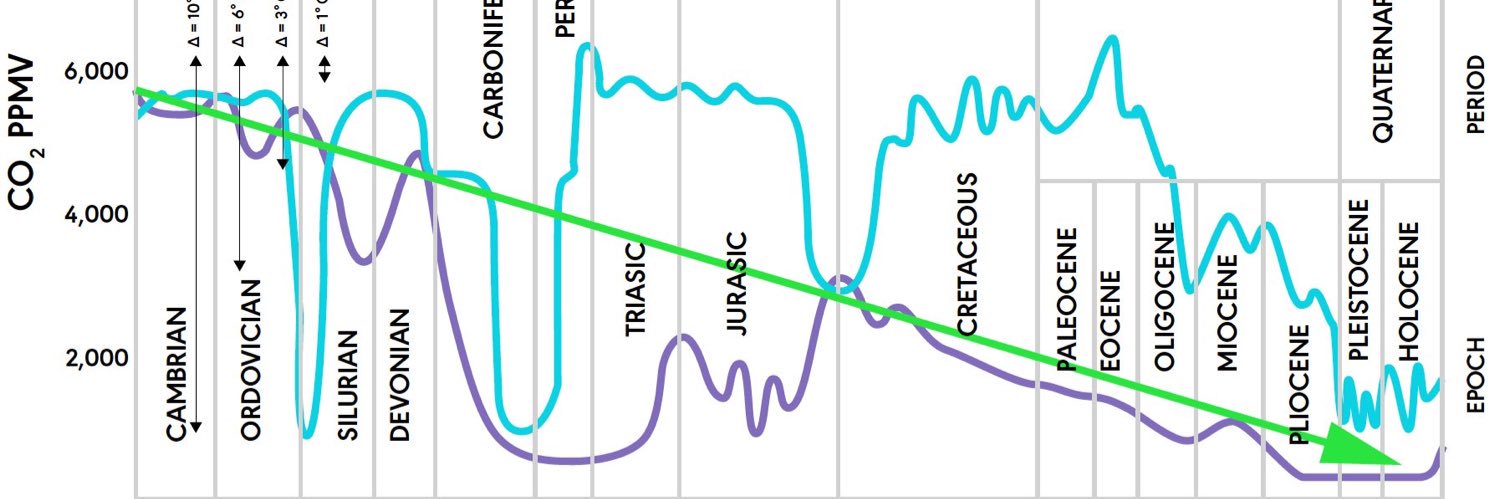
Peter Clack’s explanations of climate dynamics are always succinct and easily comprehensible. There is no way today’s simplistic climate models could even hope to express the complexities of these cycles. Don’t always trust everything you are being told about climate doom, be sceptical.
The might and power of the abyssal deep dictate the endless mood swings of the entire planet.
The air and its precocious shifting winds are almost entirely dominated by the depth, scale and complexity of the oceans. This is where the true rhythm of global climate comes from—not through the thin gaseous envelope of the atmosphere, which retains little warmth itself and contains roughly only 1–2% of the world's carbon reservoir.
It's an ephemeral, fast-acting envelope, but the oceans are the planetary flywheel. They absorb vast amounts of energy with only incremental changes in temperature—because water possesses a specific heat capacity four times greater than air.
Ocean currents have carried warmth from the tropics to the cold northern regions in cycles lasting a thousand years. Waters that sank in the 12th century are only now returning to the surface via the great global conveyor belt.
Around 93% of Earth’s accumulated heat energy is held within the oceans, leaving a mere fraction distributed across the atmosphere, land, and ice sheets combined. They absorb surface anomalies and release them over centuries or millennia. Water upwelling near the equator or in polar regions today began its descent into the abyssal depths long before modern industrial measurements existed.
Because heat penetrates the oceans slowly, through turbulent mixing and deep thermohaline overturning, surface atmospheric changes do not register immediately throughout the entire water column. This dynamic creates a profound temporal smoothing effect. This is the slower, more measured pace of planetary mood swings.
While Henry’s Law governs the surface exchange of gases—where cold water absorbs atmospheric CO₂ and warm water releases it—the ocean’s carbon storage capacity is doubly reinforced by the biological carbon pump.
Cold, dense surface water dissolves atmospheric carbon and sinks into the deep ocean basins, driven by ocean circulation and polar cooling. This endless muscle memory effectively sequesters gas from the active atmosphere for centuries.
The invisible powers of the micro world are astonishing. Photosynthetic phytoplankton in the sunlit photic zone capture carbon to build organic tissue and calcium carbonate shells. When these organisms die, a continuous shower of organic material—a 'marine snow'—descends like flower petals into the dark abyssal zone.
This biology transfers organic carbon out of contact with the atmosphere, locking it into ocean sediments on geological timescales.
The oceans serve as the true regulator of the terrestrial environment through this combination of high heat capacity, slow overturning cycles, and deep biological sequestration.
They are the invisible heartbeat of our solitary blue-green planetary home.
@TheELongWave Canada was doing fine until Canadians decided our government should be lead by the half-wit Turdeau. It remains to be seen if this country can recover or if it will just split up?
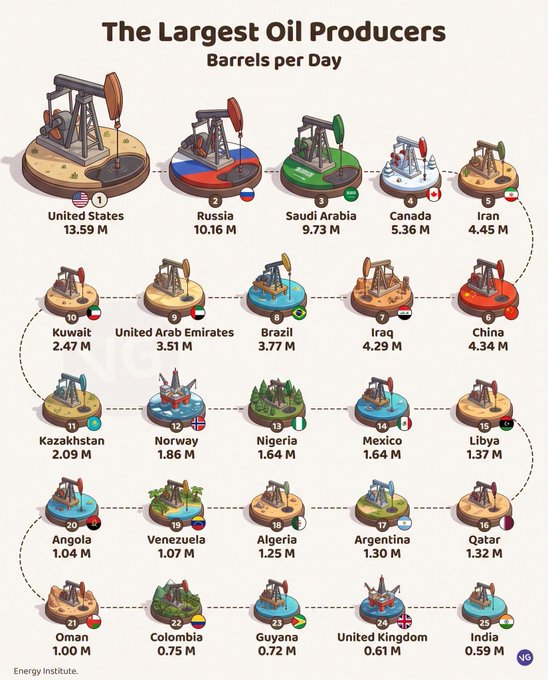
🛢️🇺🇸 US produces 13.59 million barrels a day.
That is more than Russia and Saudi Arabia , at 10.16 million and 9.73 million.
It is nearly triple Iran's 4.45 million.
America is not just the largest oil producer on earth, it is exporting record volumes of that supply overseas.
https://t.co/bvwdcCdbcX