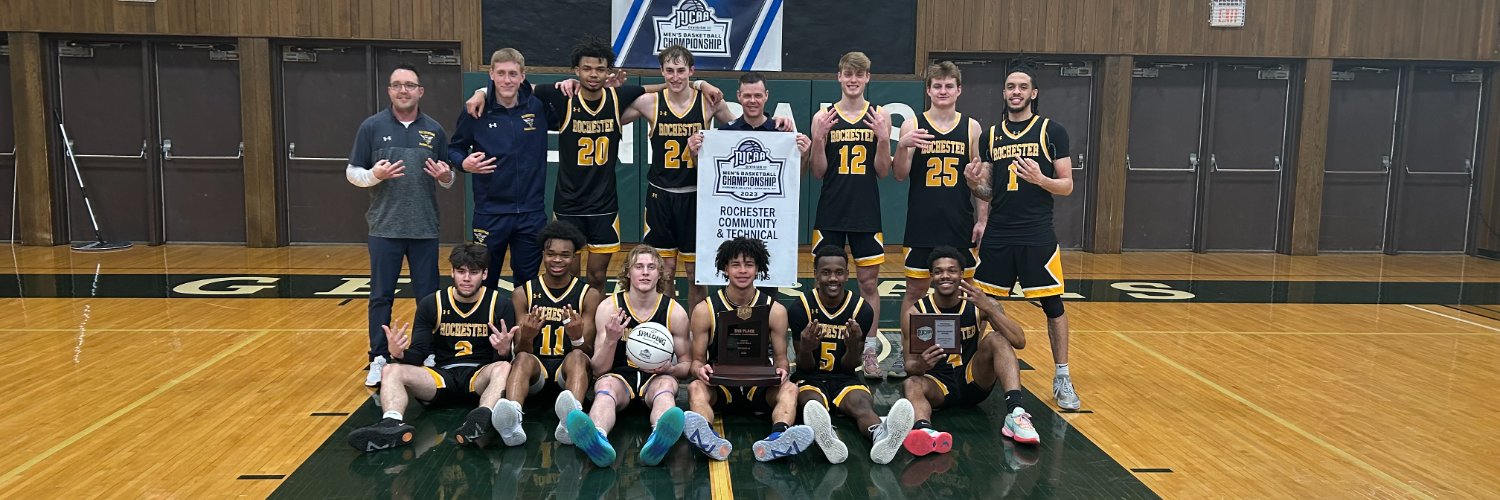
Official RCTC Men’s Basketball Twitter *8-Time NJCAA National Tournament Qualifier * NJCAA Runner-up in 2010, 2011 and 2016 *8-Time Region 13 Champions
KELVIN SAMPSON ON ROLES
"The only guys confused with their roles are the ones that don't like it ... there's somebody sitting right besides you that will go in and do what I ask them to do ... None of us are as good as all of us. TOGETHER WE'RE PRETTY GOOD."
~via @ChrisYBaldwin
If you want to change your situation you must first change your thoughts. Because if you keep on thinking what you have been thinking you’ll keep on getting what you have been getting.
Can’t figure it out, right now we just have guys who like to play basketball not Basketball players. Guys who “I just wanna hoop” guys are ok with mediocre and stats not playing right, having fun, being better than the guy in front of them offensively and defensively!
"You can complete or you can complain but you can't do both."
You can spend the whole practice complaining about what’s being asked of you.
You’ll leave with the same weaknesses you walked in with.
The work is your opportunity to improve.
Quit treating it like a punishment.
This could be said on 80% of the teams in @MarchMadnessMBB two weeks into this season. You are teaching them how to win or accepting their own view of what’s important to the individual players EVERY DAY !!
PHEW
"Before Bob Chesney could install a winning football culture at UCLA, he wanted his players to quit losing at life.
“You don’t have to do anything else ... just stop leaving the locker room a mess. Stop leaving the weight room in a mess. Stop talking down to people ...
Want to know how strong your team’s standards are?
See what happens when your best player falls short of one.
Who speaks up?
How does the star respond?
What happens on the next rep?
The whole team is watching.
The standard is the standard only when it applies to your stars too.
Pete Carroll says the Seahawks’ scouting department had a 1–7 competitor scale, and says only two or three players ever reached a seven
“You’re unfortunately right on what everybody always wants to know, because they want to know who that guy is, the seven. But there aren’t hardly any sevens. I’ll share with you, I don’t share this very often, but it’s the competitor scale. And this is not about what kind of player somebody is, it’s what is their nature, what is their makeup, and who are they?”
“It’s the same thing I’ve been talking about, that’s the guy we’re looking for. If you’re one or two, you’re a survivor. You’re just barely, you’re one, you’re just hanging on, you’re barely there, but you’re there. Two is a guy who’s just a step ahead of the guy who’s just here surviving it and getting through, but he’s got a chance.”
“Let me say this, the whole point of the scale is to figure out where somebody is so that we can identify it and agree on it. And then now we can go to battle for the guy to work, elevate him up the scale. The basics of it are really about internal motivation, guys that are internally, naturally motivated to try to get something and do something with whatever they’re faced with.”
“So a three and four on that scale, that’s pretty good, you’re a competitor. But you’re likely competing for external factors, money, for the stature, for the status, ‘I want to be a football player.’ They’re not really centered on what drives them. So as you go to the threes and fours, those are competitors, but that’s not the level that we want.”
“We’re trying to work them into the fives and sixes. A five is a guy who’s internally motivated, and he’s got his act together. Everything is pretty much in line, and he can pretty much run his own world and control it because he’s driven. You get to be a six, now that’s it, you’re the real deal.”
“You don’t care what anybody thinks. You do stuff because you know what you need, and you’re willing to do what it takes. We don’t really need to have to help you very much. We just kind of need to get out of your way, but put you in the position so that you can be successful.”
“And so that’s where we’re trying to get people to achieve the seven. Now, that’s a whole other deal. Yeah, we’ve had them, you’ve been with them. There’s only been two or three guys.”
“I’m not going to unveil it all, but I’ll tell you that what the ultimate true competitor is to us is the guy has everything going. He has everything in line, everything in order, he’s got his world, he’s maximizing who he is, but he also is compelled, he’s got to take people with him. He has to take people with him, and not only does he have to take them, but they’re going to go with him.”
“That guy to me, that’s the true seven. That’s the guy that is so much of a leader, so much of a competitor, and not just that they can see that, but that he has it in him that he needs to take people with him. That’s the ultimate guy that we’re shooting for. And we don’t win and lose based on that guy, you’re just lucky when you’ve got him.”
“It’s the sixes that we need. We need all those guys that are internally motivated, driven, focused. They’re going to give you everything they’ve got. You never have to worry about where they’re coming from.”
SABAN PROCESS
𝐂𝐨𝐦𝐦𝐢𝐭𝐦𝐞𝐧𝐭
How bad do you want it?
𝐃𝐢𝐬𝐜𝐢𝐩𝐥𝐢𝐧𝐞
It's not about what you feel like doing.
𝐄𝐟𝐟𝐨𝐫𝐭
You get out what you put in.
𝐓𝐨𝐮𝐠𝐡𝐧𝐞𝐬𝐬
You have to overcome hard.
𝐏𝐫𝐢𝐝𝐞
Take pride in all you do.
~via @TheCoachJournal
Addition by Subtraction is real.
When everybody isn't willing to put their cards on the table and keeps a few up their sleeve it enables an environment of not being in alignment.
That type of toxicity can spread like wildfire in a locker room or slow simmer. Nobody wins.
It only takes ONE.
One teammate to bring the glue.
One teammate to set the tone.
One teammate to step up and lead.
One teammate to raise the standard.
One teammate to be the missing piece.
One teammate to change everything.
Why not YOU?
#CultureWins
Sundance Wicks said his staff started "charting excuses" his players had in the first half against Regis tonight.
"Let's just make a whole booklet of all the excuses of why it's not working out for us. Chart it. Eventually, we're just going to read your excuses back to you, and then you're going to find out, 'Man, that's pretty soft.'"
The invisible scoreboard.
Who brings energy when they are tired?
Who celebrates when someone else scores?
Who listens when they’re being coached?
Who stays engaged on the bench?
The scoreboard doesn’t show everything that impacts winning.
Everybody wants the star role.
Great teams are built by people willing to star in the role they have.
You don’t need a different role to become more valuable.
You need to bring more to the one you already have.
Losing mindsets:
Blame.
Complain.
Defend.
Make excuses.
Point fingers.
Winning mindsets:
Reflect.
Own it.
Listen.
Adjust.
Look within.
Losing asks, “Whose fault is it?”
Winning asks, “What can I do better next time?”
Ownership changes everything.
Effort is the one thing nobody can do for you.
Coaches can teach you.
Teammates can challenge you.
Circumstances can test you.
But effort has to come from within.
Effort is personal. Make yours undeniable.
Pressure doesn't expose your talent. It exposes your habits.
When the moment gets big, you don't suddenly become more disciplined, focused, or prepared.
You become exactly what you've practiced being.
You can't train occasionally and expect to deliver consistently.