🚨 Toni Kroos on Cristiano Ronaldo:
“One night after a Champions League game, most of us were happy... we had won comfortably, everyone was laughing in the dressing room.
But Cristiano was silent.
I asked him, ‘What happened?’
He looked at me and said…
‘We scored 3… but I should’ve scored 2 more.’
I thought he was joking… he wasn’t.
The next morning, while others were still recovering, Cristiano was already on the training pitch—watching clips of his missed chances and repeating the same finishing drills again and again.
That’s when I understood… Cristiano wasn’t competing with defenders… he was competing with his own standards.” ⚪🐐Kroos has described Ronaldo’s scoring mentality as a “positive addiction.”
"Learning is rooted in repetition and convexity, meaning that the reading of a single text twice is more profitable than reading two different things once." - Nassim Nicholas Taleb in Skin in the Game
John Grisham isn’t 'motivated' — he’s mechanical.
7am. Same coffee. Same desk. Write till 11. Five days a week. For 40 years.
Nearly 500 million books sold.
Scott Adams was right: goals are wishes. systems are factories.
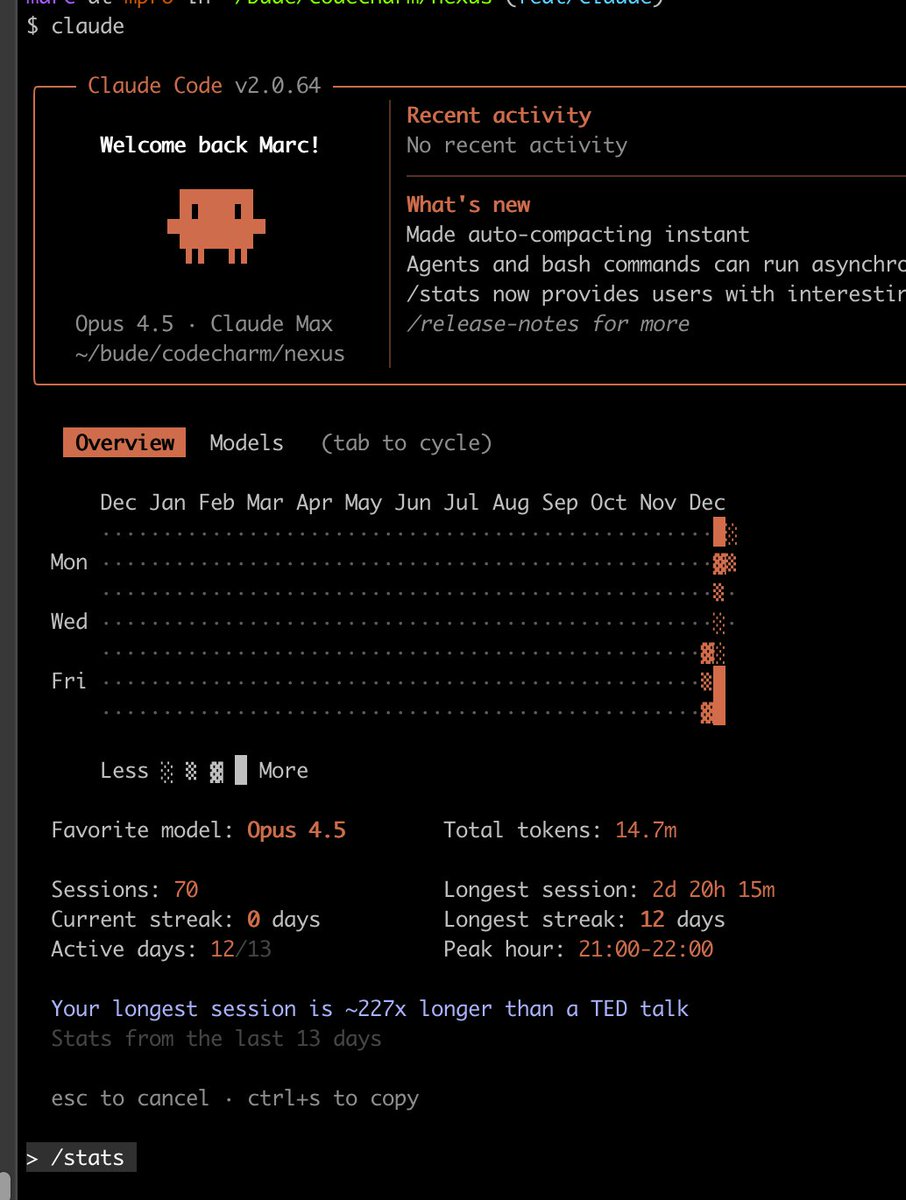
I've started using Claude Code since Opus 4.5 came out. I was blown away, and immediately used it non-stop for hardcore coding, 14h/day, I was addicted, always hitting limits, so bought two $200/month accounts. Today I cancelled both accounts and switched to Codex 5.2. Why?
On maximizing Claude Code.
Early on, I spent time building reusable workflows/patterns.
Tedious to build, but this had a wild compounding effect as models and agent harnesses improved.
I think these effects will continue to compound exponentially.
No point in starting fresh every time you start a new project/feature.
Invest time building subagents, skills, commands, planning, MCP tools, context engineering patterns,...
Believe me when I tell you that they make a huge difference in how effective and productive you can be with Claude Code.
The best part is that all these workflows are transferable to other agents like Codex.
These days, I am mostly focusing on orchestration and automating code review. The workflows help a lot already, but I sometimes feel constrained by the current tools and environment. I like sandboxes and think they are going to enable a lot of the next wave of functionalities with these coding agents. I also think we are just touching the surface of context engineering and orchestrating agents. Git worktrees are great, but I am sure we can do better for scaling the work with coding agents.
It's exciting to see all the progress on long-context understanding and multimodality. Both are critical to unlock even more insane capabilities with these coding agents. The former is important to enable uninterrupted longer sessions, and the latter unlocks all sorts of visual cues and grounding that will help to build more creative and unique experiences.
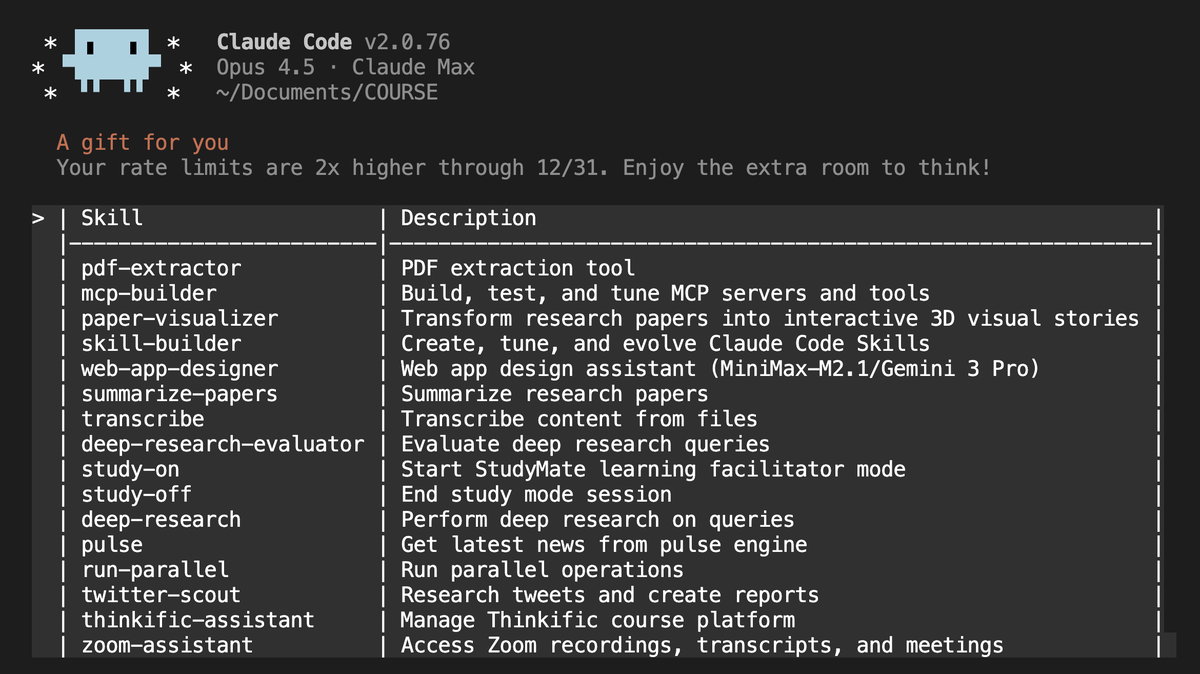
Below is a small snapshot of a few skills I have optimized and regularly use in Claude Code. All of these leverage different models and capabilities, which will only improve as capabilities are extended and models get better.
Excited for 2026 and hope to keep sharing more of my journey and keep learning from this awesome community.
Here's a strange fact: sharks save swimmers' lives.
Analysis of ocean deaths near San Diego found that every time a swimmer was killed by a shark, drowning deaths dropped for years afterward. Why? Shark attacks are vivid, memorable, and heavily covered by media. That sticks in peoples minds and as a result many will choose to stay out of the water.
This is the availability bias: we judge how likely something is by how easily we can recall examples of it. If it comes to mind quickly, we assume it's common. If it doesn't, we assume it's rare.
The problem is that what we remember has little to do with actual frequency. We remember things that are vivid, emotional, recent, or unusual. A plane crash. A terrorist attack. A pandemic. These are burned into our memory while everyday risks like car accidents and heart disease barely register.
This bias shapes decisions everywhere. Managers weight employee performance toward the last few months because recent events are easier to recall. People buy insurance right after a natural disaster, not before. Investors overreact to recent market swings.
What's easy to recall isn't the same as what's likely to happen. The next time you're assessing risk, ask yourself: am I judging this based on evidence, or just on what I can remember?
https://t.co/nXgEoDUPte
Claude Code is looking INSANE for 2026:
- Agent Swarms: Exit plan mode with swarm - instructions for launching swarm teammates when ExitPlanMode is called with isSwarm set to true
- Session Search Assistant: - agent prompt for finding relevant sessions based on user queries, with priority matching on tags, titles, branches, summaries, and transcripts
- Collaborative Agents: TeammateTool's operation parameter - description of TeammateTool operations (spawn, assignTask, claimTask, shutdown, etc.)
- MCP Search - tool for searching/selecting MCP tools before use (mandatory prerequisite) and load at runtime
- MCP through CLI - massive token reduction by MCPs called through CLI
- Custom prompt suggester: Agent Prompt: Prompt suggestion generator
Source:
Versioned system prompts extracted from cli.js of Claude Code
https://t.co/bc2wDI8P0P
Credit to @piebaldai for their amazing work
Pewdiepie has won the game of life.
He ruled YouTube with more than 115 million subscribers and then chose to walk away on his own terms.
> 36 years old
> multimillionare
> moved to japan
> spends his days with family
> posts videos only when hes inspired
> studies philosophy
Happy to see someone from the early youtube days enjoy life instead of being chronically online