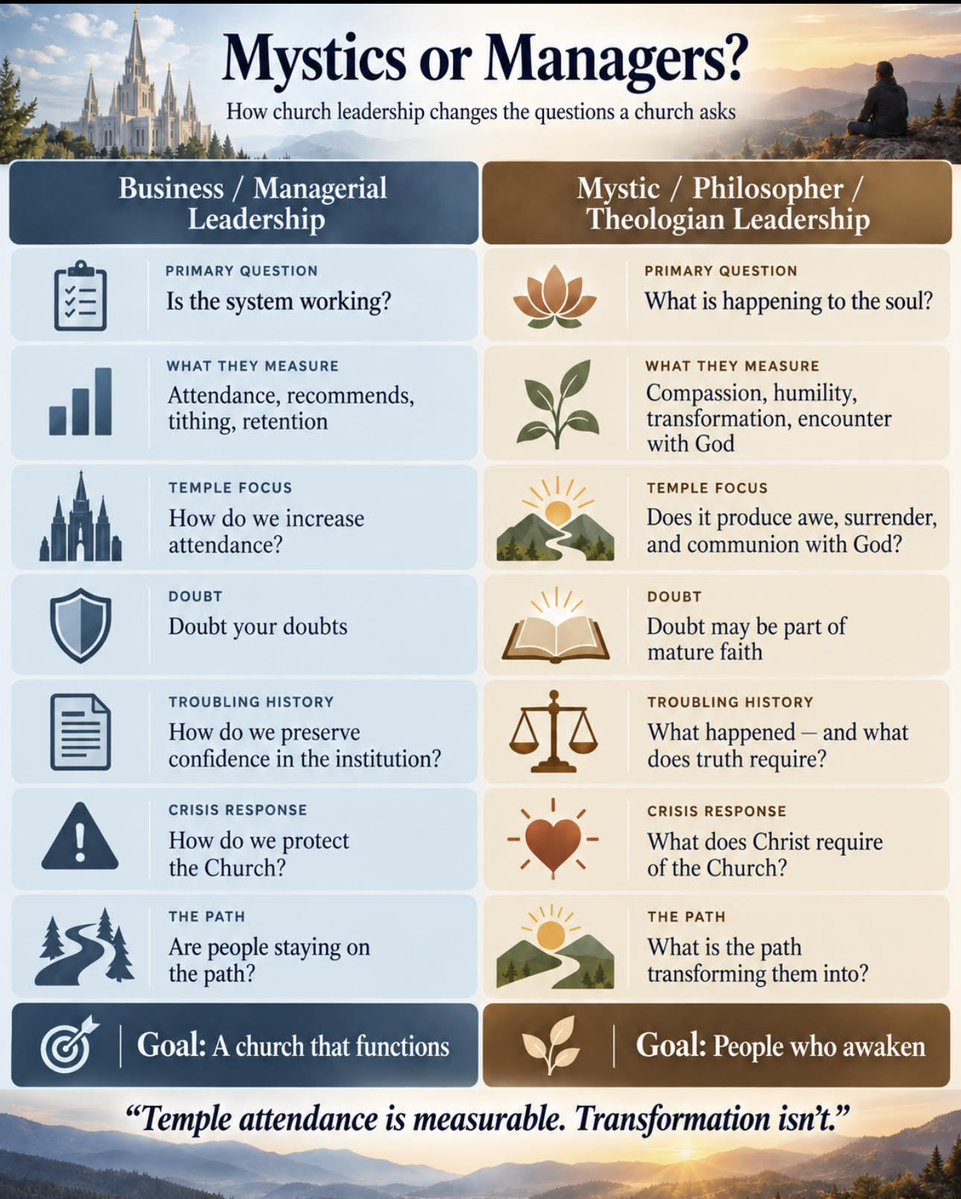
I built this graphic a while ago as I was exploring what the difference would be if the LDS church was led by spiritual mystics, philosophers and theologians instead of businessmen.
I've never shared it as I wanted to tweak it. But it came to me again as I was thinking about what I heard in General Conference and wondered how these talks would be different in the same scenario.
So below is my long ramble of how I think it would be different.
*TL;DR: General Conference is about how to stay faithful to the system with measurable, KPI-like checklists and to dos. A mystic-led General Conference would ask what the system is doing to the soul. A business manager will ask whether people are on the path. The mystic would ask whether the path is changing them.
This weekend, almost everything spiritual in General Conference eventually became something measurable. You repeatedly get:
stay on the covenant path
make and keep covenants
attend the temple
pay tithing
fast
serve missions
bear testimony
obey commandments
sustain prophets
strengthen faith
remain anchored
return when you leave
teach the next generation to do the same things
These things are not necessarily bad. But it's telling how rarely any leader then asks the obvious ask next question:
Toward what?
For example, Gong says the "temple brings safety, harmony, holiness, healing, and unity." And basically ends it there.
A real mystic might spend the entire sermon asking:
What actually happens to consciousness in sacred space? What is holiness? What does it mean to encounter the divine? Why ritual? Why symbols? Why death and rebirth? What does the temple reveal about the self?
Instead, we just get: value temples and go to them. Something we can track with numbers.
Bednar too. He says ordinances and covenants align us with God's will. But please expand, David. Align us with God's will how? For what and to where?
A real theologian might stop right there for 40 minutes:
What is God's will? How do humans know it? What does covenant actually do ontologically or spiritually? Does an ordinance change God's relationship to us, our consciousness, our community, or all three? Why would God require ritual covenant at all?
But no, it's just: make covenants and honor them to receive blessings. But not specifically what those blessings are.
Cook did it too. He said the "covenant path is well marked."
What exactly does that mean and how does that help you spiritually? A philosopher might ask:
Should a spiritual path be well marked? What role does uncertainty play in moral development? Is following a clearly prescribed path the same thing as developing wisdom? Can someone become morally mature if the central virtue is staying inside predetermined boundaries?
That conversation never really happens.
Even Oaks' science-and-faith section is interesting. He acknowledges two ways of knowing, but the conclusion is predictable: secular knowledge must not undermine spiritual knowledge (meaning LDS truth claims and doing LDS things).
If Oaks was perhaps a philosopher of religion, or a deeper spiritual teacher, he might instead ask:
What actually counts as spiritual knowledge? How do we distinguish revelation from intuition, social conditioning, confirmation bias, emotion, or inherited belief? What happens when the two methods do seem to conflict? Which beliefs should be revisable? How can you mix both?
But of course that's a much riskier sermon because talking about that doesn't guarantee that you arrive back at the approved conclusion that the church is true.
And a big example of this is missionary work. All young people should serve.
A manager sees it and asks:
How do we increase participation? We need as many missionaries as possible.
A mystic might ask:
What should an eighteen-year-old's encounter with God look like? Is missionary service a possible expression of awakening and love, or is participation itself becoming the spiritual objective? Is it a one-size fits all for every kid?
Maybe the same thing with testimony.
Caussé said about testimony that "bearing witness is a covenant responsibility."
The managerial business question becomes:
Are you bearing testimony?
The philosopher asks:
What does it mean to say “I know”?
This is an enormous difference.
And how would a theologian approach tithing differently than Conference did?
The speakers talked about it as an act of faith that returns blessings.
A real theologian might instead discuss:
What did Jesus mean by wealth? What obligations do rich institutions have to the poor? What does generosity do to attachment? Is giving supposed to be transactional at all? How did tithing work in scripture?
The mystic might say:
The purpose of giving is not to get heaven to open its windows. Giving loosens your grip on possession.
General Conference's entire recurring formula seemed to be:
Problem: suffering, doubt, family conflict, spiritual weakness, uncertainty.
Prescription: Christ.
But then “come to Christ” is repeatedly shown to be participation in more institutional behavior:
Covenants.
Temple.
Prayer.
Scripture.
Commandments.
Tithing.
Mission.
Testimony.
What still remains unexplored is the deeper meaning of spirituality. Like ...
What does “coming to Christ” actually mean as an inner transformation?
Does the ego diminish?
Does fear diminish?
Does tribalism diminish?
Does compassion increase?
Does certainty soften into humility?
Does the distinction between “us” and “them” become less important?
Does the person become more capable of sitting peacefully with suffering, mystery, death, and uncertainty?
But those aren't easily measurable for a business guy. But you know what is? Temple attendance, making covenants, missionary service, tithing, church attendance, retention.
Mystical transformation is not.
The Church certainly talks more about becoming Christlike. Props to that.
But it seems it does so in its own way, an elaborate structure for measuring and reinforcing the practices that are supposed to produce transformation, while having almost no way of knowing whether the transformation actually occurred.
A manager measures whether people are doing the practices.
A mystic asks whether the practices are transforming the people.
Maybe this is a bigger problem in institutionalized religion, I don't know. But one of the biggest problems I see now in modern Mormonism isn't a terrible thing. It's just it's extremely good at measuring the road but lost sight of asking where it leads.
It makes for a lot of boring talks that make more to do lists and less higher level spirituality.
The only reason the liturgy was ever completely in Greek was because all the parishioners were Greek. We aren’t an immigrant church anymore. Don’t visit our country and expect to hear your language, just as we don’t visit your country and expect to hear ours. Instead, be grateful when you do hear it, and get a grip when you don’t.
For the record, my family is Greek, I read Greek but am not good at conversation, I love my family’s culture and genuinely love hearing Greek in the liturgy. But I’d rather add souls to the Church than answer to Christ for putting my culture above the needs of the people.
I’m a Latter-day Saint and attended the Divine Liturgy of Eastern Orthodoxy.
It’s not something that Latter-day Saints have a good parallel for. Primarily standing and chanting, with a LOT of foreign participatory aspects.
The worshippers were very intentional and focused. I found Jesus first in this intensity.
These are definitely people we want on our team.