Right now it's downloading https://t.co/F41bYaspTW data on my VPS. No pressure, no deadlines — just curiosity and exploration. The barrier to doing this kind of thing on your own just dropped massively.
Been hearing that AI coding agents had a real jump in quality since December. So I decided to try Claude Code in my free time and I asked myself: can I use AI agents to work with raw blockchain data directly?
But most of the code was built with Claude Code. The full pipeline: binary index parsing, HTTP range fetching, tx decoding, Docker deployment, even a parallel runner script. It's amazing how effective it is.
Here in Brazil, I'm approved for a new mobile phone line every day from the same companies! Sometimes, even the very same company I already use says I'm approved for a new line. Pure joy...
New video: I had some fun giving talks on the big picture of mech interp and how to think about the field, in my recent MATS training program. I'm releasing my favourites!
First up: A stylised history of mech interp. The history of the field as I see it, until the rise of SAEs
- Call center employees have their roles simplified in scope. It is a sequence of closed ineractions/ tasks: retrieves information from text or a database and may update that database. This makes it more amenable to automation by AI and human may oversee several chats at once.
@karpathy on AI taking jobs, it is worth noting:
- "The society will refactor based on the tasks that make up jobs"
- Radiologist has to deal with much more context than analysing images
- Call center employees (see next msg) ...
https://t.co/KZoyTd5kXU
New Preprint! 🎉
w/ @EberleOliver @ashk__on and @NeelNanda5
Can we speed up finding important components in LLMs without losing faithfulness?
❌ Attribution patching: fast but noisy
❌ Integrated Gradients: more faithful but costly
✅ RelP: combines the best of both worlds 🧵
Up to 2019, I coded mostly scientific studis. The codes were short and relatively simple to develop and maintain.
After it, I began working with larger codebases and felt the need structured them better.
IA very nice to source to help it is:
https://t.co/TPt18crz3k
Challenges along the way:
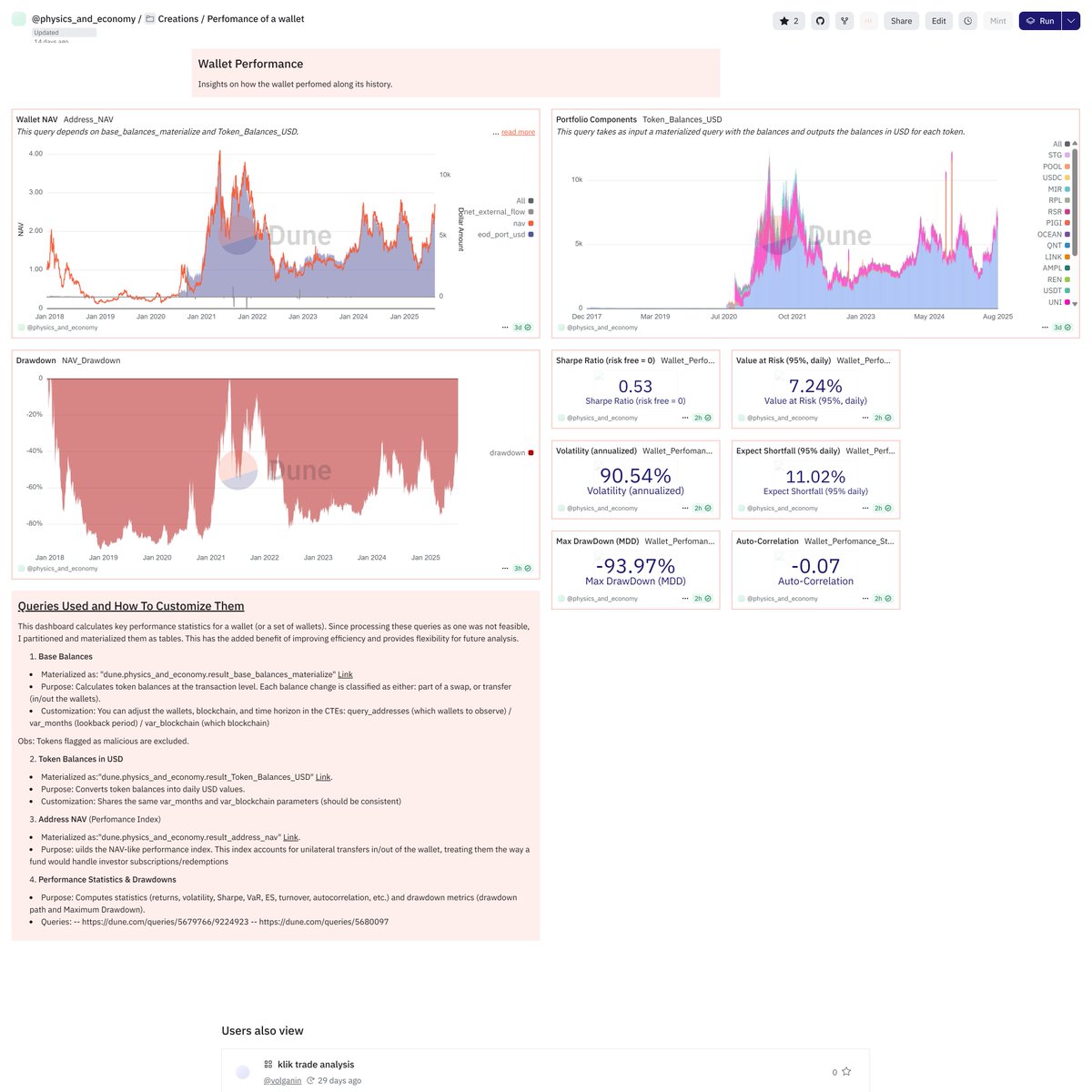
- The queries were too complex, so I had to break them down to make them feasible.
- I needed to separate inflows/outflows to calculate the statistics correctly.
- Scam tokens kept showing up - some made the AUM look like trillions of dollars!!!
Finally finished this Dune Analytics dashboard!
It tracks wallet performance and applies familiar statistics from the financial industry:
- Volatility, Sharpe, VaR, ES, drawdowns and autocorrolation
#DuneAnalytics#OnChainData#CryptoResearch
https://t.co/B7p9kFTa1x
Shock in crypto market will be transmitted to traditional financial markets, if it continues to grow.
Some mechanisms:
- more demand to treasury (implies lower yields)
- financial stability concerns in case of a fire sale
- substitute for money markets funds.
Regarding #stablecoins, I came across an interesting working paper by @i_aldasoro and @VARshad_: https://t.co/vb3WC5yWRE
They document that stablecoins are already a significant player on Treasury markets
- it already impacts its T-Bills prices
2) Large numbers of co-authors and Amateur Math: With the computer assisted proofs, even contributions from non-professionals become feasible (see the interview at 1:38:00 ).
Note: this interview was recorded before this year’s International Mathematical Olympiad.
@lexfridman has very insightful interviews. In the Terence Tao interview, two points stand out about research workflow:
1) Experimental Math. You can find the exact timing here:
https://t.co/DGNIdV6ADA via @YouTube
One can investigate patterns or discover counterexamples
1.2) Real World Impact: If patterns in prime numbers is found with those techniques, modern cryptography — which underpins banking, the internet, and blockchain — could be at risk and there will be need for new architectures.