We'll be spending a lot more time trying to understand the outputs of language models. A few thoughts, tips & tricks:
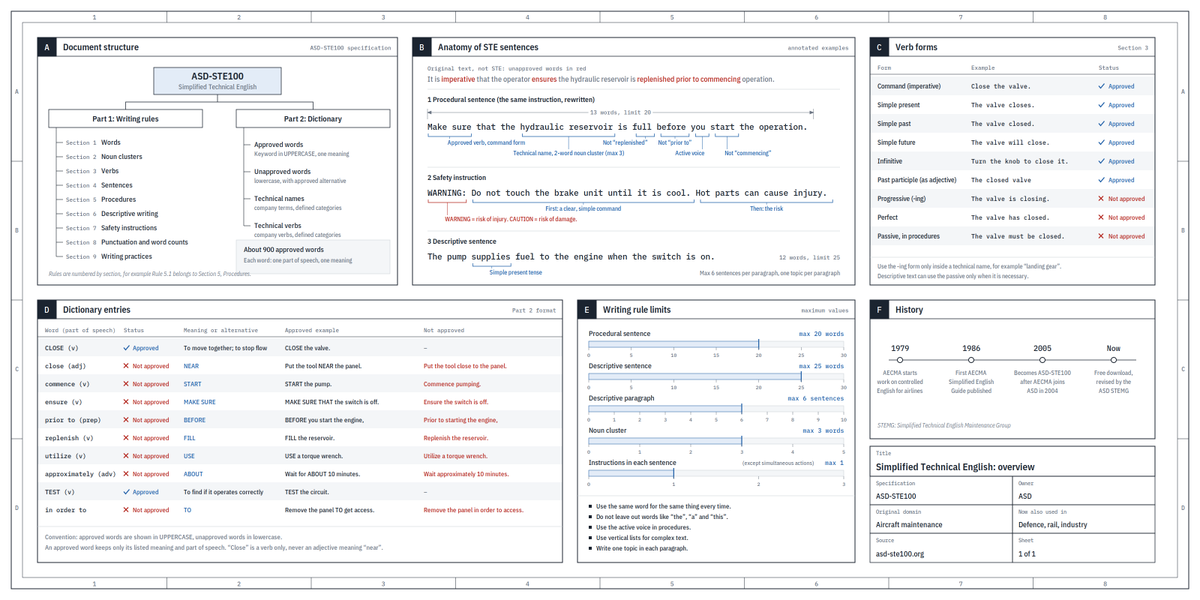
Writing. Something I've had success with: Ask your LLM to explain something in ASD-STE100, it's a controlled language specification originally developed for aerospace maintenance documentation. LLMs well-versed in this language and it comes with heavy constraints on clean writing style that I often find a lot more readable. Sometimes I've tried to soften it a bit e.g. ask for "80% of the way to ASD-STE100" because the spec is quite stringent. But even better:
Diagrams / images. Instead of writing, ask your LLM to create a diagram. These can be a lot easier to process, parse, and understand. But even better:
Web pages. Ask for output "in HTML" to get a beautiful, interactive webpage. LLMs are getting really good at frontend and can create beautiful experiences, animations, etc. But even better:
Explainer videos. The output format I am most bullish on is fully custom / bespoke explainer videos generated on any arbitrary topic. Experiment with things like "Create a 3b1b style video explainer on X. Use my ElevenLabs API key for audio narration". (you'd need an API key for the latter or you can ask your LLM to find you decent free alternatives that use your local compute). This is actually starting to work!
In summary:
- As LLMs get better, they will do more and more of the legwork autonomously, and a lot more of our work will rise up the abstractions into oversight and understanding.
- Luckily, LLMs can help here too because as intelligence and code are increasingly abundant, you can ask for large, custom, discardable software artifacts (e.g. web apps, video explainers) that would have never made sense to create before. Push the boundaries here and you'll be surprised.
@shome_rajarshi And market already started giving them a slow correction and today we have seen a start of sector rotation. I have a doubt though, hero being a majority holder of ather energy, can hold the ground being at low numbers. Ev business will add value to their mcap.
A lake, walking/cycling tracks between tall trees, flower gardens and decent sitting space for adults.
Regulate it with timings to make it safe for all.
@advpushyamitra@KailashOnline@IndoreCollector@SwachhIndore
Else one day lodha dlf will come and put 500 flats there.
Could Indore have its own version of Central Park, New York?
There is a large vacant/agricultural looking land parcel along Pipliyahana Road. If authorities can work with the landowners, it potentially be transformed into a neywork Central Park style urban park with greenery
Even though I know this won't satisfy everyone. I'm hoping this will at least make enough sense that those of who are intelligent and truly objective will have a chance at seeing the reality of markets and pricing efficiency.
Let’s take the AI argument all the way to a logical conclusion.
The claim is that AI can process more information than any human, analyze every relevant variable, eliminate emotion, learn from enormous amounts of historical data, test millions of possibilities, and ultimately make better trading decisions than a human ever could.
Fine. For the sake of argument, let’s assume all of that is true. It's perfect, or at the very least, much better than us as humans trading.
Let’s assume you can give AI the proper information, the proper objectives, the proper constraints, and enough data, and it can optimize a trading strategy to near perfection. No fear. No greed. No hesitation. No fatigue. No ego. No emotional mistakes. Just mathematically optimal decisions.
Now ask yourself the obvious question:
Who wouldn’t use it?
If AI really provides that kind of advantage, every serious professional trading operation is going to use it. Hedge funds, proprietary trading firms, market makers, institutions—anyone responsible for a meaningful amount of trading volume—is going to employ increasingly sophisticated algorithms and AI models.
And that creates a paradox many refuse to acknowledge.
If everybody has access to increasingly intelligent systems, and those systems are all analyzing essentially the same market, the same prices, the same volume, the same economic data, the same earnings reports, the same news, and increasingly similar alternative datasets—what happens when they all become “perfect”?
Where does the advantage come from?
If two tennis players were literally identical in skill, speed, strength, strategy, stamina, and execution—and neither one ever made an error—how does one consistently beat the other?
He doesn’t. It would be a tie.
Trading is no different.
For someone to generate alpha, there must be some form of inefficiency, informational advantage, analytical advantage, tactical superiority, behavioral advantage, execution advantage, or simply a difference in how information is interpreted.
I've heard comparisons made to chess. Markets are not chess. Not even close.
Chess is a closed system. Which makes it a terrible analogy for comparison. The rules are fixed. The board is visible. The pieces are known. The possible moves are defined. There is no surprise inflation report halfway through the game. The queen doesn’t suddenly announce an earnings miss. Interest rates don’t change while you’re deciding whether to move your bishop. There is always a right and wrong move.
The stock market is an open, adaptive, probabilistic system operating on incomplete information.
There often is no single mathematically “correct” move because the answer depends on an outcome that has not happened yet.
AI can calculate probabilities faster than I can. It can process more information than I can. It can recognize relationships I might never see.
But it cannot turn uncertainty into certainty.
And here is the ultimate contradiction in the “AI will perfect trading” argument:
The more universally effective a trading edge becomes, the more capital attacks it—and the more that edge gets arbitraged away. Markets adapt.
The whole argument against breakout trading is it doesn't work as well as it did because too many people are using it. Well, why wouldn't that same argument be made for AI, which ultimately would be applied in a much more universal, consistently predictable manner than humans applying breakout trading.
Even Jim Simmons understands this, and that understanding is why he is successful. That's why he as admitted to manually monitoring and changing his models routinely. And that humans can override his models at the risk level. If humans are constantly testing, changing and overriding the AI models - based on their findings - then AI is a tool, not a solution, and certainly not autonomous.
In his TED interview, Jim Simons said: “These things fade after a while; anomalies can get washed out. In another interview, Simmons confessed: “The computer is just a tool that we use.”
I rest my case.
https://t.co/JXzFFTmMtn
https://t.co/FfBnR93ojq
@1shankarsharma@TamannaInamdar when next townhall with shankar ? Shankar is ready to give some more crazy analogies and a small little target for nifty 50 and sip folks 🙂